
正方体展开图 by Benita
几何画板及绘图内容加载中,请稍等……
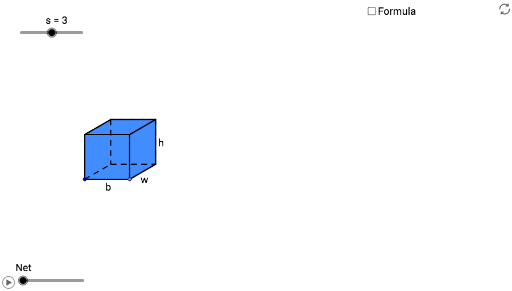
① 此范例演示正方体的网状展开图,通过平面图形直观展示立方体的空间折叠与展开现象。② 核心数学概念涉及空间几何、多面体结构、平面与立体的转换与对称性。③ 作图要点提炼自构造摘要,用到的 GeoGebra 命令包括 Point、Segment、Polygon、Circle、Line、Intersect、Rotate、OrthogonalLine、CircleArc、Vector、Translate、Ray、LineBisector、If、Midpoint,对象涉及顶点、边、多边形、圆、线、交点、旋转、垂线、圆弧、向量、平移、射线、中垂线、中点等,展示了从二维构建三维空间图形的完整过程。④ 适合初中及高中空间几何教学,帮助学生理解立体图形的展开、折叠及几何变换规律。
GeoGebra 命令及参数
Point(Circle[A, s]) → BSegment(A, B) → aPolygon(A, B, 4) → poly1, a_1, b, c, d, C, DCircle(B, e) → fLine(A, B) → gIntersect(f, g, 2) → ERotate(E, 30°, B) → E'OrthogonalLine(E', g) → hSegment(B, E') → iLine(C, i) → jIntersect(h, j) → FPolygon(E', F, 4) → poly2, e', f_1, k, l, G, HPolygon(A, H, G, D) → poly3, a_2, h_1, g_1, d_1Polygon(C, F, E', B) → poly4, c_1, f_2, e'_1, b_1Circle(B, A) → pCircle(A, B) → qIntersect(q, g, 2) → IIntersect(p, g, 2) → JCircle(J, B) → rIntersect(r, g, 2) → KLine(J, e'_1) → mLine(K, e'_1) → nLine(I, a_2) → tLine(H, E') → e_1Intersect(t, e_1) → LIntersect(m, e_1) → MIntersect(n, e_1) → NLine(B, E') → i_1Line(A, H) → j_1Intersect(f, i_1, 2) → OLine(O, g) → k_1Circle(E', B) → p_1Intersect(p_1, i_1, 2) → PLine(P, e_1) → l_1Intersect(j_1, l_1) → QLine(C, B) → m_1Circle(C, B) → q_1Intersect(q_1, m_1, 2) → RLine(R, c_1) → n_1Intersect(h, n_1) → SIntersect(j_1, k_1) → TCircleArc(C, R, D) → r_1CircleArc(B, K, R) → s_1CircleArc(E', N, S) → t_1CircleArc(E', M, F) → c_2CircleArc(B, J, C) → d_2CircleArc(A, B, I) → e_2CircleArc(H, G, L) → g_2CircleArc(F, S, G) → h_2Vector(F, P) → uVector(C, O) → vVector(D, R) → wVector(S, N) → u_1Vector(D, I) → v_1Translate(D, Vector[(o * w)]) → D'_1Ray(C, D'_1) → b_2Intersect(r_1, b_2, 1) → UTranslate(G, Vector[(o * w)]) → G'_1Ray(F, G'_1) → i_2Intersect(h_2, i_2, 1) → VLineBisector(F, P) → j_2Intersect(f, j_2, 2) → WCircleArc(W, P, F) → k_2Line(W, l_1) → l_2LineBisector(G, Q) → m_2Intersect(l_2, m_2) → ZCircleArc(Z, Q, G) → p_2Translate(C, Vector[((o - 1) * v)]) → C'Translate(D, Vector[((o - 1) * v)]) → D'_2If(o < 1, C, If[o < 2, C', O]) → A_1If(o < 1, D, If[o < 2, D'_2, T]) → B_1Translate(D, Vector[((o - 2) * v_1)]) → D'Translate(G, Vector[((o - 2) * v_1)]) → G'_2Ray(A, D') → n_2Ray(H, G'_2) → q_2Intersect(e_2, n_2, 1) → C_1Intersect(g_2, q_2) → D_1,If(o < 2, G, If[o < 3, D_1, L]) → E_1If(o < 2, D, If[o < 3, C_1, I]) → F_1Translate(G, Vector[((o - 3) * u)]) → G'Translate(F, Vector[((o - 3) * u)]) → F'Ray(H, G') → r_2Ray(E', F') → s_2Intersect(p_2, r_2, 1) → G_1Intersect(k_2, s_2, 1) → H_1If(o < 3, G, If[o < 4, G_1, Q]) → I_1If(o < 3, F, If[o < 4, H_1, P]) → J_1Translate(S, Vector[((o - 4) * u_1)]) → S'Ray(E', S') → t_2Intersect(t_1, t_2, 1) → K_1Intersect(c_2, t_2, 1) → L_1Translate(R, Vector[((o - 4) * u_1)]) → R'Ray(B, R') → a_3Intersect(s_1, a_3, 1) → M_1Intersect(d_2, a_3, 1) → N_1If(o < 1, U, If[o < 4, R, If[o < 5, M_1, K]]) → O_1If(o < 1, V, If[o < 4, S, If[o < 5, K_1, N]]) → P_1If(o < 4, C, If[o < 5, N_1, J]) → Q_1If(o < 4, F, If[o < 5, L_1, M]) → R_1Midpoint(B, E') → S_1Midpoint(A, H) → T_1Line(T_1, S_1) → c_3Circle(S_1, a / 2) → d_3OrthogonalLine(S_1, c_3) → g_3Intersect(d_3, g_3) → U_1, V_1Polygon(U_1, V_1, 4) → poly11, u_2, v_2, k_3, l_3, W_1, Z_1Polygon(Z_1, W_1, 4) → poly12, z_1, w_1, m_3, n_3, A_2, B_2Polygon(U_1, Z_1, 4) → poly13, u_3, z_2, s_3, t_3, C_2, D_2Polygon(W_1, V_1, 4) → poly14, w_2, v_3, c_4, d_4, E_2, F_2Polygon(V_1, U_1, 4) → poly15, v_4, u_4, e_4, f_4, G_2, H_2Polygon(H_2, G_2, 4) → poly16, h_6, g_4, i_4, j_4, I_2, J_2Segment(B, U_1) → m_4LineBisector(m_4) → n_4Vector(B, U_1) → zVector(T, C_2) → z_4Vector(L, A_2) → u_5Vector(P, E_2) → w_5Translate(I, Vector[(z * (o - 5))]) → I'Translate(A, Vector[(z * (o - 5))]) → A'Translate(B, Vector[(z * (o - 5))]) → B'Translate(J, Vector[(z * (o - 5))]) → J'Translate(K, Vector[(z * (o - 5))]) → K'Translate(L, Vector[(u_5 * (o - 5))]) → L'Translate(H, Vector[(u_5 * (o - 5))]) → H'Translate(E', Vector[(u_5 * (o - 5))]) → E''Translate(M, Vector[(u_5 * (o - 5))]) → M'Translate(N, Vector[(u_5 * (o - 5))]) → N'Translate(T, Vector[(z_4 * (o - 5))]) → T'Translate(O, Vector[(z_4 * (o - 5))]) → O'Translate(P, Vector[(w_5 * (o - 5))]) → P'Translate(Q, Vector[(w_5 * (o - 5))]) → Q'If(o < 5, O_1, If[o < 6, K', I_2]) → K_2If(o < 5, P_1, If[o < 6, N', J_2]) → L_2If(o < 5, Q_1, If[o < 6, J', G_2]) → M_2If(o < 5, R_1, If[o < 6, M', H_2]) → N_2If(o < 5, E', If[o < 6, E'', V_1]) → O_2If(o < 5, H, If[o < 6, H', W_1]) → P_2If(o < 5, E_1, If[o < 6, L', A_2]) → Q_2If(o < 5, J_1, If[o < 6, P', E_2]) → R_2If(o < 5, I_1, If[o < 6, Q', F_2]) → S_2If(o < 5, B, If[o < 6, B', U_1]) → T_2If(o < 5, A, If[o < 6, A', Z_1]) → U_2If(o < 5, A_1, If[o < 6, O', D_2]) → V_2If(o < 5, B_1, If[o < 6, T', C_2]) → W_2If(o < 5, F_1, If[o < 6, I', B_2]) → Z_2Polygon(Z_2, Q_2, P_2, U_2) → poly5, z_3, q_3, p_3, u_6Polygon(U_2, T_2, V_2, W_2) → poly6, u_7, t_4, v_5, w_3Polygon(U_2, P_2, O_2, T_2) → poly7, u_8, p_4, o_2, t_5Polygon(O_2, N_2, M_2, T_2) → poly8, o_1, n_5, m_5, t_6Polygon(N_2, L_2, K_2, M_2) → poly9, n_6, l_4, k_4, m_6Polygon(O_2, R_2, S_2, P_2) → poly10, o_3, r_3, s_4, p_5Intersect(k, v_5) → B_3Segment(G, B_3) → b_3Intersect(v_5, a_2) → A_3Segment(P_2, A_3) → e_3Intersect(t_4, p_5) → C_3Intersect(m_5, p_5) → D_3Segment(D_3, C_3) → f_3Segment(D_3, P_2) → h_3Point(Circle[E_3, s]) → F_3Segment(E_3, F_3) → j_3Line(E_3, F_3) → a_4Circle(F_3, e) → h_4Intersect(h_4, a_4, 2) → G_3Rotate(G_3, 30°, F_3) → H_3Segment(F_3, H_3) → b_4Line(H_3, j_3) → q_4Line(E_3, b_4) → r_4Intersect(q_4, r_4) → I_3OrthogonalLine(H_3, q_4) → a_5OrthogonalLine(F_3, j_3) → b_5OrthogonalLine(E_3, a_4) → c_5OrthogonalLine(I_3, q_4) → d_5Circle(E_3, s) → e_5Intersect(e_5, c_5, 2) → J_3OrthogonalLine(J_3, c_5) → f_5Circle(I_3, s) → g_5Intersect(g_5, d_5, 2) → K_3OrthogonalLine(K_3, d_5) → h_5Intersect(a_5, h_5) → L_3Intersect(b_5, f_5) → M_3Polygon(J_3, M_3, L_3, K_3) → poly17, j_5, m_7, l_5, k_5Polygon(J_3, E_3, F_3, M_3) → poly18, j_6, e_6, f_6, m_8Polygon(F_3, M_3, L_3, H_3) → poly19, f_7, m_9, l_6, h_7Polygon(I_3, K_3, L_3, H_3) → poly20, i_5, k_6, l_7, h_8Polygon(E_3, J_3, K_3, I_3) → poly21, e_7, j_7, k_7, i_6Polygon(E_3, I_3, H_3, F_3) → poly22, e_8, i_7, h_9, f_8