
混合数乘法建模:面积模型与交互式解法
几何画板及绘图内容加载中,请稍等……
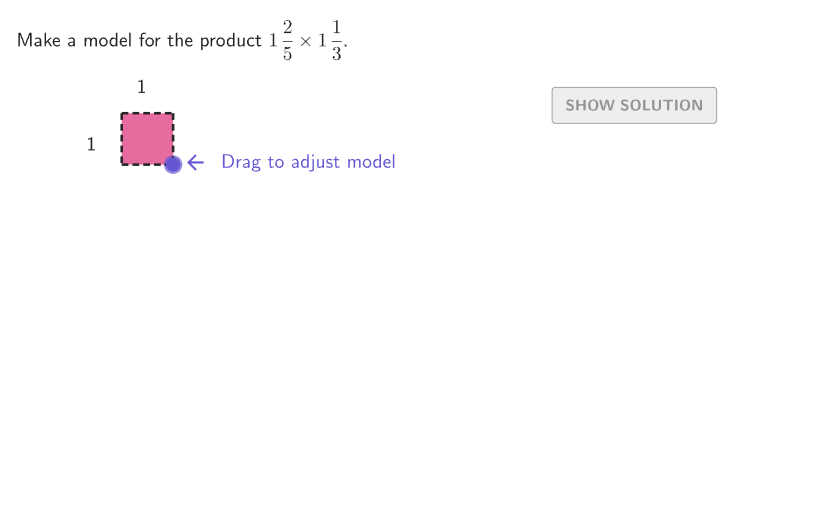
这个范例演示了如何使用面积模型和交互式工具来展示混合数的乘法运算。核心数学概念包括混合数的乘法、分数与整数的结合以及面积模型的几何意义。作图要点涉及使用GeoGebra命令如Shuffle、Polygon、PointIn、Denominator、If等来构建混合数对和乘积。适合小学四年级至五年级的学生,用于理解混合数乘法的直观表示和计算过程。
GeoGebra 命令及参数
Shuffle({{1 / 2, 3 / 4}, {3 / 4, 1 / 2}, {1 / 2, 2 / 3}, {2 / 3, 1 / 2}, {1 / 3, 1 / 2}, {1 / 2, 1 / 3}, {1 / 4, 3 / 5}, {3 / 5, 1 / 4}, {2 / 5, 1 / 3}, {1 / 3, 2 / 5}, {2 / 3, 3 / 4}, {3 / 4, 2 / 3}, {1 / 2, 3 / 5}, {3 / 5, 1 / 2}, {2 / 5, 1 / 4}, {1 / 4, 2 / 5}}) → fracPairs, {{0.6, 0.25}, {0.6666666666666666, 0.5}, {0.6, 0.5}, {0.5, 0.75}, {0.25, 0.6}, {0.75, 0.5}, {0.6666666666666666, 0.75}, {0.4, 0.25}, {0.5, 0.6666666666666666}, {0.25, 0.4}, {0.4, 0.3333333333333333}, {0.3333333333333333, 0.5}, {0.75, 0.6666666666666666}, {0.3333333333333333, 0.4}, {0.5, 0.6}, {0.5, 0.3333333333333333}}Shuffle({{1, 2}, {2, 1}, {1, 1}, {1, 2}, {3, 1}, {2, 3}, {1, 3}, {1, 1}, {2, 1}, {2, 2}, {1, 2}, {2, 1}, {1, 3}, {3, 1}, {2, 1}, {2, 2}}) → wholePairs, {{1, 2}, {3, 1}, {2, 2}, {1, 1}, {1, 2}, {1, 3}, {1, 3}, {1, 2}, {2, 1}, {3, 1}, {1, 1}, {2, 3}, {2, 1}, {2, 1}, {2, 1}, {2, 2}}Polygon({PAnchor + (1, -1), PAnchor + (5, -1), PAnchor + (5, -5), PAnchor + (1, -5)}) → moveAreaPointIn(moveArea) → PMoveDenominator(fracB) → denomBDenominator(fracA) → denomAIf(showsolution, (numA, (-numB)), PMove) → PReferenceNumerator(fracA) → numerANumerator(fracB) → numerBRemoveUndefined(Flatten[Sequence[Sequence[If[i ≥ (wholeA * denomA) ∨ j ≥ (wholeB * denomB), (i / denomA, ((-j)) / denomB) + PAnchor], i, 0, numCols - 1], j, 0, numRows - 1]]) → startPositionsFlatten(Sequence[Sequence[(i / denomA, ((-j)) / denomB) + PAnchor2 + (((wholeA * wholeB) * (1 + spacer)), 0), i, 0, denomA - 1], j, 0, denomB - 1]) → endPositionTemplateSequence(If[A ≤ numCompositeWholes, (denomA * denomB), ((fracAB * denomA) * denomB)], A, 1, numCompositeWholes + 1) → numBlocksFlatten(Sequence[Zip[Translate[A, ((K * (spacer + 1)), 0)], A, endPositionTemplate], K, 0, Length[numBlocks] - 1]) → endPositionsWithExtrasSequence(endPositionsWithExtras(A), A, 1, Sum[numBlocks]) → allEndPositionsPolygon({PAnchor, (x(PAnchor), y(PReference)), PReference, (x(PReference), y(PAnchor))}) → studentAreaPolygon({(0, 0), (1 / denomA, 0), (1 / denomA, -1 / denomB), (0, -1 / denomB)}) → smallBoxTemplateZip(Translate[smallBoxTemplate, A], A, startPositions) → allSmallBoxesFlatten(Sequence[Sequence[(i, (-j)), i, 0, wholeA - 1], j, 0, wholeB - 1]) → startUnitPositionsPolygon({(0, 0), (1, 0), (1, -1), (0, -1)}) → unitBoxTemplateSequence(PAnchor2 + ((i * (1 + spacer)), 0), i, 0, (wholeA * wholeB) - 1) → unitEndPositionsZip(Translate[unitBoxTemplate, Vector[PAnchor, A]], A, startUnitPositions) → allUnitBoxesSequence(Segment[(x(PAnchor) + A, y(PAnchor)), (x(PAnchor) + A, y(PCorner))], A, 0, x(PCorner), 1) → gridWholeVerticalSequence(Segment[(x(PCorner) - 1 + A, y(PCorner)), (x(PCorner) + A - 1, y(PAnchor) + If[x(PMove) < 1, -1, 0])], A, 0, 1, 1 / Denominator[fracA]) → gridPartsVerticalSequence(Segment[(x(PAnchor) + If[y(PMove) < -1, 0, 1], y(PCorner)) + (0, A), (x(PCorner), y(PCorner)) + (0, A)], A, 0, 1, 1 / Denominator[fracB]) → gridPartsHorizontalZip(Translate[A, Vector[(sliderSoln * Vector[B, C])]], A, allSmallBoxes, B, startPositions, C, allEndPositions) → smallBoxesZip(Translate[A, Vector[(sliderSoln * Vector[B, C])]], A, allUnitBoxes, B, startUnitPositions, C, unitEndPositions) → unitBoxesSequence(Segment[(x(PAnchor), y(PCorner) + A), (x(PCorner), y(PCorner) + A)], A, y(PAnchor) - y(PCorner), 0, -1) → gridWholeHorizontalMidpoint(PAnchor, (x(PAnchor), y(PReference)) + (-1, 0)) → AnchorNum2Circle(SolnPoint, 0.2) → solnOutlinecirclePixels(PMove, 7 + (7 * pulsing), Corner[1], Corner[3], Corner[5]) → pulsingPoint
AI 绘图提示语参考
绘制一个面积模型,展示两个带分数的乘法过程。首先,随机选择两个带分数,例如1/2和3/4,然后绘制一个矩形区域,表示这两个带分数的乘积。接着,在矩形内绘制小方格,表示每个带分数的组成部分。最后,根据选定的带分数,调整小方格的位置,展示乘积的几何意义。
以上提示语为根据原始绘图命令整理而来,仅供参考。