
使用单位立方体测量
几何画板及绘图内容加载中,请稍等……
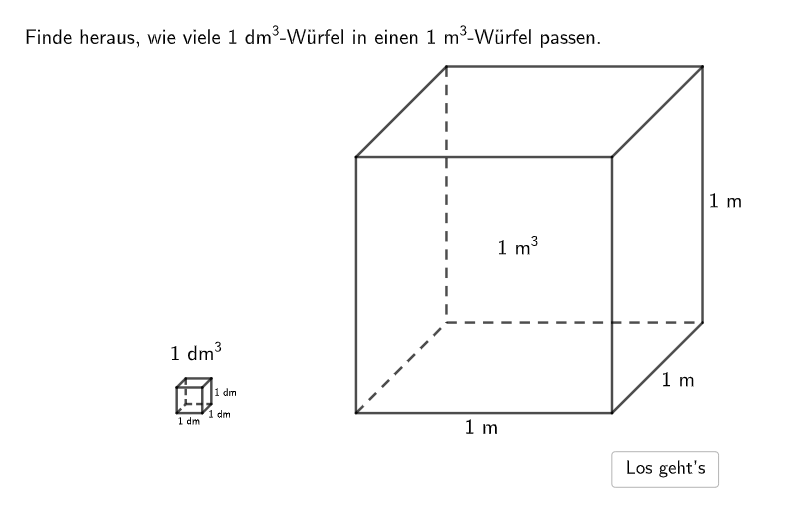
本范例演示如何使用单位立方体进行体积测量。核心数学概念涉及单位转换和体积计算。通过构造摘要中的GeoGebra命令,学生可以了解如何使用单位立方体进行体积转换。适合5-6年级学生学习测量和体积比较。
GeoGebra 命令及参数
If(step ≟ 5 ∨ step ≟ 6, input ≟ 10, If[step ≟ 8 ∨ step ≟ 9, input ≟ 100, If[step ≟ 11 ∨ step ≟ 12, input ≟ 1000]]) → correctSequence(Random[1, 10], i, 1, 10) → randomNumbers, {1, 1, 2, 1, 4, 4, 4, 6, 10, 9}Element(randomNumbers, Mod[questionCount, Length[randomNumbers]] + 1) → randomNumberTextfield(input) → inputBoxSegment(A, B) → abSegment(B, C) → bcSegment(C, D) → cdSegment(D, A) → adSegment(E, F) → efSegment(F, G) → fgSegment(G, H) → ghSegment(H, E) → ehSegment(A, E) → aeSegment(B, F) → bfSegment(C, G) → cgSegment(D, H) → dhSequence(Sequence[Polygon[A + (i, j), A + (i, j) + (cubeLength / 10, 0), A + (i, j) + (cubeLength / 10, cubeLength / 10), A + (i, j) + (0, cubeLength / 10)], i, 0, cubesHorizontal - 1], j, 0, cubesVertical - 1) → cubesAB, {{1}}Sequence(Sequence[Polygon[A + (cubesHorizontal, j) + ((i * cubeDepthCatheters / 10), (i * cubeDepthCatheters / 10)), A + (cubesHorizontal, j) + ((i * cubeDepthCatheters / 10), (i * cubeDepthCatheters / 10)) + (cubeDepthCatheters / 10, cubeDepthCatheters / 10), A + (cubesHorizontal, j) + ((i * cubeDepthCatheters / 10), (i * cubeDepthCatheters / 10)) + (cubeDepthCatheters / 10, cubeDepthCatheters / 10 + cubeLength / 10), A + (cubesHorizontal, j) + ((i * cubeDepthCatheters / 10), (i * cubeDepthCatheters / 10)) + (0, cubeLength / 10)], i, 0, cubesDepth - 1], j, 0, cubesVertical - 1) → cubesBF, {{0.35355339059327373}}Segment(BSmall, CSmall) → bcSmallSegment(CSmall, DSmall) → cdSmallSegment(DSmall, ASmall) → adSmallSegment(ESmall, FSmall) → efSmallSegment(FSmall, GSmall) → fgSmallSegment(GSmall, HSmall) → ghSmallSegment(HSmall, ESmall) → ehSmallSegment(ASmall, ESmall) → aeSmallSegment(BSmall, FSmall) → bfSmallSegment(CSmall, GSmall) → cgSmallSegment(DSmall, HSmall) → dhSmallSequence(Sequence[Polygon[A + (i, cubesVertical) + ((j * cubeDepthCatheters / 10), (j * cubeDepthCatheters / 10)), A + (i, cubesVertical) + ((j * cubeDepthCatheters / 10), (j * cubeDepthCatheters / 10)) + (cubeLength / 10, 0), A + (i, cubesVertical) + ((j * cubeDepthCatheters / 10), (j * cubeDepthCatheters / 10)) + (cubeLength / 10 + cubeDepthCatheters / 10, cubeDepthCatheters / 10), A + (i, cubesVertical) + ((j * cubeDepthCatheters / 10), (j * cubeDepthCatheters / 10)) + (cubeDepthCatheters / 10, cubeDepthCatheters / 10)], i, 0, cubesHorizontal - 1], j, 0, cubesDepth - 1) → cubesAD, {{0.35355339059327373}}Sequence(Sequence[Polygon[ASmall + (i, j), ASmall + (i, j) + (cubeLength / 10, 0), ASmall + (i, j) + (cubeLength / 10, cubeLength / 10), ASmall + (i, j) + (0, cubeLength / 10)], i, 0, cubesHorizontal - 1], j, 0, cubesVertical - 1) → cubeABSmall, {{1}}Sequence(Sequence[Polygon[ASmall + (cubesHorizontal, j) + ((i * cubeDepthCatheters / 10), (i * cubeDepthCatheters / 10)), ASmall + (cubesHorizontal, j) + ((i * cubeDepthCatheters / 10), (i * cubeDepthCatheters / 10)) + (cubeDepthCatheters / 10, cubeDepthCatheters / 10), ASmall + (cubesHorizontal, j) + ((i * cubeDepthCatheters / 10), (i * cubeDepthCatheters / 10)) + (cubeDepthCatheters / 10, cubeDepthCatheters / 10 + cubeLength / 10), ASmall + (cubesHorizontal, j) + ((i * cubeDepthCatheters / 10), (i * cubeDepthCatheters / 10)) + (0, cubeLength / 10)], i, 0, cubesDepth - 1], j, 0, cubesVertical - 1) → cubeBFSmall, {{0.35355339059327395}}Sequence(Sequence[Polygon[ASmall + (i, cubesVertical) + ((j * cubeDepthCatheters / 10), (j * cubeDepthCatheters / 10)), ASmall + (i, cubesVertical) + ((j * cubeDepthCatheters / 10), (j * cubeDepthCatheters / 10)) + (cubeLength / 10, 0), ASmall + (i, cubesVertical) + ((j * cubeDepthCatheters / 10), (j * cubeDepthCatheters / 10)) + (cubeLength / 10 + cubeDepthCatheters / 10, cubeDepthCatheters / 10), ASmall + (i, cubesVertical) + ((j * cubeDepthCatheters / 10), (j * cubeDepthCatheters / 10)) + (cubeDepthCatheters / 10, cubeDepthCatheters / 10)], i, 0, cubesHorizontal - 1], j, 0, cubesDepth - 1) → cubeADSmall, {{0.3535533905932744}}Segment(meterA, meterB) → meterSegment(ASmall, BSmall) → abSmallSegment(BSmall_{1}, CSmall_{1}) → bcSmall_{1}Segment(CSmall_{1}, DSmall_{1}) → cdSmall_{1}Segment(DSmall_{1}, ASmall_{1}) → adSmall_{1}Segment(ESmall_{1}, FSmall_{1}) → efSmall_{1}Segment(FSmall_{1}, GSmall_{1}) → fgSmall_{1}Segment(GSmall_{1}, HSmall_{1}) → ghSmall_{1}Segment(HSmall_{1}, ESmall_{1}) → ehSmall_{1}Segment(ASmall_{1}, ESmall_{1}) → aeSmall_{1}Segment(BSmall_{1}, FSmall_{1}) → bfSmall_{1}Segment(CSmall_{1}, GSmall_{1}) → cgSmall_{1}Segment(DSmall_{1}, HSmall_{1}) → dhSmall_{1}Segment(ASmall_{1}, BSmall_{1}) → abSmall_{1}Segment((-11, 0), (-11.05, 0)) → cubeCM
AI 绘图提示语参考
画一个立方体的体积测量示例,包含多个立方体和测量线。立方体的尺寸可以根据用户输入的值进行调整。示例中包含 3D 立方体、测量线和标签。要求 AI 绘图工具根据用户输入的值生成相应的立方体和测量线,体现出立方体的体积测量过程。
以上提示语为根据原始绘图命令整理而来,仅供参考。