
对称轴探究:多边形与圆的镜像对称
几何画板及绘图内容加载中,请稍等……
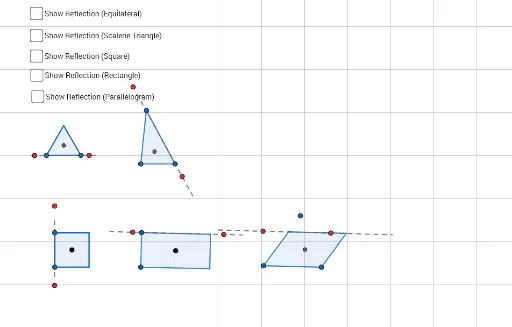
本范例通过动态几何演示多边形及其内切圆、外接圆等图形的对称轴性质。核心数学概念包括轴对称、镜像变换、角平分线、垂直平分线以及对称轴与图形元素(如顶点、边、圆心)的关系。作图要点:使用GeoGebra命令Polygon创建多边形,OrthogonalLine和LineBisector构造垂线与中垂线,AngularBisector作角平分线,Mirror实现镜像对称,Intersect求交点,Circle和Incircle构造圆及内切圆,Segment连接线段,Length测量长度,Midpoint取中点,Point定义点。通过拖动顶点或调整参数,可动态观察对称轴数量与位置的变化。适合初中至高中阶段学习几何对称、变换及图形性质,也可用于教师课堂演示或学生自主探究。
GeoGebra 命令及参数
Polygon(A, B, 3) → poly1, f, g, h, COrthogonalLine(C, f) → iOrthogonalLine(A, g) → jIntersect(i, j) → DLine(E, F) → kCircle(D, Segment[A, B]) → cIntersect(c, k, 1) → GIntersect(c, k, 2) → HSegment(H, G) → lMirror(poly1, l) → poly1'Polygon(I, J, K) → t1, k_1, i_1, j_1AngularBisector(J, I, K) → mAngularBisector(I, K, J) → nIntersect(m, n) → LLength(i_1) → aLength(j_1) → bLength(k_1) → dCircle(L, Max[a, Max[b, d]]) → eLine(M, N) → pIntersect(e, p, 1) → OIntersect(e, p, 2) → PSegment(O, P) → qMirror(I, q) → I'Mirror(J, q) → J'Mirror(K, q) → K'Polygon(I', J', K') → t1', k', i', j'Polygon(Q, R, 4) → poly2, s, t, f_1, g_1, S, TMidpoint(Q, T) → UMidpoint(T, S) → VOrthogonalLine(U, g_1) → h_1OrthogonalLine(V, f_1) → l_1Point(l_1) → WCircle(W, Segment[R, Q]) → c_1Line(Z, A_1) → m_1Intersect(c_1, m_1, 1) → B_1Intersect(c_1, m_1, 2) → C_1Segment(B_1, C_1) → n_1Mirror(poly2, n_1) → poly2'Segment(D_1, E_1) → p_1OrthogonalLine(E_1, p_1) → q_1Circle(E_1, Segment[E_1, D_1]) → d_1Intersect(d_1, q_1, 2) → F_1Circle(F_1, Segment[E_1, D_1]) → e_1Intersect(e_1, q_1, 2) → G_1OrthogonalLine(G_1, q_1) → r_1OrthogonalLine(D_1, p_1) → s_1Intersect(r_1, s_1) → H_1Polygon(E_1, G_1, H_1, D_1) → q1, e_2, g_2, h_2, d_2LineBisector(D_1, E_1) → t_1LineBisector(e_2) → a_1Point(t_1) → I_1Circle(I_1, e_2) → c_2Line(J_1, K_1) → b_1Intersect(c_2, b_1, 1) → L_1Intersect(c_2, b_1, 2) → M_1Segment(L_1, M_1) → f_2Segment(L_1, M_1) → i_2Mirror(E_1, i_2) → N_1Mirror(G_1, i_2) → O_1Mirror(H_1, i_2) → P_1Mirror(D_1, i_2) → Q_1Polygon(N_1, O_1, P_1, Q_1) → q1', n_2, o_1, p_2, q_2Line(R_1, e_2) → j_2OrthogonalLine(R_1, j_2) → k_2Circle(R_1, Segment[E_1, D_1]) → r_2Intersect(r_2, k_2, 2) → T_1Line(T_1, j_2) → l_2Line(R_1, S_1) → m_2Point(j_2) → U_1Line(U_1, m_2) → s_2Intersect(l_2, s_2) → V_1Intersect(l_2, m_2) → W_1Polygon(V_1, W_1, R_1, U_1) → q2, v_1, w_1, r_3, u_1Midpoint(W_1, U_1) → Z_1Circle(Z_1, Segment[R_1, V_1]) → t_2Line(A_2, B_2) → a_2Intersect(t_2, a_2, 2) → C_2Intersect(t_2, a_2, 1) → D_2Segment(C_2, D_2) → b_2Mirror(V_1, b_2) → E_2Mirror(W_1, b_2) → F_2Mirror(R_1, b_2) → G_2Mirror(U_1, b_2) → H_2Polygon(E_2, F_2, G_2, H_2) → q2', e_3, f_3, g_3, h_3