
探究分数相加 by laura.rees-hughes
几何画板及绘图内容加载中,请稍等……
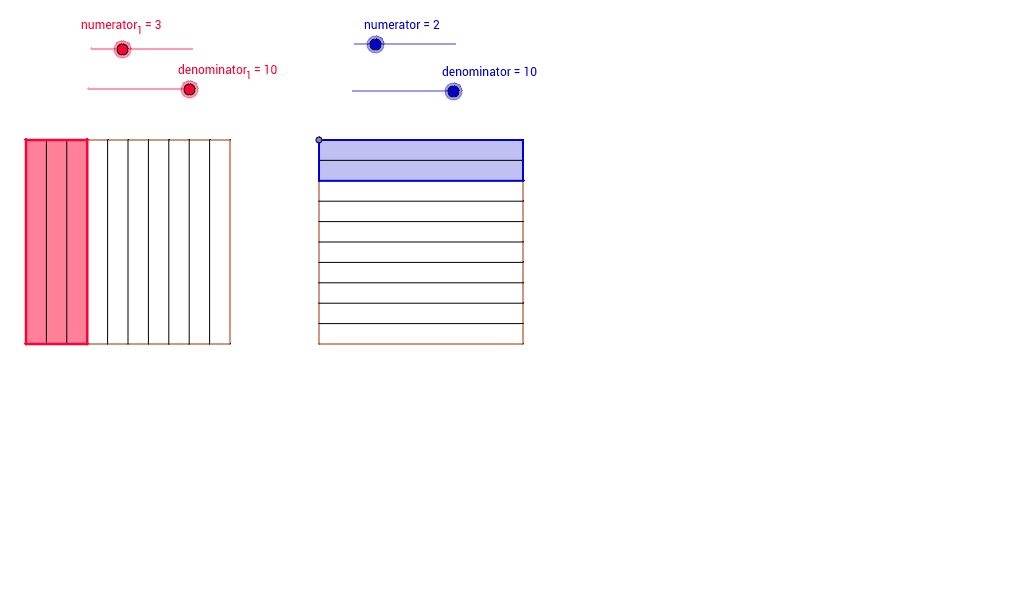
这个范例演示了如何通过几何画板探究分数相加的过程。核心数学概念包括分数和加法。通过使用GeoGebra命令如OrthogonalLine, Circle, Intersect等,可以动态地展示分数相加的几何意义。适合小学高年级和初中学生使用。
GeoGebra 命令及参数
OrthogonalLine(A, yAxis) → eOrthogonalLine(A, e) → fCircle(A, size) → hIntersect(h, e, 1.0) → BIntersect(h, f, 2.0) → CIntersect(h, e, 1.0) → DOrthogonalLine(B, e) → iIntersect(h, f, 2.0) → EOrthogonalLine(C, f) → jIntersect(i, j) → FPolygon(A, B, F, C) → P, a_1, b_1, f_1, c_1Circle(A, VarRadius) → kIntersect(k, a_1) → G,Circle(G, A) → pIntersect(p, a_1, 2.0) → HCircle(H, G) → qIntersect(q, a_1) → I, JCircle(J, H) → rIntersect(r, a_1) → K, LCircle(L, J) → sIntersect(s, a_1) → M, NCircle(N, L) → tIntersect(t, a_1) → O, QCircle(Q, N) → d_1Intersect(d_1, a_1) → R, SCircle(S, Q) → e_1Intersect(e_1, a_1) → T, UCircle(U, S) → g_1Intersect(g_1, a_1) → V, WCircle(W, U) → h_1OrthogonalLine(G, a_1) → lOrthogonalLine(H, a_1) → mOrthogonalLine(J, a_1) → nOrthogonalLine(L, a_1) → i_1OrthogonalLine(N, a_1) → j_1OrthogonalLine(Q, a_1) → k_1OrthogonalLine(S, a_1) → l_1OrthogonalLine(U, a_1) → m_1OrthogonalLine(W, a_1) → n_1Intersect(f_1, l) → YIntersect(f_1, m) → ZIntersect(f_1, n) → A_1Intersect(f_1, i_1) → B_1Intersect(f_1, j_1) → C_1Intersect(f_1, k_1) → D_1Intersect(l_1, f_1) → E_1Intersect(f_1, m_1) → F_1Intersect(f_1, n_1) → G_1Ray(A, B) → p_1Point(p_1) → H_1Vector(A, H_1) → uTranslate(A, u) → A'Translate(B, u) → B'Translate(F, u) → F'Translate(C, u) → C'Polygon(A', B', F', C') → P', a', b', f', c'OrthogonalLine(V, a_1) → q_1Circle(V, U) → r_1Segment(G, Y) → s_1Segment(H, Z) → t_1Segment(J, A_1) → a_2Segment(L, B_1) → b_2Segment(N, C_1) → c_2Segment(Q, D_1) → d_2Segment(S, E_1) → e_2Segment(U, F_1) → f_2Segment(W, G_1) → g_2Circle(H_1, VarRadius_2) → h_2Intersect(h_2, c', 1.0) → J_1Circle(J_1, H_1) → k_2Intersect(k_2, c', 2.0) → K_1Circle(K_1, J_1) → p_2Intersect(p_2, c', 2.0) → L_1Circle(L_1, K_1) → q_2Intersect(q_2, c', 2.0) → M_1Circle(M_1, L_1) → r_2Intersect(r_2, c', 2.0) → N_1Circle(N_1, M_1) → s_2Intersect(s_2, c') → O_1, P_1Circle(P_1, N_1) → t_2Intersect(t_2, c', 2.0) → Q_1Circle(Q_1, P_1) → c_3Intersect(c_3, c', 2.0) → R_1Circle(R_1, Q_1) → d_3Intersect(d_3, c', 2.0) → S_1Circle(S_1, R_1) → e_3OrthogonalLine(J_1, c') → i_2OrthogonalLine(K_1, c') → j_2OrthogonalLine(L_1, c') → l_2OrthogonalLine(M_1, c') → m_2OrthogonalLine(N_1, c') → n_2OrthogonalLine(P_1, c') → a_3OrthogonalLine(Q_1, c') → b_3OrthogonalLine(R_1, c') → f_3OrthogonalLine(S_1, c') → g_3Intersect(b', i_2) → T_1Intersect(b', j_2) → U_1Intersect(b', l_2) → V_1Intersect(b', m_2) → W_1Intersect(b', n_2) → Y_1Intersect(b', a_3) → Z_1Intersect(b', b_3) → A_2Intersect(b', f_3) → B_2Intersect(b', g_3) → C_2Segment(J_1, T_1) → h_3Segment(U_1, K_1) → i_3Segment(L_1, V_1) → j_3Segment(W_1, M_1) → k_3Segment(N_1, Y_1) → l_3Segment(Z_1, P_1) → m_3Segment(Q_1, A_2) → n_3Segment(B_2, R_1) → p_3Segment(S_1, C_2) → q_3Circle(A, VarWidth_1) → r_3Intersect(r_3, a_1) → D_2, S_2OrthogonalLine(D_2, f_1) → s_3Intersect(s_3, f_1) → E_2OrthogonalLine(E_2, s_3) → t_3Intersect(t_3, c_1) → F_2Polygon(A, D_2, E_2, F_2) → P_2, a_4, d_4, e_4, f_4OrthogonalLine(O, a_1) → b_4Intersect(b_4, f_1) → G_2Circle(O, N) → g_4Circle(O_1, N_1) → q_4OrthogonalLine(O_1, c') → t_4Circle(H_1, VarWidth_2) → h_5Intersect(h_5, c') → F_3,OrthogonalLine(F_3, c') → i_5Intersect(i_5, b') → G_3Polygon(H_1, F_3, G_3, B') → P_3, h_6, f_6, g_6, b'_1