
三个长方体的穿透
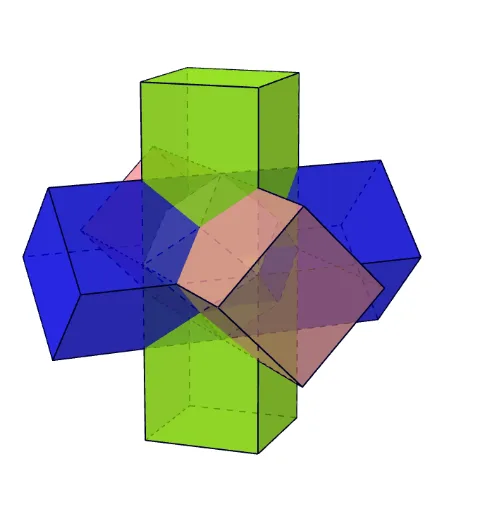
几何画板及绘图内容加载中,请稍等……
①本范例演示三个长方体相互穿透的几何体组合现象;②涉及的核心数学概念包括立体几何、多边形、棱柱、交集、线段等;③作图要点提炼自构造摘要,使用了Polygon(多边形)、Prism(棱柱)、Intersect(交集)、Segment(线段)等GeoGebra命令与对象;④适合高中立体几何教学或几何建模入门学习。
GeoGebra 命令及参数
Polygon(A_1, B_1, C_1, D_1) → v1, a_1, b_1, c_1, d_1Prism(v1, H_1) → a, A, Kante2, Kante3, Kante4, Kante5, KanteAB, KanteBC, Kante6, B, C, Fläche1, Fläche3, Fläche4, Fläche2, Fläche5, Kante1Polygon(A_2, B_2, C_2, D_2) → v2, a_2, b_2, c_2, d_2Prism(v2, H_2) → b, D, Kante8, Kante9, Kante10, Kante11, KanteDE, KanteEF, Kante12, E, F, Fläche6, Fläche8, Fläche9, Fläche7, Fläche10, Kante7Polygon(A_3, B_3, C_3, D_3) → v3, a_3, b_3, c_3, d_3Prism(v3, H_3) → c, G, Kante14, Kante15, Kante16, Kante17, KanteGH, KanteHI, Kante18, H, I, Fläche11, Fläche13, Fläche14, Fläche12, Fläche15, Kante13Intersect(Kante10, Kante14) → JIntersect(Kante13, Kante2) → KIntersect(Kante7, Fläche1) → LIntersect(Kante8, Kante14) → MIntersect(Kante13, Kante4) → NIntersect(Kante2, Kante15) → OIntersect(Kante1, Kante9) → PIntersect(Kante4, Kante15) → QIntersect(Kante16, Kante10) → RIntersect(Kante3, Kante9) → SIntersect(Kante16, Kante8) → TIntersect(Kante3, Kante7) → UIntersect(Kante3, Kante16) → VSegment(K, V) → fIntersect(Kante2, Kante10) → WSegment(U, W) → gIntersect(xAxis, Kante13) → ZSegment(R, Z) → hIntersect(g, h) → E_1Segment(W, L) → iSegment(Z, J) → jIntersect(Kante1, Kante14) → F_1Segment(K, F_1) → kIntersect(i, j) → G_1Segment(O, F_1) → lSegment(W, P) → mIntersect(Kante15, Kante9) → I_1Segment(J, I_1) → nIntersect(m, n) → J_1Segment(R, I_1) → pSegment(V, O) → qSegment(W, S) → rIntersect(r, p) → K_1Intersect(Kante4, zAxis) → L_1Segment(U, L_1) → sSegment(V, N) → tSegment(Z, T) → eIntersect(t, s) → M_1Segment(L, L_1) → f_1Segment(N, F_1) → g_1Segment(Z, M) → h_1Intersect(g_1, f_1) → N_1Segment(P, L_1) → i_1Segment(M, I_1) → j_1Segment(F_1, Q) → k_1Intersect(j_1, k_1) → O_1Segment(S, L_1) → l_1Segment(Q, V) → m_1Segment(T, I_1) → n_1Intersect(l_1, m_1) → P_1Polygon(Z, G_1, W, E_1) → v4, z_1, p_1, w, e_1Polygon(G_1, F_1, J_1, W) → v5, q_1, r_1, s_1, w_1Polygon(J_1, I_1, K_1, W) → v6, t_1, f_2, g_2, w_2Polygon(W, K_1, V, E_1) → v7, w_3, h_2, v, i_2Polygon(V, M_1, Z, E_1) → v8, v_1, j_2, z_2, k_2Polygon(M_1, L_1, N_1, Z) → v9, l_2, m_2, n_2, z_3Polygon(Z, N_1, F_1, G_1) → v10, z_4, p_2, q_2, r_2Polygon(L_1, O_1, F_1, N_1) → v11, s_2, o_1, t_2, e_2Polygon(F_1, O_1, I_1, J_1) → v12, f_3, g_3, h_3, i_3Polygon(L_1, P_1, I_1, O_1) → v13, j_3, k_3, l_3, m_3Polygon(P_1, V, K_1, I_1) → v14, n_3, v_2, p_3, q_3Polygon(L_1, M_1, V, P_1) → v15, r_3, s_3, v_3, t_3