
几何直观的线性方程练习:用运算逆元定位解
几何画板及绘图内容加载中,请稍等……
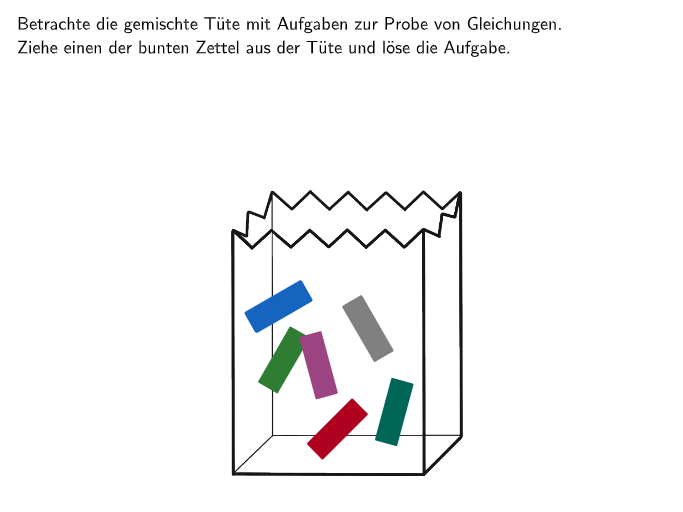
该范例以“彩色样本袋”风格的交互练习界面展示:在图形与候选点/表达式之间选择并验证,学生通过对等式两边运算逆元的思想找到线性方程的解。核心数学概念包括一元一次方程、通过反向运算(逆运算)求解、以及用几何/交互方式进行答案检查与反馈。作图与交互要点来自构造摘要中的对象与命令:利用多个解候选(如sol1a、sol1b、sol2a、sol2b、sol3a、sol3b、sol7、sol8、sol9等)与下拉选择输入(DropDown9/7/8、input9/7/8)组织题目;用If/Shuffle/Join/Append/Remove对条件分支、候选集合与随机顺序进行管理;用Textfield呈现提示与过程文字;用Point、Polygon与PointIn判断几何区域或候选位置是否落在指定区域;用Length、Midpoint、Element、IsInRegion辅助度量与区域检验;最后借助Defined与一系列正确性标记(correct1-9、check3-7、btnValidate/btnNext/btnNochmal等)完成“选择—验证—反馈”的闭环。适合5-6学段学生用于一元一次方程教学的互动练习、巩固与形成性评价(也可用于课堂投屏或作业系统)。
GeoGebra 命令及参数
SelectedIndex(DropDown9) → input9SelectedIndex(DropDown7) → input7If(exnum ≟ 2, 2, 3) → sol9If(exnum ≟ 1, 2, 3) → sol7If(exnum ∈ {1, 4}, 1, If[exnum ∈ {2, 5}, 2, 3]) → extypeIf(exnum ≟ 3, check6, check5) → correct6SelectedIndex(DropDown8) → input8If(exnum ≟ 2, check3, check4) → correct5Join(Sequence[Shuffle[{1, 2, 3, 4, 5, 6, 7}], m, 1, 9]) → listExnumTextfield(input1) → Eingabefeld1Textfield(input2) → Eingabefeld2Textfield(input3) → Eingabefeld3Polygon(TüteBound1, TüteBound2, TüteBound3, TüteBound4) → TüteBounda, tütebound1, tütebound2, tütebound3, tütebount4PointIn(TüteBounda) → Z1aLength(Vector[Z1b, Z1c]) → dIf(exnum ≟ 1, 4, 3.7) → sol1If(exnum ≟ 1, 36, 14.8) → sol2If(exnum ≟ 1, 39, 8.7) → sol3If(exnum ≟ 1, check1, check2) → correct4Element({correct1 ∧ correct2 ∧ correct3 ∧ correct7 ∧ correct8, correct9, correct6}, extype) → correctPolygon(Translate[TüteBound1, (0.8, 0.4)], Translate[TüteBound2, (0.8, 0.4)], Translate[TüteBound3, (0.8, 0.4)], Translate[TüteBound4, (0.8, 0.4)]) → TüteBoundb, f, g, h, iTextfield(input1old) → InputBox1Textfield(input2old) → InputBox2Polygon(PtopLeftCornerFeedback, PtopRightCornerFeedback, PbottomRightCornerFeedback, PbottomLeftCornerFeedback) → rectangleCorrect, rectangleCorrectS3, rectangleCorrectS4, rectangleCorrectS2, rectangleCorrectS1Shuffle(Sequence[Random[0, 10], i, 1, 100]) → randomNosForX, {10, 3, 2, 1, 5, 3, 0, 3, 10, 3, 10, 6, 1, 2, 8, 4, 10, 8, 3, 5, 7, 8, 7, 10, 2, 5, 4, 6, 7, 8, 8, 8, 9, 6, 4, 6, 10, 9, 9, 9, 0, 0, 10, 8, 5, 3, 3, 3, 0, 5, 4, 3, 5, 3, 8, 7, 1, 0, 6, 7, 8, 3, 0, 9, 7, 7, 2, 0, 1, 6, 3, 9, 10, 6, 4, 9, 6, 3, 0, 4, 9, 2, 9, 10, 1, 0, 0, 0, 4, 5, 3, 3, 6, 4, 6, 6, 9, 3, 0, 4}Element(randomNosForX, Mod[questionCount, 100] + 1) → numXShuffle(Sequence[Random[0, 10], i, 1, 100]) → randomNosForY, {4, 4, 6, 7, 9, 5, 8, 9, 4, 4, 1, 8, 2, 5, 9, 3, 9, 6, 7, 8, 9, 5, 4, 2, 5, 7, 8, 5, 3, 2, 5, 5, 4, 8, 9, 4, 2, 0, 5, 2, 1, 10, 9, 10, 6, 2, 3, 5, 5, 1, 1, 5, 0, 9, 3, 4, 2, 8, 2, 8, 0, 2, 8, 6, 8, 6, 7, 5, 6, 0, 8, 0, 5, 3, 4, 10, 3, 2, 10, 3, 1, 8, 9, 1, 10, 1, 0, 1, 3, 5, 5, 1, 3, 8, 10, 6, 0, 6, 10, 0}Element(randomNosForY, Mod[questionCount, 100] + 1) → numYAppend(true, Sequence[If[randomNosForX(i) ≟ randomNosForX(i - 1), false, true], i, 2, 100]) → stayXAppend(true, Sequence[If[randomNosForY(i) ≟ randomNosForY(i - 1), false, true], i, 2, 100]) → stayYRemove(Sequence[If[stayX(i), randomNosForX(i), 0], i, 1, 100], Sequence[0, i, 1, 100]) → randomNosForXwithoutRepeatRemove(Sequence[If[stayY(i), randomNosForY(i), 0], i, 1, 100], Sequence[0, i, 1, 100]) → randomNosForYwithoutRepeatElement(randomNosForXwithoutRepeat, Mod[questionCount, Length[randomNosForXwithoutRepeat]] + 1) → numXwithoutRepeatElement(randomNosForYwithoutRepeat, Mod[questionCount, Length[randomNosForYwithoutRepeat]] + 1) → numYwithoutRepeatPoint(Line[Bu1, xAxis]) → Bu2PointIn(TüteBounda) → Z2aPointIn(TüteBounda) → Z3aPointIn(TüteBounda) → Z4aPointIn(TüteBoundb) → Z5aPointIn(TüteBoundb) → Z6aPointIn(TüteBoundb) → Z7aPolygon(D1, (x(D1), y(D2)), D2, (x(D2), y(D1))) → DecisionArea, d1, j, d2, kMidpoint(Z1a, Z1c) → Z1MMidpoint(Z2a, Z2c) → Z2MMidpoint(Z3a, Z3c) → Z3MMidpoint(Z4a, Z4c) → Z4MMidpoint(Z5a, Z5c) → Z5MMidpoint(Z6a, Z6c) → Z6MMidpoint(Z7a, Z7c) → Z7MIsInRegion(Z1M, DecisionArea) → zettel1decIsInRegion(Z2M, DecisionArea) → zettel2decIsInRegion(Z3M, DecisionArea) → zettel3decIsInRegion(Z4M, DecisionArea) → zettel4decIsInRegion(Z5M, DecisionArea) → zettel5decIsInRegion(Z6M, DecisionArea) → zettel6decIsInRegion(Z7M, DecisionArea) → zettel7decLength(Vector[Z1a, Z1b]) → cTextfield(input3old) → InputBox3Point(Line[Pi1, xAxis]) → Pi2Element({If[part ≟ 1, 3, 1], 1, 2}, extype) → versuchePoint(Line[Hakerl1a, xAxis]) → Hakerl1bDefined(((input1(h, c) * input2(h, c)) * input3(h, c))) → fixedDropDown7
AI 绘图提示语参考
创建一个交互式几何练习,展示如何通过逆操作解一元线性方程,并使用视觉反馈验证答案。包含多个候选解,通过下拉菜单选择,几何图形区域显示解的位置,正确解位于特定区域内。提供按钮进行答案验证和反馈,以及文本提示。使用点、多边形和长度计算,以及条件逻辑控制交互流程。
以上提示语为根据原始绘图命令整理而来,仅供参考。