
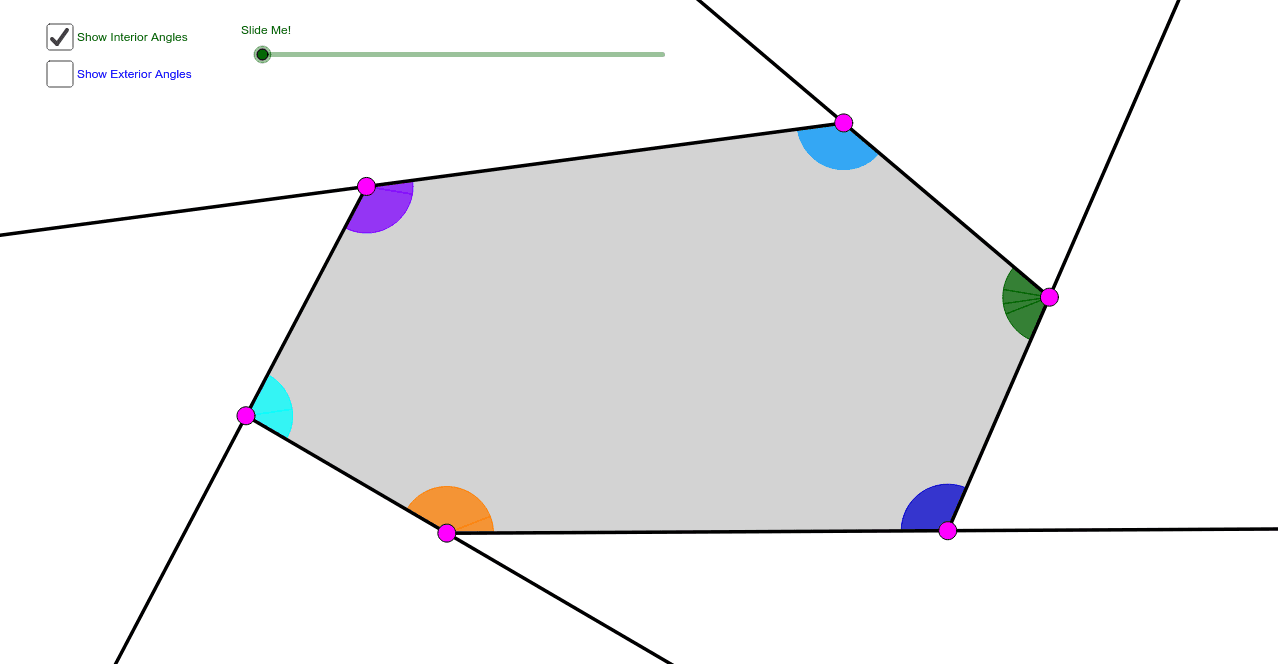
六边形内角和与外角和定理演示
几何画板及绘图内容加载中,请稍等……
所属专题
Polygons & Angles
Polygons & Angles
Polygons & Angles
Geometry: Polygons & Angles
Geometry: Polygons & Angles
①本范例通过交互式演示,向学生展示任意六边形的内角和为720度,外角和为360度的几何现象;②涉及的核心数学概念包括多边形内角和定理、外角和定理、角度计算;③作图要点——从下方『构造摘要』提炼用到了Segment(线段)、Circle(圆)、Intersect(交点)、Ray(射线)、CircleSector(扇形)、Vector(向量)、Translate(平移)、Mirror(镜像)、Dilate(缩放)、If(条件)、Rotate(旋转)、Polygon(多边形)、Point(点)等GeoGebra命令/对象;④适合初中及以上数学学习者,用于理解和验证多边形角度性质,增强空间想象能力。
GeoGebra 命令及参数
Segment(C, A_1) → i_3Circle(C, 1.5) → hIntersect(h, i_3) → L,Ray(C, D) → cIntersect(h, c, 1) → PRay(A, B) → aRay(B, C) → bRay(E, A) → eCircle(A, 1.5) → fCircle(B, 1.5) → gCircle(D, 1.5) → kCircle(E, 1.5) → pSegment(C, A) → iSegment(C, E) → jIntersect(f, a, 1) → FIntersect(f, i, 1) → GIntersect(f, e, 1) → HIntersect(f, e, 2) → IIntersect(p, e) → J,Intersect(p, j) → K,Intersect(k, c, 2) → OIntersect(h, j, 1) → QIntersect(h, i, 1) → RIntersect(h, b, 1) → SIntersect(g, a, 2) → TIntersect(g, b, 1) → UIntersect(g, a, 1) → VCircleSector(A, F, G) → qCircleSector(A, G, H) → rCircleSector(B, U, V) → sCircleSector(C, Q, R) → c_1CircleSector(C, R, S) → d_1Intersect(k, c, 1) → WCircleSector(E, J, K) → h_1CircleSector(A, I, F) → p_1CircleSector(B, T, U) → q_1Intersect(h, b, 2) → ZCircleSector(C, Z, P) → r_1Vector(A, B) → uVector(C, B) → vVector(E, D) → wVector(C, D) → u_1Vector(C, E) → v_1Vector(A, E) → w_1Translate(q, u) → q'Translate(d_1, v) → s_1Mirror(s_1, B) → t_1Dilate(A, If[0 < l ≤ 1, 1 - l, 0], B) → A'Dilate(C, If[0 < l ≤ 1, 1 - l, 0], B) → C'Dilate(A, If[1 < l ≤ 2, 2 - l, 0], E) → A'_1Dilate(C, If[1 < l ≤ 2, 2 - l, 0], E) → C'_1Dilate(C, If[2 < l ≤ 3, 3 - l, 0], D) → C'_2Dilate(E, If[2 < l ≤ 3, 3 - l, 0], D) → E'Vector(A, B) → a_1Vector(C, C') → b_1Vector(A, A'_1) → i_1Vector(E, E') → j_1Vector(C, C'_2) → l_1Vector(C, C'_1) → m_1Translate(d_1, b_1) → c_2Translate(r, i_1) → r'_1Translate(r, w_1) → r'_2Translate(c_1, v_1) → f_2Translate(c_1, m_1) → g_2CircleSector(C, P, L) → tTranslate(t, u_1) → t'Translate(t, l_1) → t'_1Translate(q, a_1) → r'Translate(d_1, b_1) → h_2If(0 < l < 1, Rotate[h_2, ((l * 180))°, C']) → k_2Vector(A, A') → n_1Translate(q, n_1) → q'_1Mirror(r'_2, E) → p_2If(1 < l < 2, Rotate[r'_1, (((l - 1) * 180))°, A'_1]) → q_2Segment(E, C) → i_2Vector(D, C) → u_2Vector(E, C) → v_2Vector(A, C) → w_2Vector(B, C) → l_2Dilate(B, If[0 < o < 1, 1 - o, 0], C) → B'Dilate(A, If[1 < o < 2, 2 - o, 0], C) → A'_2Dilate(E, If[2 < o < 3, 3 - o, 0], C) → E'_1Dilate(D, If[3 < o < 4, 4 - o, 0], C) → D'Vector(B, B') → m_2Vector(A, A'_2) → n_2Vector(E, E'_1) → s_2Vector(D, D') → t_2Translate(q_1, m_2) → c_3Translate(q_1, l_2) → d_3Translate(p_1, w_2) → e_3If(1 < o < 2, Translate[p_1, n_2]) → h_3Ray(D, A_1) → a_3Ray(A_1, E) → b_3Circle(A_1, 1.5) → q_3Intersect(q_3, i_3) → M,Intersect(q_3, b_3, 1) → NIntersect(q_3, a_3, 2) → B_1Intersect(k, c, 2) → C_1Intersect(k, a_3, 1) → D_1Intersect(k, c, 1) → E_1CircleSector(C, L, Q) → dIntersect(p, b_3, 1) → F_1Intersect(p, i_2) → G_1,CircleSector(E, G_1, N) → e_1Dilate(E, If[2 < l < 3, 3 - l, 0], A_1) → E'_2Dilate(C, If[2 < l < 3, 3 - l, 0], A_1) → C'_3Dilate(C, If[3 < l < 4, 4 - l, 0], D) → C'_4Dilate(A_1, If[3 < l < 4, 4 - l, 0], D) → H_1Vector(E, A_1) → f_1Vector(C, A_1) → g_1Translate(e_1, f_1) → k_1Translate(d, g_1) → d'Vector(E, E'_2) → a_2Vector(C, C'_3) → b_2Translate(e_1, a_2) → d_2Translate(d, b_2) → d'_1Rotate(d_2, If[2 < l < 3, (((l - 2) * 180))°, 0], E'_2) → e_2Mirror(k_1, A_1) → r_2CircleSector(A_1, N, M) → f_3Intersect(q_3, a_3, 1) → I_1CircleSector(A_1, M, I_1) → g_3CircleSector(D, D_1, E_1) → k_3Vector(C, D) → j_2Vector(A_1, D) → u_3Translate(g_3, u_3) → p_3Translate(t, j_2) → t'_2Mirror(p_3, D) → r_3Vector(A_1, H_1) → v_3Vector(C, C'_4) → w_3Translate(g_3, v_3) → s_3Translate(t, w_3) → t'_3Rotate(s_3, If[3 < l < 4, (((l - 3) * 180))°, 0], H_1) → t_3Intersect(p, b_3, 2) → J_1Polygon(A, B, C) → poly1, c_4, a_4, b_4Polygon(A, C, E) → poly2, e_4, a_5, c_5Polygon(E, C, A_1) → poly3, a_6, e_5, c_6Polygon(A_1, C, D) → poly4, d_4, a_7, c_7Polygon(A, B, C, D, A_1, E) → poly5, a_8, b_5, c_8, d_5, a_9, e_6Intersect(e, e_6) → K_1Intersect(p, e, 1) → L_1CircleSector(E, J_1, L_1) → f_4CircleSector(A_1, B_1, N) → g_4CircleSector(D, C_1, D_1) → h_4Vector(E, C) → j_3Vector(A_1, C) → l_3Vector(D, C) → m_3Translate(f_4, j_3) → k_4Translate(g_4, l_3) → p_4Translate(h_4, m_3) → q_4Dilate(E, If[2 < o < 3, 3 - o, 0], C) → E'_3Dilate(A_1, If[3 < o < 4, 4 - o, 0], C) → M_1Dilate(D, If[4 < o < 5, 5 - o, 0], C) → D'_1Vector(E, E'_3) → n_3Vector(A_1, M_1) → u_4Vector(D, D'_1) → v_4If(2 < o < 3, Translate[f_4, n_3]) → r_4If(3 < o < 4, Translate[g_4, u_4]) → s_4If(4 < o < 5, Translate[h_4, v_4]) → t_4Ray(C, A_1) → l_4Ray(C, E) → m_4Point(l_4) → N_1Point(m_4) → O_1Ray(A_1, N_1) → i_4Ray(E, O_1) → j_4