
分数、小数与百分数转换演示
几何画板及绘图内容加载中,请稍等……
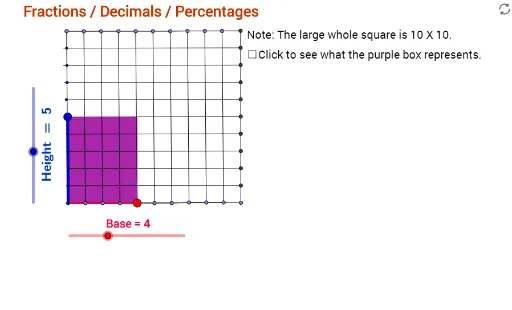
①本范例通过交互式图形演示分数、小数与百分数之间的转换关系;②涉及核心数学概念包括分数的基本性质、小数表示法、百分数意义及它们间的等价转换;③作图要点运用了Point(点)、Segment(线段)、OrthogonalLine(垂线)、Line(直线)、Intersect(交点)、Polygon(多边形)、RotateText(旋转文本)等GeoGebra命令与对象;④适合初中及以上数学学习者,用于直观理解数值转换和几何表示。
GeoGebra 命令及参数
Point(Circle[A, 10]) → BSegment(A, B) → aPoint(Circle[A, 1]) → CSegment(A, C) → bPoint(Circle[C, 1]) → DSegment(C, D) → cPoint(Circle[D, 1]) → ESegment(D, E) → dPoint(Circle[E, 1]) → FSegment(E, F) → ePoint(Circle[F, 1]) → GSegment(F, G) → fPoint(Circle[G, 1]) → HSegment(G, H) → gPoint(Circle[H, 1]) → ISegment(H, I) → hPoint(Circle[I, 1]) → JSegment(I, J) → iPoint(Circle[J, 1]) → KSegment(J, K) → jOrthogonalLine(A, a) → kPoint(Circle[A, 1]) → LSegment(A, L) → lPoint(Circle[L, 1]) → MSegment(L, M) → mPoint(Circle[M, 1]) → NSegment(M, N) → nPoint(Circle[N, 1]) → OSegment(N, O) → pPoint(Circle[O, 1]) → PSegment(O, P) → qPoint(Circle[P, 1]) → QSegment(P, Q) → rPoint(Circle[Q, 1]) → RSegment(Q, R) → sPoint(Circle[R, 1]) → SSegment(R, S) → tPoint(Circle[S, 1]) → TSegment(S, T) → a_1Point(Circle[T, 1]) → USegment(T, U) → b_1Line(U, a) → c_1Line(B, k) → d_1Intersect(c_1, d_1) → VLine(T, c_1) → e_1Line(S, e_1) → f_1Line(R, f_1) → g_1Line(Q, g_1) → h_1Line(P, h_1) → i_1Line(O, i_1) → j_1Line(N, j_1) → k_1Line(M, k_1) → l_1Line(L, l_1) → m_1Intersect(d_1, e_1) → WIntersect(d_1, f_1) → ZIntersect(d_1, g_1) → A_1Intersect(d_1, h_1) → B_1Intersect(d_1, i_1) → C_1Intersect(d_1, j_1) → D_1Intersect(d_1, k_1) → E_1Intersect(d_1, l_1) → F_1Intersect(d_1, m_1) → G_1Segment(V, H_1) → n_1Segment(U, V) → p_1Segment(T, W) → q_1Segment(S, Z) → r_1Segment(R, A_1) → s_1Segment(Q, B_1) → t_1Segment(P, C_1) → a_2OrthogonalLine(A, a) → b_2Segment(O, D_1) → c_2Segment(N, E_1) → d_2Segment(M, F_1) → e_2Segment(L, G_1) → f_2Point(Circle[U, 1]) → I_1Segment(U, I_1) → g_2Point(Circle[I_1, 1]) → J_1Segment(I_1, J_1) → h_2Point(Circle[J_1, 1]) → K_1Segment(J_1, K_1) → i_2Point(Circle[K_1, 1]) → L_1Segment(K_1, L_1) → j_2Point(Circle[L_1, 1]) → M_1Segment(L_1, M_1) → k_2Point(Circle[M_1, 1]) → N_1Segment(M_1, N_1) → l_2Point(Circle[N_1, 1]) → O_1Segment(N_1, O_1) → m_2Point(Circle[O_1, 1]) → P_1Segment(O_1, P_1) → n_2Point(Circle[P_1, 1]) → Q_1Segment(P_1, Q_1) → p_2Segment(C, I_1) → q_2Segment(J_1, D) → r_2Segment(K_1, E) → s_2Segment(L_1, F) → t_2Segment(M_1, G) → a_3Segment(N_1, H) → b_3Segment(O_1, I) → c_3Segment(P_1, J) → d_3Segment(Q_1, K) → e_3Segment(A, U) → f_3Point(Circle[A, Base]) → Base_1Segment(A, Base_1) → g_3Point(Circle[A, Height]) → Height_1Segment(A, Height_1) → h_3Line(Height_1, g_3) → i_3Line(Base_1, h_3) → j_3Intersect(i_3, j_3) → T_1Segment(Height_1, T_1) → k_3Segment(T_1, Base_1) → l_3Polygon(Height_1, T_1, Base_1, A) → poly1, s_3, t_3, r_3, a_4Intersect(s_1, f_3) → R_1Intersect(r_1, f_3) → S_1Intersect(q_1, f_3) → U_1RotateText(text11, 1.5707963267948966) → text12