
使用乘法框架分解标准二次表达式(含步骤说明)
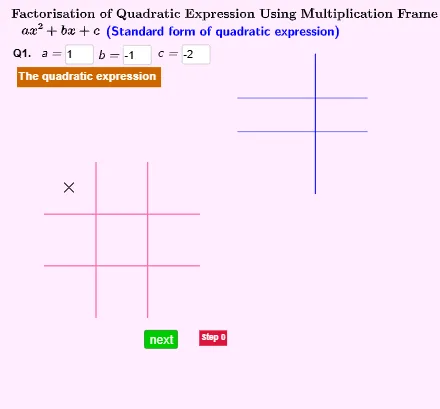
几何画板及绘图内容加载中,请稍等……
①本范例演示如何使用乘法框架分解标准二次表达式,并逐步展示分解过程;②涉及的核心数学概念包括二次表达式的因式分解、乘法运算、代数运算;③作图要点——从下方『构造摘要』提炼用到了 DivisorsList, Factors, Sequence, IndexOf, Element, If, Expand, Textfield, Point, Segment, Text, Vector, Polygon, Circle, CircumcircleArc, CircleArc 等GeoGebra命令/对象;④适合初中及以上学生,用于教师引导下的初步讲解和学生自主探究学习。
GeoGebra 命令及参数
DivisorsList(d_.2) → listDivisorsFactors(d_.2) →Sequence(Element[list2, p] + Element[list3, p], p, 1, d) → list4, {-1}IndexOf(b, list4) → poointElement(list3, pooint) → p_.2Factors((a * x^(2)) + (b * x) + c) → m1If(Element[Coefficients[Element[m1, 1, 1]], 1] < Element[Coefficients[Element[m1, 2, 1]], 1], Element[Coefficients[Element[m1, 1, 1]], 2], Element[Coefficients[Element[m1, 2, 1]], 2]) → g_{r1}If(Element[Coefficients[Element[m1, 1, 1]], 1] < Element[Coefficients[Element[m1, 2, 1]], 1], Element[Coefficients[Element[m1, 2, 1]], 1], Element[Coefficients[Element[m1, 1, 1]], 1]) → g_{m1}Element(list2, pooint) → p_.1If(Element[Coefficients[Element[m1, 1, 1]], 1] < Element[Coefficients[Element[m1, 2, 1]], 1], Element[Coefficients[Element[m1, 1, 1]], 1], Element[Coefficients[Element[m1, 2, 1]], 1]) → g_{o1}Expand((g_o * x) + g_r) → g_{f2}If(Element[Coefficients[Element[m1, 1, 1]], 1] < Element[Coefficients[Element[m1, 2, 1]], 1], Element[Coefficients[Element[m1, 2, 1]], 2], Element[Coefficients[Element[m1, 1, 1]], 2]) → g_{n1}Expand((g_m * x) + g_n) → g_{f1}Textfield(a) → InputBox1Textfield(b) → InputBox2Textfield(c) → InputBox3Sequence((4.5, 3 - (p * 1.3)), p, 1, d) → list5_.factors1Sequence((7, 6 - (p * 1.8)), p, 1, d + 3) → list7_.midlinePoint(list7_.midline) → ASegment(C, F) → jSegment(G, H) → kSegment(I, J) → lSegment(K, L) → mSequence(Text[Element[list2, p], Element[list5_.factors1, p]], p, 1, d) → listfactor1Sequence((4.8, 3 - (p * 1.3)), p, 1, d) → list9_.factors2Sequence((7.5, 3 - (p * 1.3)), p, 1, d) → list11_.sumSegment(Element[list7_.midline, 1], Element[list7_.midline, d + 2]) → iSequence((3.8, 3 - (p * 1.3)), p, 1, d) → list13_.brkt1Text("[", Element[list13_.brkt1, pooint]) → text22Sequence((10, 3 - (p * 1.3)), p, 1, d) → list14_.brkt2Text("]", Element[list14_.brkt2, pooint]) → text21Element(list13_.brkt1, pooint) → PKVector(PK, A_1) → wVector(PK, B_1) → nPolygon(U + (-0.2, 0.4), V + (0, 0.4), W, Z + (-0.2, 0)) → poly1, g_1, h_1, p_1, a_1Polygon(C_1 + (-0.2, 0.4), D_1 + (0.1, 0.4), E_1 + (0.1, 0), F_1 + (-0.2, 0)) → poly2, g, s, t, f_1Polygon(G_1, H_1, I_1, J_1) → poly3, g_2, h_2, i_1, j_1Polygon(O_1, P_1, Q_1, R_1) → poly5, o_1, p_2, q_1, r_1Polygon(S_1, T_1, U_1, V_1) → poly6, s_1, t_1, u_1, v_1Polygon(K_1, L_1, M_1, N_1) → poly4, k_1, l_1, m_1, n_1Sequence(Segment[(4, 3.8 - (p * 1.3)), (9, 3.8 - (p * 1.3))], p, 1, d + 1) → listSegmentIf(Defined[rootdiscrim], If[(Numerator[rootdiscrim] / Denominator[rootdiscrim])^(2) ≟ rootdiscrim^(2), true, false], false) → isrootrationalCircle(W_1, 0.8) → eCircle(Z_1, 0.9) → fSequence(Text[" × " + (Element[list3, p]), Element[list9_.factors2, p]], p, 1, d) → listFactor2Sequence(Text[Element[list2, p] + " + " + (Element[list3, p]) + " = " + (Element[list4, p]), Element[list11_.sum, p]], p, 1, d) → listSumCircumcircleArc(M + (0.3, -0.5), Midpoint[M + (0.6, 0), P + (0.6, 0)], P + (0.5, 0)) → hCircleArc(P + (8, -6), M - (0, 0.3), O + (1.5, -0.4)) → pPoint(p) → B_2CircumcircleArc(M + (0.3, -0.5), Midpoint[M + (1.2, 0), S + (1.2, 0)], S + (0.5, 0)) → qCircumcircleArc(M - (0, 0.4), O + (0.3, 0), R + (0.5, -0.05)) → r
AI 绘图提示语参考
画一个标准二次方程的因式分解图,展示因式分解过程。包含一个乘法框架,逐步解释分解步骤。显示二次方程的系数和因式分解结果,用点和线段连接相关元素,形成几何化表示。先画出乘法框架和因式分解的中间步骤,再展示最终分解结果和几何图形,强调数学概念和操作关系。
以上提示语为根据原始绘图命令整理而来,仅供参考。