
用图形解决整数除以分数的问题
几何画板及绘图内容加载中,请稍等……
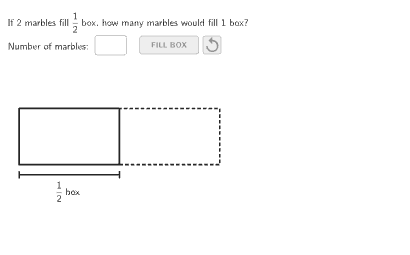
这个范例通过GeoGebra的图形模型,演示如何用盒子或弹珠的视觉化方式解决整数除以分数或混合数的数学问题。核心数学概念包括分数除法、混合数运算以及比例关系。作图要点涉及使用Shuffle、Element、Random、If、Max、Min、Sequence等GeoGebra命令,以及Polygon、Segment、Midpoint等对象来构建动态图形。适合小学四年级至五年级的学生,用于理解分数除法的实际应用和数学建模能力。
GeoGebra 命令及参数
Shuffle({1, 2, 3, 1, 2, 3}) → randomList1, {2, 1, 3, 2, 1, 3}Element(randomList1, Mod[countQuestion, Length[randomList1]] + 1) → randomNum1Shuffle({2, 3, 4, 2, 3, 4}) → randomList3, {2, 4, 4, 3, 2, 3}Element(randomList3, Mod[countQuestion, Length[randomList3]] + 1) → randomNum3Shuffle({0, 0, 0, 0, 1, 1, 2, 2}) → randomList2, {0, 1, 2, 0, 2, 0, 1, 0}Element(randomList2, Mod[countQuestion, Length[randomList2]] + 1) → randomNum2Random(1, den - 1) → numIf(Defined[input1], Min[input1, totalSlots + 1] + 1, 1) → timeOrangeMax(timeOrange, marblesTotal + 1) → timePurpleMin(2, If[ratioPic > ratioReference, Distance[C1, C2] / widthReference, Distance[C1, C4] / heightReference]) → radiusSequence((x(Midpoint[C1, C3]) - widthBox / 2 + (0.7 * radius) + ((radius * 1.2) * (n - 1)), y(Midpoint[C1, C3]) - (radius * heightReference / 2) + (0.2 * radius) + radius / 2), n, 1, marblesBox) → centersFlatten(Sequence[Sequence[(x(Midpoint[C1, C3]) - widthBox / 2 + (0.7 * radius) + ((radius * 1.2) * (n - 1)), y(Midpoint[C1, C3]) - (radius * heightReference / 2) + (0.2 * radius) + radius / 2 + ((T * 1.8) * radius)), n, 1, marblesBox], T, whole, 1, -1]) → centersWholeFlatten({centersWhole, centers, {ExtraCenter}}) → centersTotalSequence(Circle[FromTo[A, Element[centersTotal, k], step(k, time)], radius / 2], k, input1 + 1, marblesTotal) → marblesAnimTotalIf(time ≤ 1, 0, time ≤ timeOrange, 1, time ≤ timePurple, 2, time ≤ timeFading, 3, 4) → animStepSequence(Circle[FromTo[A, Element[centersTotal, k], step(k, time)], radius / 2], k, 1, Min[input1, (numBoxes * marblesBox) + 1]) → marblesAnimStTextfield(input1) → InputBox1Polygon(Zip[PixelsToPoint[Corner[1], Corner[3], Corner[5], A], A, {(pixelsLeft, pixelsTop), (pixelsLeft, y(Corner[5]) - pixelsBottom), Corner[5] - (pixelsRight, pixelsBottom), (x(Corner[5]) - pixelsRight, pixelsTop)}]) → borderBoxSequence(Polygon[{(x(Midpoint[C1, C3]) - widthBox / 2, y(Midpoint[C1, C3]) + (((n * 1.8) - heightReference / 2) * radius)), (x(Midpoint[C1, C3]) + widthBox / 2, y(Midpoint[C1, C3]) + (((n * 1.8) - heightReference / 2) * radius)), (x(Midpoint[C1, C3]) + widthBox / 2, y(Midpoint[C1, C3]) + (radius * (1.4 + (1.8 * n) - heightReference / 2))), (x(Midpoint[C1, C3]) - widthBox / 2, y(Midpoint[C1, C3]) + (((1.8 * n) + 1.4 - heightReference / 2) * radius))}], n, 1, whole) → boxesPolygon({(x(Midpoint[C1, C3]) - widthBox / 2 + ((0.1 + ((num * factor) * 1.2)) * radius), y(Midpoint[C1, C3]) + (((-heightReference)) / 2 * radius)), (x(Midpoint[C1, C3]) + widthBox / 2, y(Midpoint[C1, C3]) + (((-heightReference)) / 2 * radius)), (x(Midpoint[C1, C3]) + widthBox / 2, y(Midpoint[C1, C3]) + (radius * (1.4 - heightReference / 2))), (x(Midpoint[C1, C3]) - widthBox / 2 + ((0.1 + ((num * factor) * 1.2)) * radius), y(Midpoint[C1, C3]) + ((1.4 - heightReference / 2) * radius))}) → boxUnusedSegment((x(Midpoint[C1, C3]) - widthBox / 2 + ((0.1 + ((num * factor) * 1.2)) * radius), y(Midpoint[C1, C3]) + (((-heightReference)) / 2 * radius) - 0.5), (x(Midpoint[C1, C3]) - widthBox / 2, y(Midpoint[C1, C3]) + (((-heightReference)) / 2 * radius) - 0.5)) → braceMidpoint(brace) → labelBracePosSequence(Circle[FromTo[A, Element[Join[{centers, Sequence[A, p, 1, input1 - marblesBox]}], k], step(k, timeStep)], radius / 2], k, 1, input1) → marblesAnimTake(boxes, 1, Length[boxes] - 1) → shadowedBoxesZip(Circle[P, radius / 2], P, centersWhole) → marblesWholeSequence(Circle[Element[Join[{centers, Sequence[A, p, 1, input1 - marblesBox]}], k], radius / 2], k, input1 + 1, marblesBox) → marblesMissingPolygon({(x(Midpoint[C1, C3]) - widthBox / 2, y(Midpoint[C1, C3]) + (((-heightReference)) / 2 * radius)), (x(Midpoint[C1, C3]) - widthBox / 2 + ((0.1 + ((num * factor) * 1.2)) * radius), y(Midpoint[C1, C3]) + (((-heightReference)) / 2 * radius)), (x(Midpoint[C1, C3]) - widthBox / 2 + ((0.1 + ((num * factor) * 1.2)) * radius), y(Midpoint[C1, C3]) + ((1.4 - heightReference / 2) * radius)), (x(Midpoint[C1, C3]) - widthBox / 2, y(Midpoint[C1, C3]) + ((1.4 - heightReference / 2) * radius))}) → boxUncompleteTake(centersTotal, marblesBox + 1, Length[centersTotal]) → centersNotTopSequence(Circle[Element[centersTotal, k], radius / 2], k, input1 + 1, (marblesBox * numBoxes)) → marblesMissingTotalIf(animStep < 3, 0, animStep > 3, goalOpac, ((time - timePurple) * goalOpac / (timeFading - timePurple))) → fadingOpacZip(Circle[P, radius / 2], P, centersNotTop) → fadingCorner(5) → Appsize
AI 绘图提示语参考
画一个包含若干个盒子和小球的图形。首先画一个边界框,然后在框内随机分布一些盒子,每个盒子内随机放置一些小球。接着,根据给定的数字,从盒子中移除一些小球,并用不同颜色标记这些小球。最后,根据剩余小球的数量,动态显示剩余小球的动画效果。
以上提示语为根据原始绘图命令整理而来,仅供参考。