
骰子平均值
几何画板及绘图内容加载中,请稍等……
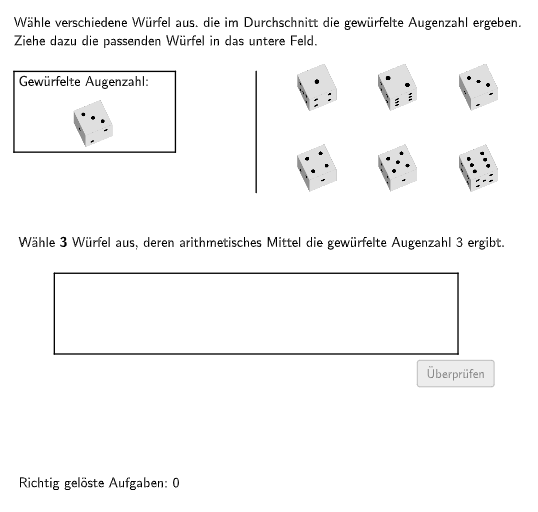
这个范例演示了如何通过随机生成骰子点数来计算平均值。涉及的核心数学概念包括算术平均值、中位数和众数。使用了GeoGebra命令如Shuffle、Sum等进行数据处理和图形展示。适合小学五年级至六年级学生进行概率统计练习。
GeoGebra 命令及参数
Shuffle(Sequence[Random[2, 5], i, 1, 100]) → gewAugenzahl, {3, 5, 3, 5, 3, 3, 4, 5, 5, 5, 4, 4, 5, 4, 2, 4, 4, 5, 5, 4, 5, 5, 5, 4, 5, 3, 3, 5, 3, 2, 5, 4, 3, 2, 3, 3, 4, 4, 5, 5, 5, 2, 2, 2, 5, 5, 2, 3, 5, 4, 2, 2, 4, 5, 2, 5, 4, 5, 4, 3, 4, 2, 2, 4, 3, 3, 4, 3, 5, 3, 3, 3, 4, 5, 3, 4, 4, 5, 4, 5, 5, 4, 2, 3, 3, 2, 4, 4, 3, 5, 5, 5, 3, 4, 3, 3, 2, 5, 5, 3}Append(true, Sequence[If[gewAugenzahl(i) ≟ gewAugenzahl(i - 1), false, true], i, 2, 100]) → stayXRemove(Sequence[If[stayX(i), gewAugenzahl(i), 0], i, 1, 100], Sequence[0, i, 1, 100]) → randomNosForXwithoutRepeatMidpoint(Corner[B63, 1], Corner[B63, 3]) → MidPoint_{B63}Midpoint(Corner[B62, 1], Corner[B62, 3]) → MidPoint_{B62}Midpoint(Corner[B53, 1], Corner[B53, 3]) → MidPoint_{B53}Midpoint(Corner[B52, 1], Corner[B52, 3]) → MidPoint_{B52}Midpoint(Corner[B43, 1], Corner[B43, 3]) → MidPoint_{B43}Midpoint(Corner[B42, 1], Corner[B42, 3]) → MidPoint_{B42}Midpoint(Corner[B33, 1], Corner[B33, 3]) → MidPoint_{B33}Midpoint(Corner[B32, 1], Corner[B32, 3]) → MidPoint_{B32}Midpoint(Corner[B23, 1], Corner[B23, 3]) → MidPoint_{B23}Midpoint(Corner[B22, 1], Corner[B22, 3]) → MidPoint_{B22}Midpoint(Corner[B13, 1], Corner[B13, 3]) → MidPoint_{B13}Midpoint(Corner[B12, 1], Corner[B12, 3]) → MidPoint_{B12}Polygon(M, N, O, P) → v1, m, n, o, pIsInRegion(MidPoint_{B63}, v1) → in6_3IsInRegion(MidPoint_{B62}, v1) → in6_2IsInRegion(MidPoint_{B53}, v1) → in5_3IsInRegion(MidPoint_{B52}, v1) → in5_2IsInRegion(MidPoint_{B43}, v1) → in4_3IsInRegion(MidPoint_{B42}, v1) → in4_2IsInRegion(MidPoint_{B33}, v1) → in3_3IsInRegion(MidPoint_{B32}, v1) → in3_2IsInRegion(MidPoint_{B23}, v1) → in2_3IsInRegion(MidPoint_{B22}, v1) → in2_2IsInRegion(MidPoint_{B13}, v1) → in1_3IsInRegion(MidPoint_{B12}, v1) → in1_2Midpoint(Corner[Bild6, 1], Corner[Bild6, 3]) → MidPoint_{Bild6}IsInRegion(MidPoint_{Bild6}, v1) → in6Midpoint(Corner[Bild5, 1], Corner[Bild5, 3]) → MidPoint_{Bild5}IsInRegion(MidPoint_{Bild5}, v1) → in5Midpoint(Corner[Bild4, 1], Corner[Bild4, 3]) → MidPoint_{Bild4}IsInRegion(MidPoint_{Bild4}, v1) → in4Midpoint(Corner[Bild3, 1], Corner[Bild3, 3]) → MidPoint_{Bild3}IsInRegion(MidPoint_{Bild3}, v1) → in3Midpoint(Corner[Bild2, 1], Corner[Bild2, 3]) → MidPoint_{Bild2}IsInRegion(MidPoint_{Bild2}, v1) → in2Midpoint(Corner[Bild1, 1], Corner[Bild1, 3]) → MidPoint_{Bild1}IsInRegion(MidPoint_{Bild1}, v1) → in1Shuffle(Sequence[Random[3, 6], i, 1, 100]) → anzahlWürfelZiehbar, {3, 4, 3, 3, 4, 4, 4, 5, 3, 5, 4, 4, 3, 3, 4, 4, 6, 6, 5, 3, 5, 6, 5, 4, 4, 5, 5, 5, 6, 4, 6, 6, 3, 4, 4, 6, 6, 5, 3, 6, 3, 6, 4, 3, 5, 6, 3, 5, 4, 4, 3, 5, 5, 3, 5, 3, 4, 6, 4, 4, 4, 4, 5, 4, 3, 5, 3, 5, 4, 6, 4, 6, 6, 5, 3, 4, 6, 3, 3, 5, 6, 4, 4, 4, 4, 6, 3, 6, 3, 5, 3, 4, 5, 3, 6, 3, 4, 4, 6, 6}Element(anzahlWürfelZiehbar, Mod[questionCount, 100] + 1) → würfelZahlElement(randomNosForXwithoutRepeat, Mod[questionCount, 100] + 1) → augenZahlIf(in1, 1, 0) → zahl1If(in2, 2, 0) → zahl2If(in3, 3, 0) → zahl3If(in4, 4, 0) → zahl4If(in5, 5, 0) → zahl5Sum(listeElementeInVieleck) → sumCorrectIf(in6, 6, 0) → zahl6If(in1_2, 1, 0) → zahl1_2If(in1_3, 1, 0) → zahl1_3If(in2_2, 2, 0) → zahl2_2If(in2_3, 2, 0) → zahl2_3If(in3_2, 3, 0) → zahl3_2If(in3_3, 3, 0) → zahl3_3If(in4_2, 4, 0) → zahl4_2If(in4_3, 4, 0) → zahl4_3If(in5_2, 5, 0) → zahl5_2If(in5_3, 5, 0) → zahl5_3If(in6_2, 6, 0) → zahl6_2If(in6_3, 6, 0) → zahl6_3Sum(listeSumme) → augenSummeTextfield(aInput) → InputBox1Textfield(bInput) → InputBox2Polygon(PtopLeftCornerFeedback, PtopRightCornerFeedback, PbottomRightCornerFeedback, PbottomLeftCornerFeedback) → rectangleCorrect, ptopleftcornerfeedback, ptoprightcornerfeedback, pbottomrightcornerfeedback, pbottomleftcornerfeedbackAppend(true, Sequence[If[anzahlWürfelZiehbar(i) ≟ anzahlWürfelZiehbar(i - 1), false, true], i, 2, 100]) → stayYRemove(Sequence[If[stayY(i), anzahlWürfelZiehbar(i), 0], i, 1, 100], Sequence[0, i, 1, 100]) → randomNosForYwithoutRepeatElement(randomNosForXwithoutRepeat, Mod[questionCount, Length[randomNosForXwithoutRepeat]] + 1) → numXwithoutRepeatElement(randomNosForYwithoutRepeat, Mod[questionCount, Length[randomNosForYwithoutRepeat]] + 1) → numYwithoutRepeatDefined((aInput * bInput)) → fixedPolygon(Q, R, S, T) → v2, q, r, s, tSegment(U, V) → gMidpoint(Corner[Zweier, 1], Corner[Zweier, 3]) → MidPoint_{Bild8}Midpoint(Corner[Dreier, 1], Corner[Dreier, 3]) → MidPoint_{Bild9}Midpoint(Corner[Vierer, 1], Corner[Vierer, 3]) → MidPoint_{Bild10}Midpoint(Corner[Fünfer, 1], Corner[Fünfer, 3]) → MidPoint_{Bild11}If(in1, Append[zahl1, {}]) → anfügenArithm1If(in2, Append[zahl2, anfügenArithm1]) → anfügenArithm2If(in3, Append[zahl3, anfügenArithm2]) → anfügenArithm3If(in4, Append[zahl4, anfügenArithm3]) → anfügenArithm4If(in5, Append[zahl5, anfügenArithm4]) → anfügenArithm5If(in6, Append[zahl6, anfügenArithm5]) → anfügenArithm6Midpoint(Corner[Zweier, 1], Corner[Zweier, 3]) → MidPoint_{Zweier}Midpoint(Corner[Dreier, 1], Corner[Dreier, 3]) → MidPoint_{Dreier}Midpoint(Corner[Vierer, 1], Corner[Vierer, 3]) → MidPoint_{Vierer}Midpoint(Corner[Fünfer, 1], Corner[Fünfer, 3]) → MidPoint_{Fünfer}CountIf(x > 0, listeElementeInVieleck) → zähleWennTestSum(gezogen) → sumIn
AI 绘图提示语参考
画一个展示骰子平均值的图形,包含一个由100个随机骰子点数构成的序列,通过去除重复值得到一个无重复的序列。用多个点表示这个序列中的点数,并连接这些点形成一个多边形。然后,用多个区域表示点数出现的次数,并用不同颜色填充这些区域,以展示概率分布。
以上提示语为根据原始绘图命令整理而来,仅供参考。