
长方体展开图生成器 by Jennifer Gottschalk
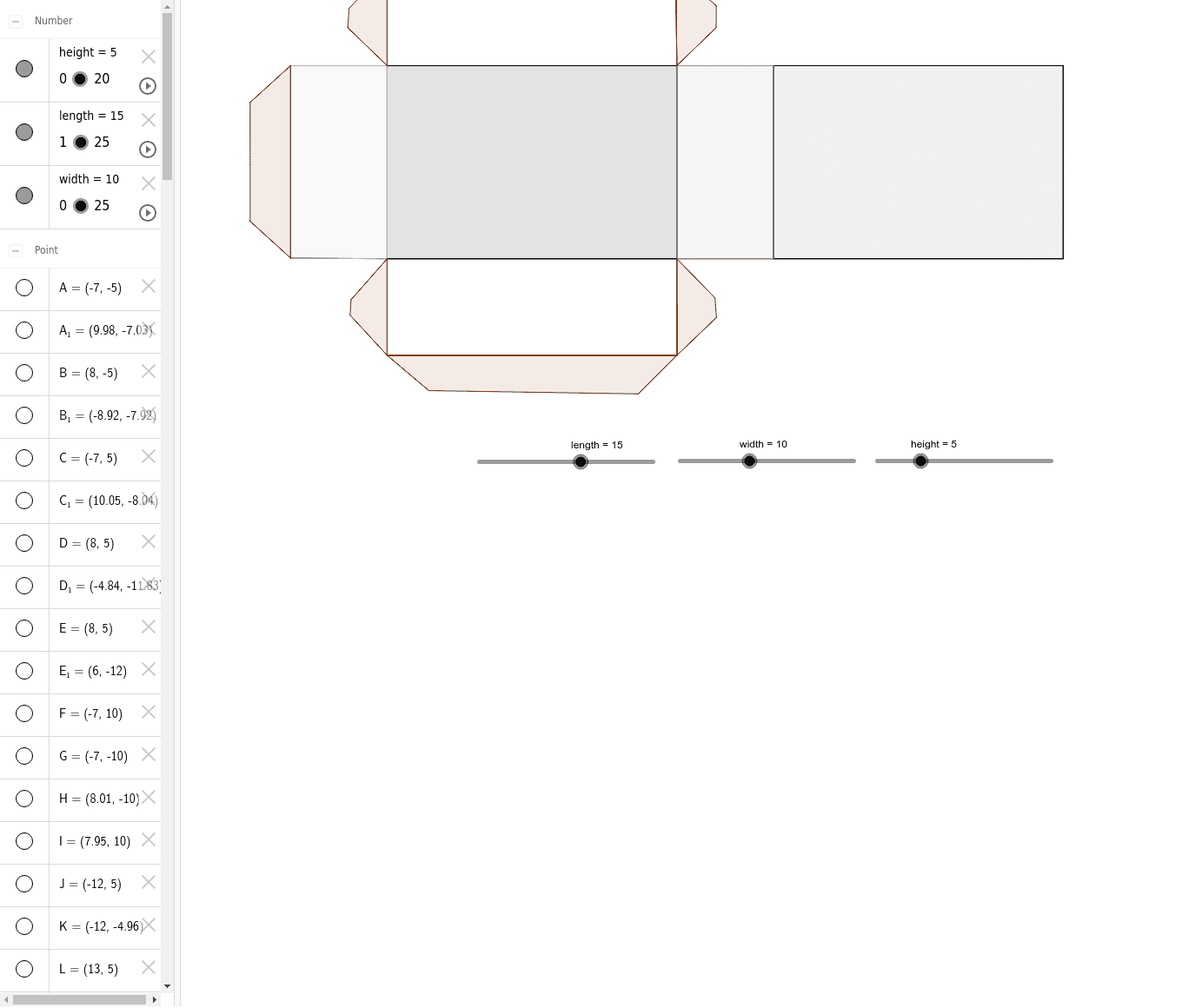
几何画板及绘图内容加载中,请稍等……
这个范例演示了如何生成长方体的展开图。核心数学概念包括几何变换和立体几何。通过使用GeoGebra命令如Point, Segment, Polygon等,可以构造出长方体的各个面。适合初中及以上学生学习立体几何和几何作图。
GeoGebra 命令及参数
Point(Circle[A, length]) → BSegment(A, B) → fPoint(Circle[A, width]) → CSegment(A, C) → gPoint(Circle[B, width]) → DSegment(B, D) → hPoint(Circle[C, length]) → ESegment(C, E) → iPoint(Circle[C, height]) → FSegment(C, F) → jPoint(Circle[A, height]) → GSegment(A, G) → kPoint(Circle[B, height]) → HSegment(B, H) → lPoint(Circle[E, height]) → ISegment(E, I) → mPoint(Circle[C, height]) → JSegment(C, J) → nPoint(Circle[A, height]) → KSegment(A, K) → pPoint(Circle[E, height]) → LSegment(E, L) → qPoint(Circle[B, height]) → MSegment(B, M) → rSegment(J, K) → sSegment(G, H) → tSegment(M, L) → dSegment(F, I) → ePoint(Circle[L, length]) → NSegment(L, N) → f_1Point(Circle[M, length]) → OSegment(M, O) → g_1Segment(N, O) → h_1Polygon(L, M, O, N) → poly1, l_1, m_1, o, n_1Polygon(C, A, B, E) → poly2, c, a, b, e_1Polygon(J, C, A, K) → poly3, j_1, c_1, a_1, k_1Polygon(F, I, E, C) → poly4, f_2, i_1, e_2, c_2Polygon(A, G, H, B) → poly5, a_2, g_2, h_2, b_1Polygon(E, L, M, B) → poly6, e_3, l_2, m_2, b_2Point(Circle[J, 2.83]) → PSegment(J, P) → p_1Point(Circle[K, 2.83]) → QSegment(K, Q) → q_1Polygon(P, Q, K, J) → poly7, p_2, q_2, k_2, j_2Point(Circle[F, 2.83]) → RSegment(F, R) → r_1Point(Circle[I, 2.83]) → SSegment(I, S) → s_1Polygon(F, R, S, I) → poly8, f_3, r_2, s_2, i_2Point(Circle[F, 2.83]) → TSegment(F, T) → t_1Point(Circle[C, 2.83]) → USegment(C, U) → d_1Point(Circle[I, 2.83]) → VSegment(I, V) → n_2Point(Circle[E, 2.83]) → WSegment(E, W) → t_2Polygon(F, T, U, C) → poly9, f_4, t_3, u, c_3Polygon(I, E, W, V) → poly10, i_3, e_4, w, vPoint(Circle[A, 2.83]) → ZSegment(A, Z) → d_2Point(Circle[B, 2.83]) → A_1Segment(B, A_1) → g_3Point(Circle[G, 2.83]) → B_1Segment(G, B_1) → h_3Point(Circle[H, 2.83]) → C_1Segment(H, C_1) → j_3Point(Circle[G, 2.83]) → D_1Segment(G, D_1) → k_3Point(Circle[H, 2.83]) → E_1Segment(H, E_1) → l_3Polygon(A, Z, B_1, G) → poly11, a_3, z_1, b_3, g_4Polygon(G, H, E_1, D_1) → poly12, g_5, h_4, e_5, d_3Polygon(B, H, C_1, A_1) → poly13, b_4, h_5, c_4, a_4