
立方体与棱柱的几何构造:演示立方体、棱柱及相关几何概念
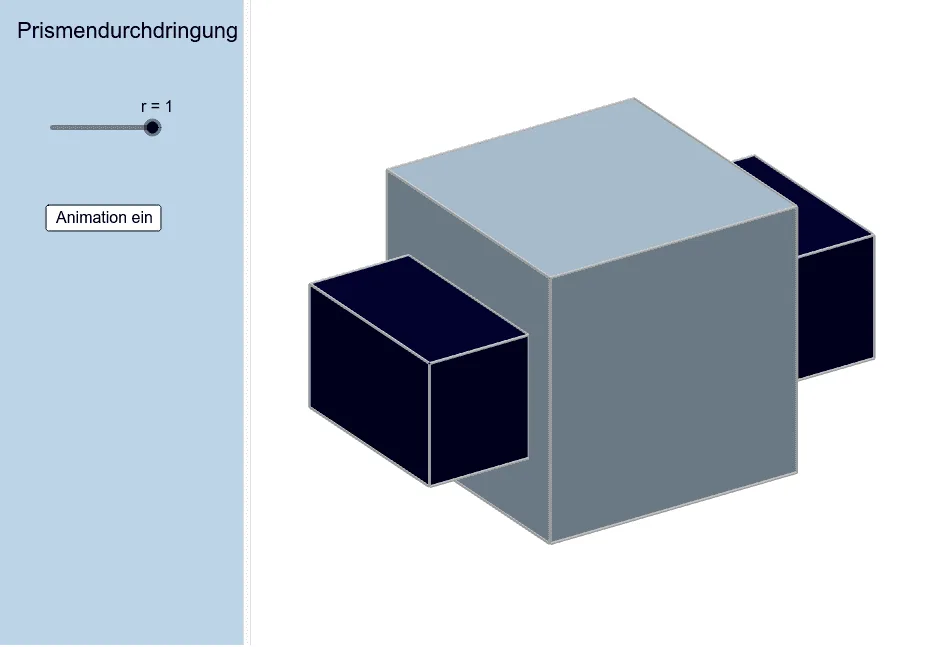
几何画板及绘图内容加载中,请稍等……
这个范例展示了立方体(Würfel)和棱柱(Quader)的几何构造,涉及多边形、棱、面等概念。构造中使用了GeoGebra命令如Point、Cube、Segment、Circle、Line、Intersect、Polygon、Prism等对象,包括r、G、A、W、B、C、D、E、F等。作图要点包括确定立方体顶点、棱、面以及棱柱的生成。适合初中或高中数学学习,用于理解立体几何和几何作图。核心数学概念包括几何构造、立体几何、多边形、棱、面等。
GeoGebra 命令及参数
Point(Circle[(1, -1, -1), Distance[(-1, -1, -1), (1, -1, -1)], Segment[(-1, -1, -1), (1, -1, -1)]]) → ACube((-1, -1, -1), (1, -1, -1), A) → W, B, FlächeABFE, FlächeCDEF, Kante2, Kante1, Kante4, KanteAB, Kante3, KanteBF, KanteCF, KanteCD, C, Kante5, KanteDE, KanteAE, KanteEF, D, E, F, Fläche1, Fläche3, Fläche2, Fläche4Segment(G, F) → gSegment(G, C) → fSegment(G, D) → hCircle(F, r, g) → cSegment(G, E) → iCircle(E, r, i) → dCircle(D, r, h) → eCircle(C, r, f) → kCircle(B, r, h) → pCircle(A, r, f) → qCircle(H, r, i) → r_1Circle(I, r, g) → sPoint(c) → P_1Line(P_1, KanteCF) → jIntersect(j, k, 1) → JLine(P_1, KanteEF) → lIntersect(l, d, 1) → KLine(P_1, KanteBF) → mIntersect(m, p, 1) → LLine(J, Kante3) → nIntersect(n, r_1, 1) → MLine(K, KanteDE) → tIntersect(t, e, 1) → NLine(N, Kante5) → aLine(K, KanteAE) → bIntersect(a, s, 1) → OIntersect(b, q, 1) → PPolygon(P_1, J, N, K) → v1, p_1, j_1, n_1, k_1Prism(v1, L) → o, Q, KanteJQ, KanteNR, KanteKS, KanteLQ, KanteQR, KanteRS, KanteLS, R, S, Fläche5, FlächeJNRQ, FlächeKNRS, Fläche6, FlächeLQRS, Kante6Intersect(KanteBF, v1) → TIntersect(Kante3, v1) → UIntersect(Kante5, v1) → VIntersect(Kante3, FlächeLQRS) → ZIntersect(KanteBF, FlächeLQRS) → A_1Intersect(Kante5, FlächeLQRS) → B_1Intersect(KanteAE, FlächeLQRS) → C_1Intersect(KanteAE, v1) → D_1Segment(B_1, C_1) → f_1Segment(C_1, A_1) → g_1Segment(A_1, Z) → h_1Segment(Z, B_1) → i_1Segment(U, V) → l_1Segment(T, U) → m_1Segment(V, D_1) → q_1Segment(D_1, T) → s_1Intersect(k_1, Fläche3) → E_1Intersect(j_1, Fläche3) → F_1Segment(E_1, F_1) → t_1Intersect(KanteQR, Fläche3) → G_1Intersect(KanteLS, Fläche3) → H_1Intersect(k_1, Fläche4) → I_1Intersect(j_1, Fläche4) → J_1Intersect(KanteQR, Fläche4) → K_1Intersect(KanteLS, Fläche4) → L_1Segment(I_1, L_1) → a_1Segment(L_1, K_1) → b_1Segment(J_1, K_1) → c_1Intersect(k_1, a_1) → M_1Segment(J_1, M_1) → d_1Segment(H_1, G_1) → f_2Segment(E_1, H_1) → g_2Intersect(Kante2, FlächeJNRQ) → O_1Intersect(KanteCF, FlächeJNRQ) → Q_1Intersect(KanteDE, FlächeJNRQ) → R_1Intersect(Kante4, FlächeJNRQ) → S_1Segment(R_1, S_1) → h_2Segment(Q_1, R_1) → i_2Segment(Q_1, O_1) → j_2Segment(O_1, S_1) → k_2Intersect(KanteCF, Fläche6) → T_1Intersect(Kante2, Fläche6) → U_1Intersect(KanteDE, Fläche6) → V_1Intersect(Kante4, Fläche6) → W_1Segment(V_1, T_1) → l_2Segment(V_1, W_1) → m_2Segment(T_1, U_1) → n_2Segment(W_1, U_1) → p_2Intersect(Kante6, FlächeCDEF) → Z_1Intersect(KanteJQ, FlächeCDEF) → A_2Intersect(KanteNR, FlächeCDEF) → B_2Segment(Z_1, A_2) → q_2Segment(A_2, B_2) → r_2Intersect(KanteKS, FlächeCDEF) → C_2Segment(B_2, C_2) → s_2Segment(Z_1, C_2) → t_2Intersect(KanteKS, Fläche1) → D_2Intersect(KanteNR, Fläche1) → E_2Intersect(Kante6, Fläche1) → F_2Intersect(KanteJQ, Fläche1) → G_2Segment(D_2, F_2) → a_2Segment(F_2, G_2) → b_2Segment(E_2, D_2) → c_2Segment(G_2, E_2) → d_2Intersect(KanteEF, Fläche5) → H_2Intersect(KanteCD, Fläche5) → I_2Intersect(KanteAB, Fläche5) → J_2Intersect(Kante1, Fläche5) → K_2Intersect(KanteCD, FlächeKNRS) → L_2Intersect(Kante1, FlächeKNRS) → M_2Intersect(KanteEF, FlächeKNRS) → N_2Intersect(KanteAB, FlächeKNRS) → O_2Segment(L_2, N_2) → e_2Segment(N_2, O_2) → f_3Segment(L_2, M_2) → g_3Segment(M_2, O_2) → h_3Segment(H_2, I_2) → i_3Segment(I_2, K_2) → j_3Segment(J_2, K_2) → k_3Segment(H_2, J_2) → l_3Intersect(p_1, Fläche2) → N_1Intersect(n_1, Fläche2) → P_2Intersect(KanteLQ, Fläche2) → Q_2Intersect(KanteRS, Fläche2) → R_2Segment(N_1, P_2) → e_1Segment(P_2, R_2) → m_3Segment(N_1, Q_2) → n_3Segment(Q_2, R_2) → p_3Intersect(n_1, FlächeABFE) → S_2Intersect(KanteRS, FlächeABFE) → T_2Intersect(p_1, FlächeABFE) → U_2Intersect(KanteLQ, FlächeABFE) → V_2Segment(S_2, U_2) → q_3Segment(U_2, V_2) → r_3Segment(S_2, T_2) → s_3Segment(T_2, V_2) → t_3Segment(F_1, G_1) → a_3