
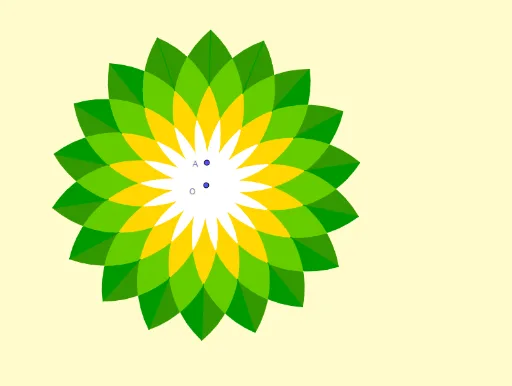
BP标志
几何画板及绘图内容加载中,请稍等……
这个GeoGebra范例演示了BP标志的几何构造。涉及的核心数学概念包括向量、旋转、椭圆和对称性。通过使用Circle, Vector, Rotate, Line, LineBisector, OrthogonalLine, Intersect, Midpoint, CircleArc, Mirror, Segment, Polygon, Sequence等命令,构造了标志的几何形状。适合用于高中几何教学或学生练习几何作图。
GeoGebra 命令及参数
Circle(O, A) → cVector(O, A) → uRotate(E, (-(20°)), O) → E'Circle(O, E) → dRotate(E', (-(20°)), O) → E''Rotate(E'', (-(20°)), O) → E'''Rotate(E''', (-(20°)), O) → FRotate(F, (-(20°)), O) → F'Circle(O, D) → pLine(E, O) → gCircle(O, B) → rCircle(O, C) → sLineBisector(O, E) → lOrthogonalLine(E'', l) → kIntersect(k, l) → GIntersect(p, l) → I, JMidpoint(I, G) → HVector(G, H) → vCircleArc(K, E, O) → eRotate(e, (-(20°)), O) → e'Rotate(e', (-(20°)), O) → e''Mirror(e, g) → e'_1Rotate(e'', (-(20°)), O) → e'''Rotate(e''', (-(20°)), O) → hRotate(h, (-(20°)), O) → h'Rotate(h', (-(20°)), O) → h''Rotate(h'', (-(20°)), O) → h'''Rotate(h''', (-(20°)), O) → fRotate(f, (-(20°)), O) → f'Rotate(f', (-(20°)), O) → f''Rotate(f'', (-(20°)), O) → f'''Rotate(f''', (-(20°)), O) → qRotate(q, (-(20°)), O) → q'Rotate(q', (-(20°)), O) → q''Rotate(q'', (-(20°)), O) → q'''Rotate(q''', (-(20°)), O) → tRotate(e, 20°, O) → e'_2Rotate(e'_1, 20°, O) → c_1Rotate(e'_1, (-(20°)), O) → d_1Intersect(e'_1, e') → L, M, ,Intersect(e'_1, e'') → N, P, ,Intersect(c_1, e'') → Q, R, ,Intersect(e''', e'_1) → S, T, ,Intersect(c_1, e) → W, Z, ,CircleArc(K, W, O) → e_1Rotate(e_1, (-(20°)), O) → f_1Line(W, O) → iMirror(e_1, i) → g_1Mirror(e_1, g) → h_1Mirror(K, g) → K'Line(E', O) → jCircle(O, T) → s_1Intersect(s_1, e'') → A_1, , ,Segment(A_1, T) → mMirror(T, m) → T'Mirror(N, g) → N'_1Mirror(T, g) → T'_1CircleArc(K, N'_1, T'_1) → k_1Mirror(k_1, g) → p_1Polygon(T, A_1, N) → t1, n, t_1, a_1Mirror(p_1, j) → q_1Mirror(T, g) → T'_2Mirror(T, g) → T'_3Mirror(A_1, g) → C_1Mirror(N, g) → N'_2Polygon(T'_3, C_1, N'_2) → t1', n'_2, t'_3, aMirror(q_1, g) → r_1Mirror(T, m) → T'_4Mirror(A_1, m) → D_1Mirror(N, m) → N'_3Mirror(N, m) → N'_4Mirror(T, m) → T'_5Mirror(N, m) → N'_5Mirror(T, m) → T'_6Mirror(N, m) → N'Mirror(T'_4, g) → B_1Mirror(D_1, g) → E_1Mirror(N'_3, g) → F_1Rotate(k_1, (-(20°)), O) → e_2Mirror(e_2, g) → f_2Rotate(T'_3, (-(20°)), O) → G_1Rotate(C_1, (-(20°)), O) → H_1Rotate(N'_2, (-(20°)), O) → I_1Polygon(G_1, H_1, I_1) → t1'', n_1, g_2, h_2Rotate(F_1, (-(20°)), O) → J_1Rotate(B_1, (-(20°)), O) → K_1Rotate(B_1, 20°, O) → N_1Rotate(E_1, 20°, O) → O_1Rotate(F_1, 20°, O) → P_1Rotate(B_1, (-(20°)), O) → Q_1Rotate(E_1, (-(20°)), O) → R_1Rotate(F_1, (-(20°)), O) → S_1Rotate(r_1, 20°, O) → c_3Rotate(k_1, 20°, O) → d_3Rotate(T'_3, 20°, O) → T_1Rotate(C_1, 20°, O) → U_1Rotate(N'_2, 20°, O) → V_1Polygon(T_1, U_1, V_1) → t1''_1, v_1, a_2, u_1Rotate(e_1, 20°, O) → e_3Rotate(g_1, 20°, O) → f_3Mirror(e_3, g) → g_3Mirror(f_3, g) → h_3Mirror(d_3, g) → k_3Mirror(T_1, g) → W_1Mirror(U_1, g) → Z_1Mirror(V_1, g) → A_2Polygon(W_1, Z_1, A_2) → t3, b_2, w_1, z_1Mirror(N_1, g) → B_2Mirror(O_1, g) → C_2Mirror(P_1, g) → D_2Rotate(q_1, (-(20°)), O) → q_3Circle(O, S_1) → s_3Mirror(e_2, i) → c_2Sequence(Rotate[d_1, ((20 * λ))°, O], λ, 1, 18) → l1Sequence(Rotate[h_3, ((20 * β))°, O], β, 1, 16) → l2Rotate(l2, 20°, O) → l2'Sequence(Rotate[g_3, ((-((20 * α))))°, O], α, 1, 16) → l3Sequence(Rotate[q_3, ((-20 * β))°, O], β, 1, 16) → l4Sequence(Rotate[k_3, ((-20 * β))°, O], β, 1, 16) → l5Sequence(Polygon[Rotate[W_1, ((-20 * β))°, O], Rotate[Z_1, ((-20 * β))°, O], Rotate[A_2, ((-20 * β))°, O]], β, 1, 16) → l6LineBisector(S_1, A_1) → bOrthogonalLine(E''', b) → i_1Intersect(i_1, b) → UCircleArc(U, A_1, S_1) → d_2Mirror(d_2, g) → k_2Rotate(k_2, (-(20°)), O) → p_2Sequence(Rotate[k_2, ((-((20 * β))))°, O], β, 1, 19) → l7Sequence(Rotate[d_2, ((-((20 * β))))°, O], β, 1, 19) → l8Rotate(S_1, (-(20°)), O) → VPolygon(A_1, S_1, V) → t2, v_2, j_1, l_1Sequence(Polygon[Rotate[A_1, ((-((20 * α))))°, O], Rotate[S_1, ((-((20 * α))))°, O], Rotate[V, ((-((20 * α))))°, O]], α, 1, 19) → l9Segment(E, I_1) → m_1Sequence(Segment[Rotate[E, ((-((20 * θ))))°, O], Rotate[I_1, ((-((20 * θ))))°, O]], θ, 1, 19) → l10