
角度大小比较与分类
几何画板及绘图内容加载中,请稍等……
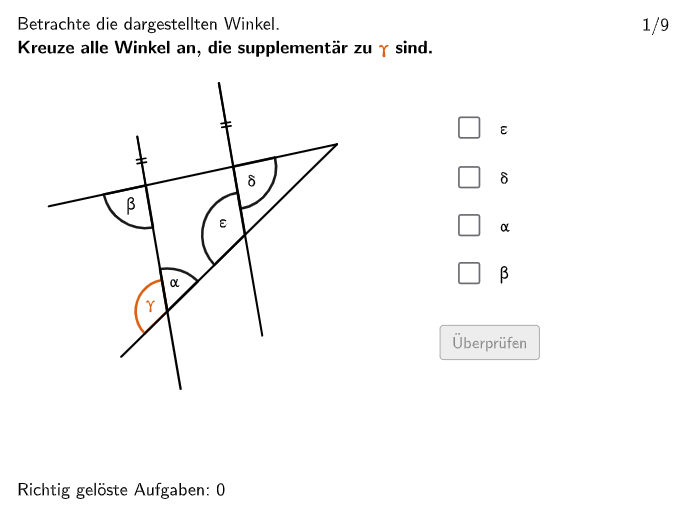
本范例演示如何比较和分类不同角度的大小,包括锐角、直角、钝角、平角、优角和全角。涉及的核心数学概念是角度的度量及其分类。作图要点包括使用GeoGebra命令如Join, SelectedIndex, Element, If, KeepIf, Zip, Point, Textfield, Polygon, Shuffle, Append, Remove, Angle, Sort等来创建和操作角度对象。适合小学5-6年级学生使用,用于教学和练习角度分类及度量。
GeoGebra 命令及参数
Join(Sequence[Shuffle[Sequence[1, maxexnum]], m, 1, floor(110 / maxexnum)]) → listExNumsSelectedIndex(DropDown2Alt) → input2bSelectedIndex(DropDown2) → input2aElement(listwinkelart(exnum), 2) → winkelart2SelectedIndex(DropDown1Alt) → input1bSelectedIndex(DropDown1) → input1aElement(listwinkelart(exnum), 1) → winkelart1If(altDropDown2, input2b, input2a) → input2If(altDropDown1, input1b, input1a) → input1KeepIf(m ≠ 0, m, input0) → input0cleanZip(IndexOf[m, MCPosActual], m, sol0) → sol0realPoint(Line[H3, Vector[OrthogonalVector[Vector[H4, H5]]]]) → H2Textfield(input1) → InputBox1Textfield(input2) → InputBox2Polygon(PtopLeftCornerFeedback, PtopRightCornerFeedback, PbottomRightCornerFeedback, PbottomLeftCornerFeedback) → rectangleCorrect, rectangleCorrectS3, rectangleCorrectS4, rectangleCorrectS2, rectangleCorrectS1Shuffle(Sequence[Random[0, 10], i, 1, 100]) → randomNosForX, {4, 9, 5, 3, 10, 10, 3, 7, 9, 0, 9, 5, 4, 7, 8, 6, 8, 7, 10, 10, 10, 2, 10, 8, 10, 8, 3, 6, 5, 5, 10, 4, 2, 7, 9, 7, 9, 9, 0, 7, 7, 5, 0, 0, 0, 8, 7, 8, 8, 0, 1, 6, 9, 1, 5, 4, 4, 1, 8, 9, 5, 10, 8, 9, 4, 8, 2, 8, 3, 7, 0, 5, 0, 9, 5, 2, 5, 4, 10, 7, 2, 9, 9, 0, 5, 7, 8, 1, 1, 4, 8, 10, 0, 7, 8, 3, 9, 0, 6, 0}Element(randomNosForX, Mod[questionCount, 100] + 1) → numXShuffle(Sequence[Random[0, 10], i, 1, 100]) → randomNosForY, {4, 6, 6, 0, 10, 8, 10, 9, 8, 3, 7, 1, 3, 7, 3, 3, 1, 5, 10, 2, 3, 2, 8, 6, 0, 9, 0, 6, 0, 5, 5, 7, 8, 1, 0, 9, 3, 6, 10, 10, 8, 5, 10, 9, 1, 0, 7, 6, 7, 0, 4, 4, 4, 5, 10, 8, 1, 0, 10, 5, 8, 6, 2, 9, 5, 10, 3, 2, 4, 10, 9, 1, 6, 2, 10, 1, 2, 8, 7, 5, 10, 2, 2, 9, 7, 7, 9, 9, 1, 1, 10, 2, 8, 8, 9, 8, 1, 8, 4, 4}Element(randomNosForY, Mod[questionCount, 100] + 1) → numYAppend(true, Sequence[If[randomNosForX(i) ≟ randomNosForX(i - 1), false, true], i, 2, 100]) → stayXAppend(true, Sequence[If[randomNosForY(i) ≟ randomNosForY(i - 1), false, true], i, 2, 100]) → stayYRemove(Sequence[If[stayX(i), randomNosForX(i), 0], i, 1, 100], Sequence[0, i, 1, 100]) → randomNosForXwithoutRepeatRemove(Sequence[If[stayY(i), randomNosForY(i), 0], i, 1, 100], Sequence[0, i, 1, 100]) → randomNosForYwithoutRepeatElement(randomNosForXwithoutRepeat, Mod[questionCount, Length[randomNosForXwithoutRepeat]] + 1) → numXwithoutRepeatElement(randomNosForYwithoutRepeat, Mod[questionCount, Length[randomNosForYwithoutRepeat]] + 1) → numYwithoutRepeatPoint(Line[F3, Vector[F5, F4]]) → F2Point(Line[G4, Vector[OrthogonalVector[Vector[G6, G7]]]]) → G3Point(Segment[G6, G7]) → G5Point(Line[H2, Vector[OrthogonalVector[Vector[H4, H6]]]]) → H1Point(Line[C6, xAxis]) → C5Point(Line[C6, yAxis]) → C8Point(Line[E1, xAxis]) → E3Point(Line[E5, xAxis]) → E4Point(Line[E8, Vector[E7, E5]]) → E6Point(Line[E6, xAxis]) → E2Angle(A2, Intersect[Line[A1, A2], Line[A3, A4]], A3) → w1aAngle(A1, A2, A5) → w1bAngle(A2, Intersect[Line[A5, A2], Line[A3, A4]], A3) → w1cAngle(A3, Intersect[Line[A5, A2], Line[A3, A4]], A5) → w1dAngle(A5, Intersect[Line[A5, A2], Line[A3, A4]], A4) → w1eAngle(B1, Intersect[Line[B1, B2], Line[B7, B5]], B7) → w2aAngle(B6, Intersect[Line[B1, B2], Line[B6, B5]], B2) → w2bAngle(B5, Intersect[Line[B1, B2], Line[B7, B5]], B1) → w2cAngle(B4, Intersect[Line[B3, B4], Line[B6, B5]], B5) → w2dAngle(B3, Intersect[Line[B3, B4], Line[B7, B5]], B7) → w2eAngle(C6, Intersect[Line[C1, C2], Line[C6, C5]], C1) → w3aAngle(C2, Intersect[Line[C2, C1], Line[C8, C7]], C8) → w3bAngle(C8, Intersect[Line[C2, C1], Line[C8, C7]], C1) → w3cAngle(C1, Intersect[Line[C2, C1], Line[C8, C7]], C7) → w3dAngle(C2, Intersect[Line[C2, C1], Line[C3, C4]], C4) → w3eAngle(E7, Intersect[Line[E1, E3], Line[E7, E5]], E1) → w5aAngle(E3, Intersect[Line[E1, E3], Line[E8, E6]], E8) → w5bAngle(E1, Intersect[Line[E1, E3], Line[E8, E6]], E6) → w5cAngle(E4, Intersect[Line[E5, E4], Line[E7, E5]], E7) → w5dAngle(E8, Intersect[Line[E8, E6], Line[E2, E6]], E2) → w5eAngle(F5, Intersect[Line[F4, F5], Line[F6, F1]], F6) → w6aAngle(F4, Intersect[Line[F4, F5], Line[F6, F1]], F1) → w6bAngle(F1, Intersect[Line[F4, F5], Line[F6, F1]], F5) → w6cAngle(F3, Intersect[Line[F2, F3], Line[F6, F1]], F6) → w6dAngle(F6, Intersect[Line[F2, F3], Line[F6, F1]], F2) → w6eAngle(G5, Intersect[Line[G2, G4], Line[G1, G5]], G2) → w7aAngle(G4, Intersect[Line[G2, G4], Line[G1, G5]], G5) → w7bAngle(G3, Intersect[Line[G2, G4], Line[G4, G3]], G2) → w7cAngle(G6, Intersect[Line[G7, G6], Line[G3, G4]], G4) → w7dAngle(G3, Intersect[Line[G7, G5], Line[G3, G4]], G6) → w7eAngle(G1, G5, G7) → w7fAngle(G7, G5, G6) → w7gAngle(H2, Intersect[Line[H2, H3], Line[H4, H5]], H5) → w8aAngle(H2, Intersect[Line[H2, H3], Line[H6, H4]], H6) → w8bAngle(H5, Intersect[Line[H2, H1], Line[H4, H5]], H1) → w8cAngle(H2, Intersect[Line[H2, H1], Line[H4, H6]], H6) → w8dAngle(H6, Intersect[Line[H2, H1], Line[H4, H6]], H1) → w8eAngle(H5, H4, H6) → w8fAngle(H3, H2, H1) → w8gKeepIf(IndexOf[M, listwinkelnames] ≠ listwinkel(exnum), M, listwinkelnames) → listwinkelnamesextraZip(Length[m], m, listsol0) → listNumCorrectAnswersJoin({{sol0(1)}, {RandomElement[Sequence[1, 4] \ RemoveUndefined[{sol0(1), sol0(2)}]]}}) → MCSwapZip(If[a ∈ MCSwap, RandomElement[MCSwap \ {a}], a], a, MCPosActual) → MCPosNextSort({option1, option2, option3, option4}, MCPosActual) → optionsrealZip(listwinkelnamesextra(m), m, MCPosActual) → listwinkelnamesActual
AI 绘图提示语参考
请绘制一个展示不同角度分类的图形。图形应包含锐角、直角、钝角、平角、反射角和完整角等关键角度对象。这些角度可以通过连接相应点并标注类型来呈现。构造顺序为:先绘制基础点,然后连接点形成角度,再添加标注说明角度分类。图形应清晰直观,适合教学使用。
以上提示语为根据原始绘图命令整理而来,仅供参考。