
快速十位加法练习(第二版)
几何画板及绘图内容加载中,请稍等……
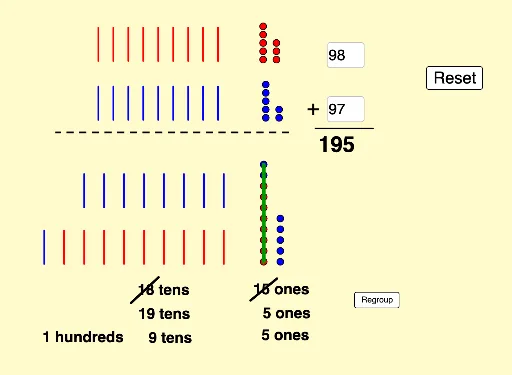
① 本范例通过可视化十位分组(Quick Tens)的方式,演示两位数加法的竖式与位值概念,帮助学习者直观理解进位过程。② 核心数学概念包括位值(个位、十位)、加法进位、十进制计数系统,以及通过图形化表示(如点阵、平片)强化数感。③ 作图要点:使用GeoGebra的Sequence、Flatten、Textfield、Mod、Segment等命令构建可交互界面,包含水平/垂直间距、点阵、平片等对象,并设置输入框(InputBox1/2)接收两个加数,通过Mod命令拆分个位和十位,利用多个数组(如destinationarraydotsbig、smallarrayfirstbig等)动态显示结果,还包含重置按钮(Reset)和显示控制(showfirstones等)。④ 适合小学低年级(如一年级下学期至二年级)数学教学,也可用于家长辅导或学生自主练习,通过动手操作理解加法进位原理。
GeoGebra 命令及参数
Sequence(Sequence[(x(A) + (i * horizontalspacing), y(A) + (j * verticalspacing)), j, 0, verticaldots - 1], i, 0, horizontaldots - 1) → destinationarraydotsbigFlatten(destinationarraydotsbig) → destinationonesflatTextfield(firsttext) → InputBox1Textfield(secondtext) → InputBox2Mod(firstnumber, 10) → firstonesMod(secondnumber, 10) → secondonesSequence(Sequence[(x(B) + (i * smallhorizontalspacing), y(B) + (j * smallverticalspacing)), j, 0, smallverticaldots - 1], i, 0, smallhorizontaldots - 1) → smallarrayfirstbigSequence(Sequence[(x(C) + (i * smallhorizontalspacing), y(C) + (j * smallverticalspacing)), j, 0, smallverticaldots - 1], i, 0, smallhorizontaldots - 1) → smallarraysecondbigFlatten(smallarrayfirstbig) → smallonesfirstflatFlatten(smallarraysecondbig) → smallonessecondflatSequence(Element[smallonesfirstflat, i], i, 1, firstones) → showfirstonesSequence(Element[smallonessecondflat, i], i, 1, secondones) → showsecondonesSequence(Sequence[(x(D) - (i * smalltenswidth), y(D) + (j * smalltensheight)), j, 0, smalltensrows - 1], i, 0, smalltenscolumns - 1) → smalltensfirstbigSequence(Sequence[(x(E) - (i * smalltenswidth), y(E) + (j * smalltensheight)), j, 0, smalltensrows - 1], i, 0, smalltenscolumns - 1) → smalltenssecondbigFlatten(smalltensfirstbig) → smalltensfirstflatFlatten(smalltenssecondbig) → smalltenssecondflatSequence(Segment[Element[smalltensfirstflat, (2 * i) + 1], Element[smalltensfirstflat, (2 * i) + 2]], i, 0, firsttens - 1) → showfirsttensSequence(Segment[Element[smalltenssecondflat, (2 * i) + 1], Element[smalltenssecondflat, (2 * i) + 2]], i, 0, secondtens - 1) → showsecondtensFlatten(Sequence[Sequence[(x(F) - (i * destinationtenswidth), y(F) + (j * destinationtensheight)), i, 0, destinationtenscolumns - 1], j, 0, destinationtensrows - 1]) → destinationtensflatSequence(Translate[Element[showfirstones, i], Vector[(Vector[Element[smallonesfirstflat, i], Element[destinationonesflat, i]] * slideit)]], i, 1, firstones) → swooponesfirstSequence(Translate[Element[showsecondones, i], Vector[(Vector[Element[smallonessecondflat, i], Element[destinationonesflat, i + firstones]] * slideit)]], i, 1, secondones) → swooponessecondSegment(G, H) → fSegment(I, J) → gMod(total, 10) → totalonesMod(total, 10) → finalonesSegment(Element[destinationonesflat, 1], Element[destinationonesflat, (10 * regroupit)]) → hSegment(K, L) → iSegment(M, N) → jSequence(Vector[Element[smalltensfirstflat, (2 * i)], Element[destinationtensflat, i]], i, 1, firsttens) → slidefirsttensvectorsSequence(Vector[Element[smalltenssecondflat, (2 * i)], Element[destinationtensflat, i + firsttens]], i, 1, secondtens) → slidesecondtensvectorsSequence(Translate[Element[showfirsttens, i], Vector[(Element[slidefirsttensvectors, i] * slideit)]], i, 1, firsttens) → swooptensfirstSequence(Translate[Element[showsecondtens, i], Vector[(Element[slidesecondtensvectors, i] * slideit)]], i, 1, secondtens) → swooptenssecond