
Zhao Shuang String Diagram: A Classic Geometric Proof of the Pythagorean Theorem
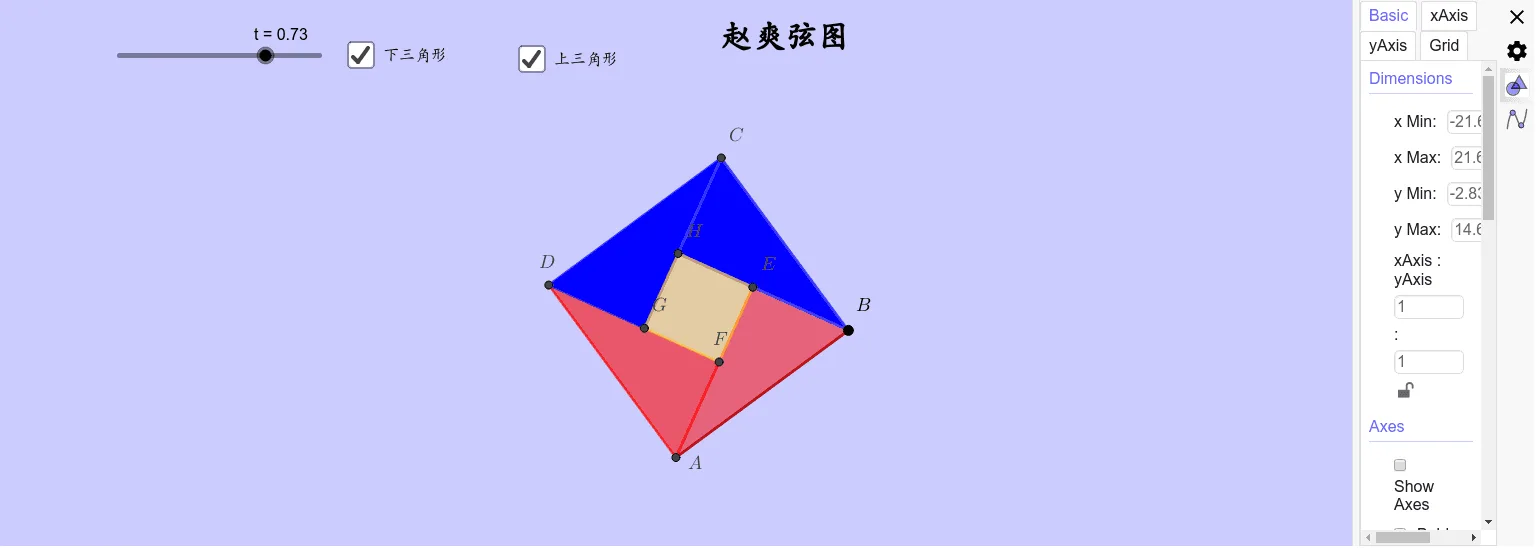
This GeoGebra applet demonstrates the String Diagram (弦图), an elegant geometric construction originally created by the ancient Chinese mathematician Zhao Shuang as a visual proof of the Pythagorean theorem. The applet guides students through the process of assembling four congruent right triangles together with a central small square to form a large outer square. By manipulating the parameters—such as the leg lengths a and b of the right triangles—learners can observe how the pieces rearrange while preserving area relationships. The core insight is that the area of the large square can be expressed in two ways: either as c², where c is the hypotenuse of the right triangle, or as the sum of the areas of the four congruent right triangles plus the area of the central small square. This dual accounting leads directly to the fundamental identity a² + b² = c², beautifully bridging algebraic reasoning with geometric intuition. The applet also allows users to explore variations, such as adjusting the dimensions of the triangles to see how the diagram adapts dynamically. This makes it an excellent interactive teaching tool for deepening students understanding of the Pythagorean theorem, area-based proofs, and the timeless mathematical wisdom embedded in ancient Chinese geometry. It serves as a perfect illustration of the unity between numbers and shapes, embodying the 数形结合思想 that is central to mathematical thinking.
In collections
Lumei Junior High Geometry Models
Loading the math board and drawing, please wait…