
Volume of a Rectangular Prism
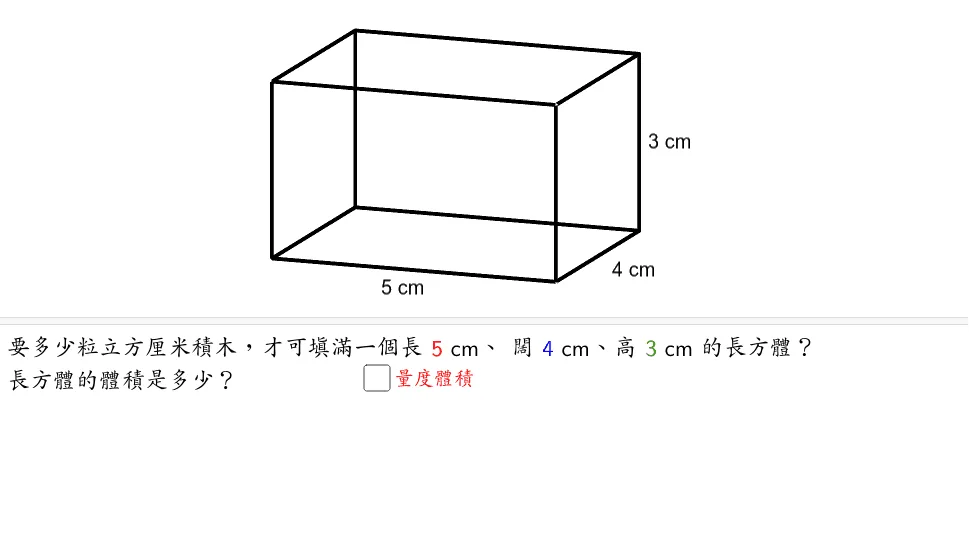
This GeoGebra example demonstrates the volume calculation of a rectangular prism (cuboid) through 3D visualization. Using commands such as Translate, Vector, and Sequence, it constructs an interactive model with adjustable length (l), width (w), and height (h). Interactive buttons allow users to reveal unit cubes row by row, layer by layer, or all at once, helping learners intuitively grasp the geometric meaning of the volume formula V = l × w × h. By progressively revealing the unit cubes in layers or rows and counting them, the abstract concept of volume is transformed into a visible spatial stacking process. This hands-on exploration enables students to see how length determines the number of cubes per row, width determines the number of rows per layer, and height determines the number of layers, ultimately showing that multiplying these three dimensions gives the total count of unit cubes—the volume. The applet is well suited for立体几何教学 (solid geometry instruction) and inquiry-based learning of volume concepts, allowing teachers and students to experiment with different dimensions and observe in real time how changes in l, w, or h affect the overall volume. It supports multiple pedagogical approaches, including guided discovery, where students predict outcomes before revealing the cubes, and collaborative exploration, where learners compare models with varying dimensions. The combination of adjustable sliders, animated reveals, and immediate visual feedback makes this an effective tool for building deep conceptual understanding rather than rote memorization of the volume formula.
Loading the math board and drawing, please wait…