
Volume Comparison of Pyramids and Prisms
Volume Comparison of Pyramids and Prisms
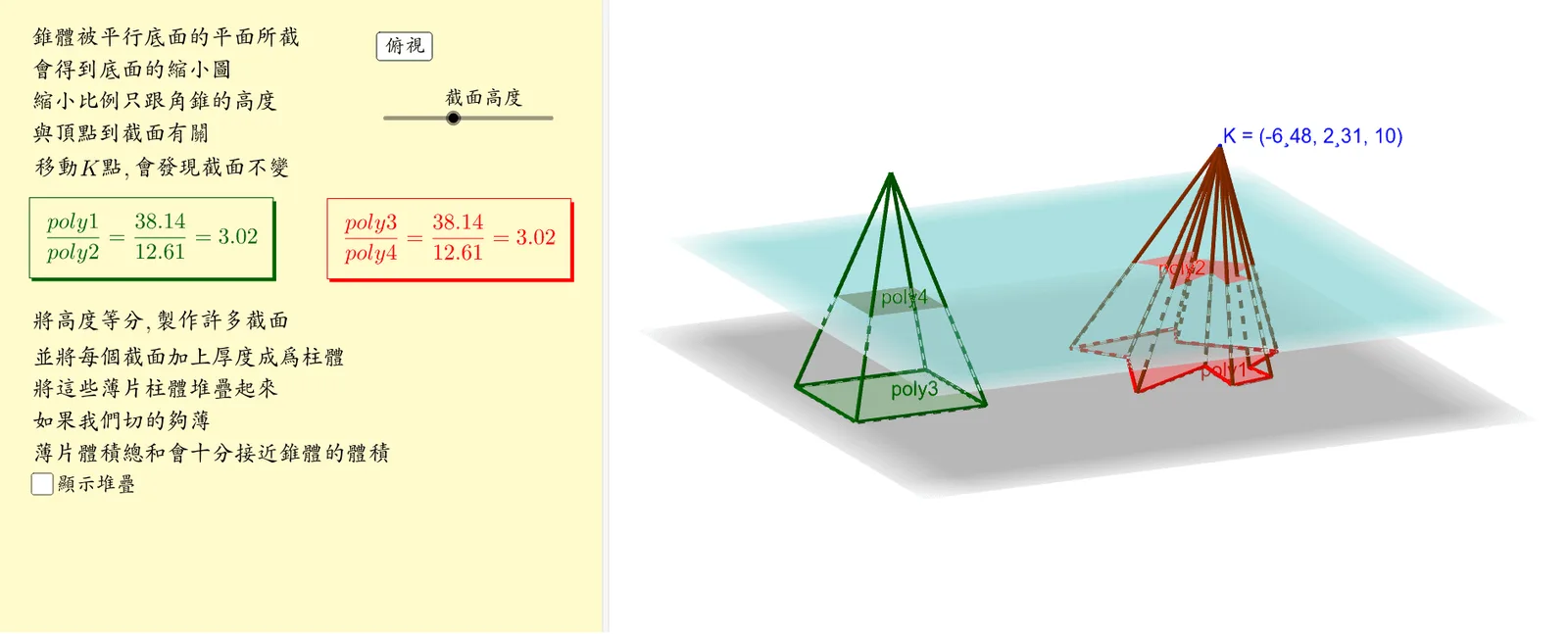
This GeoGebra applet provides an interactive three-dimensional geometric demonstration that visually compares the volumes of pyramids and prisms. Through dynamic 3D construction, users can explore how the volume of a pyramid relates to that of a prism sharing the same base and height, reinforcing the fundamental theorem that a pyramid's volume is exactly one-third of the volume of a prism with identical base area and height.
The applet begins by constructing polygonal bases in the 3D workspace, then extends these bases upward to form both a prism and a pyramid with corresponding vertices. Users can manipulate the position of the apex and modify the shape of the base polygon in real time, observing how these changes affect the resulting volumes while the one-third relationship remains invariant. Orthogonal planes and cross-sectional slices are integrated into the model to provide deeper geometric insight, allowing learners to examine how horizontal cross-sections scale within each solid and why the volume formula for a pyramid takes its characteristic form.
Key interactive features include the ability to toggle the visibility of individual components such as the base, lateral faces, and internal cross-sections, as well as to animate the movement of the pyramid's apex to demonstrate how the volume ratio is preserved regardless of the pyramid's slant. The applet also supports dragging vertices of the base polygon to transform the base from regular polygons to arbitrary convex shapes, further generalizing the result beyond symmetric cases.
This applet is designed for middle school and high school mathematics instruction, offering a powerful visual and kinesthetic tool for solid geometry education. By allowing students to actively engage with the constructions rather than passively observe static diagrams, it strengthens spatial reasoning skills and builds intuitive understanding of volumetric relationships. The dynamic nature of the model makes abstract theorems tangible, helping learners internalize the derivation of the pyramid volume formula through direct exploration. It is particularly effective for classroom demonstrations, self-directed practice, and remedial instruction in立体几何 (solid geometry), serving as a valuable supplement to traditional textbook presentations of volume formulas.
In collections
Volume and Surface Area of Cones and Spheres
Loading the math board and drawing, please wait…