
Visualizing Volume by Cross-Section Problems
Loading the math board and drawing, please wait…
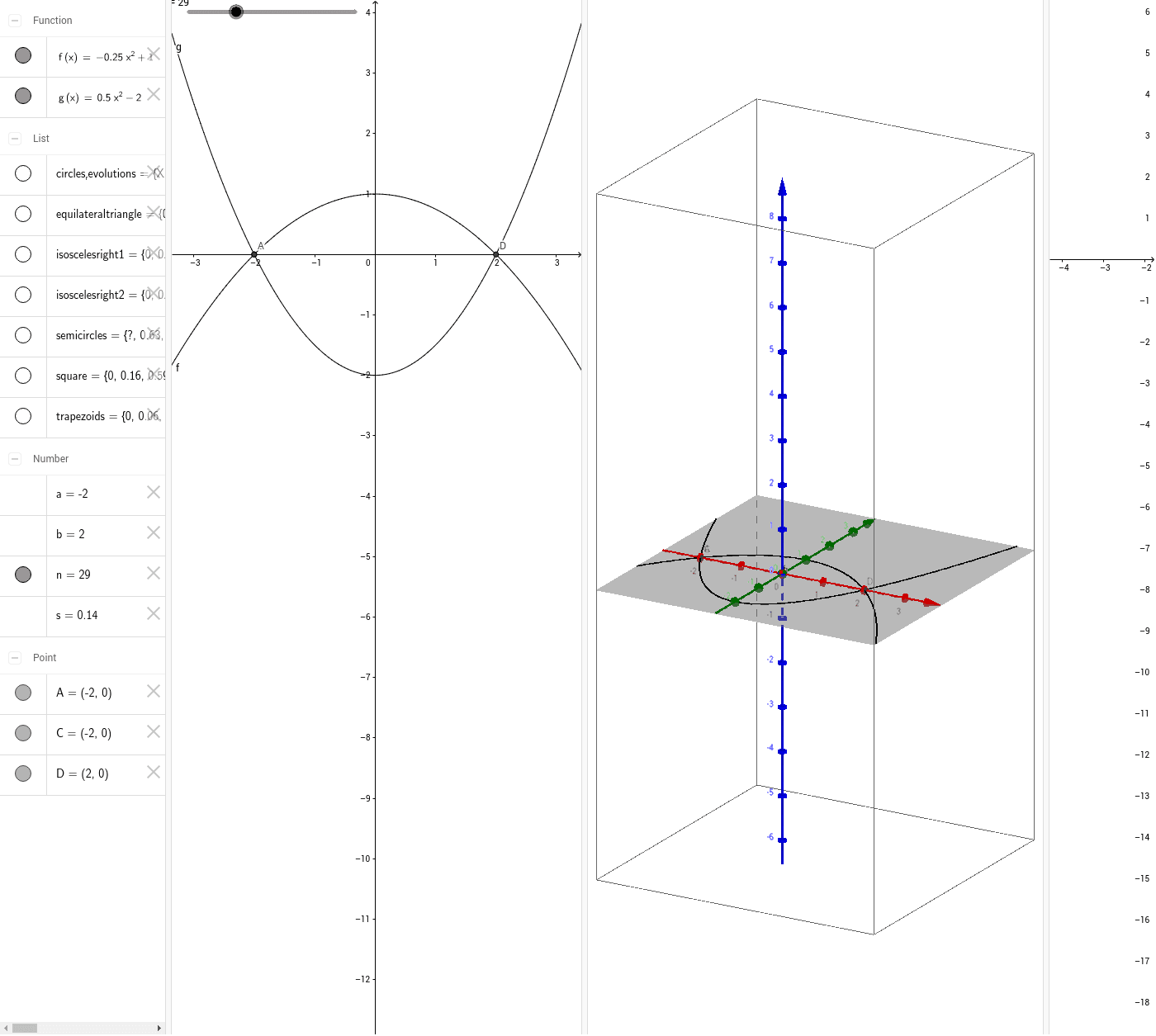
This example demonstrates the visualization of volume calculation using cross-section methods in geometry. It involves core mathematical concepts such as volume computation, coordinate geometry, integration, function graphing, and geometric construction. Key GeoGebra commands and objects used include Intersect, Sequence, and various geometric shapes like squares, isosceles right triangles, equilateral triangles, trapezoids, and circles. It is suitable for high school and above, particularly for teaching solid geometry and calculus with a focus on visualization and understanding.
GeoGebra Commands & Parameters
Intersect(f, g) → C, DIntersect(f, g, 1) → ASequence(Polygon[(i, f(i), 0), (i, g(i), 0), (i, g(i), f(i) - g(i)), (i, f(i), f(i) - g(i))], i, a, b, s) → squareSequence(Polygon[(i, f(i), 0), (i, g(i), 0), (i, g(i) + (f(i) - g(i)) / 2, (0.5 * (f(i) - g(i))))], i, a, b, s) → isoscelesright1Sequence(Polygon[(i, f(i), 0), (i, g(i), 0), (i, g(i), f(i) - g(i))], i, a, b, s) → isoscelesright2Sequence(Polygon[(i, f(i), 0), (i, g(i), 0), (i, g(i) + (f(i) - g(i)) / 2, (sqrt(3) / 2 * (f(i) - g(i))))], i, a, b, s) → equilateraltriangleSequence(Polygon[(i, f(i), 0), (i, g(i), 0), (i, g(i) + (0.25 * (f(i) - g(i))), (0.5 * (f(i) - g(i)))), (i, g(i) + (0.75 * (f(i) - g(i))), (0.5 * (f(i) - g(i))))], i, a, b, s) → trapezoidsSequence(Circle[(i, f(i), 0), (i, g(i), 0), (i, g(i) + (0.5 * (f(i) - g(i))), (0.5 * (f(i) - g(i))))], i, a, b, s) → circles_revolutionsSequence(Arc[Circle[(i, f(i), 0), (i, g(i), 0), (i, g(i) + (0.5 * (f(i) - g(i))), (0.5 * (f(i) - g(i))))], (i, g(i)), (i, f(i))], i, a, b, s) → semicircles
AI Drawing Prompt Reference
Draw a 3D shape by sequentially constructing different cross-sections along the x-axis from a to b. Start with a series of squares, followed by isosceles right triangles, then equilateral triangles, next trapezoids, and finally semicircles. Each shape's base lies on the x-axis, with heights varying according to functions f(x) and g(x), forming a complex 3D shape.
The prompt above was compiled from the original drawing commands and is for reference only.