
Visualizing Integer Solutions in Linear Programming
Loading the math board and drawing, please wait…
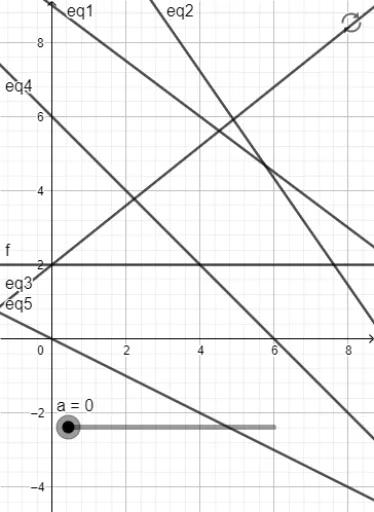
This GeoGebra example demonstrates the process of finding integer solutions in linear programming problems, visually showing the feasible region, objective function, and the optimal integer point. Core mathematical concepts include linear programming, integer constraints, feasible region, objective function level lines, and optimality conditions. Construction details: using objects eq1, eq2, eq3, eq4 to define linear inequality constraints, f as the objective function, a possibly as a parameter or auxiliary object, and eq5 for integer solution conditions or auxiliary equations. Suitable for high school and early college students learning operations research or mathematical modeling, it helps understand the geometric meaning of integer programming beyond the simplex method. It can be used for teacher demonstrations or student self-exploration. By dragging sliders or modifying constraints, users can observe the difference between integer and continuous optimal solutions, deepening understanding of the essence of integer programming.
GeoGebra Commands & Parameters
(3 * x) + (4 * y) = 36(13 * x) + (9 * y) = 117(5 * y) - (4 * x) = 10(5 * x) + (5 * y) = 30y = 2Numeric a(0)x + (2 * y) = a