
Visualizing Arithmetic Sequence Sum
Loading the math board and drawing, please wait…
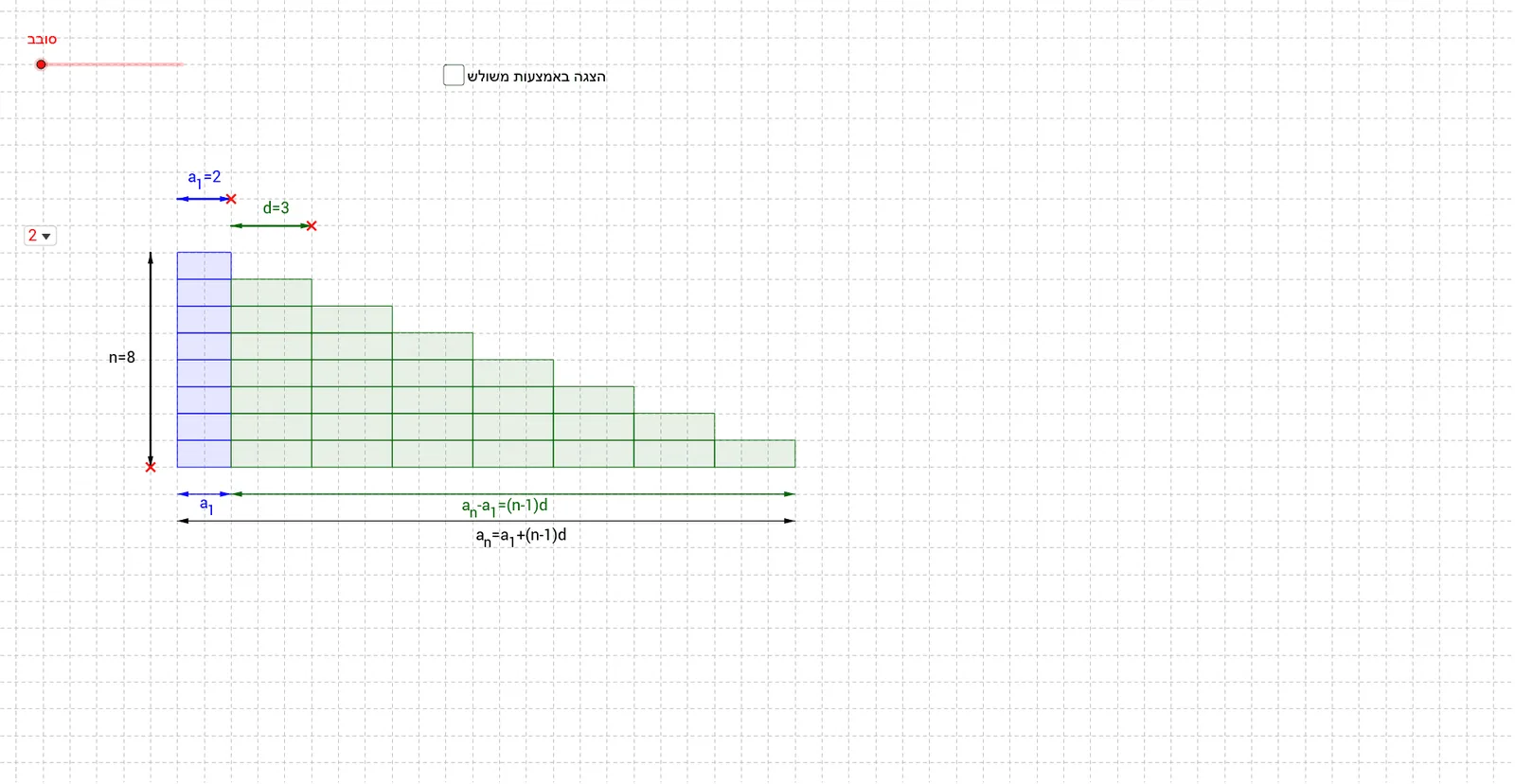
① This example demonstrates the sum of an arithmetic sequence through geometric visualization, turning the algebraic formula into an intuitive area or shape arrangement. ② Core mathematical concepts include arithmetic sequences, their common difference, first term, number of terms, and the correspondence between the sum and geometric areas (like trapezoids or rectangles). ③ Construction highlights: from the summary, it uses GeoGebra commands such as Point, Segment, Polygon, Vector, Sequence, Rotate, and Zip, creating multiple points, segments, polygons, and vectors, with sequences and rotations to arrange shapes, and polygon areas representing the sum, plus text objects displaying the formula. ④ Suitable for middle or high school students learning arithmetic sequences, and for teachers to illustrate the geometric meaning of the summation formula in class.
GeoGebra Commands & Parameters
Point(Segment[(-1, -1), (-1, -10)]) → ASegment((-1, 0), A) → nPoint(Segment[(0, 2), (4, 2)]) → BPoint(Segment[(x(B), 1), (x(B) + 5, 1)]) → CSegment((x(B), 1), (x(C), 1)) → dSegment((0, 2), B) → a_1Polygon((0, 0), ((2 * a_1) + ((n - 1) * d), (-n)), (0, (-n))) → poly1, a, b, cVector((-1, 0), A) → kVector(A, (-1, 0)) → lSequence(Polygon[(0, (-k)), (0, (-k) - 1), (a_1, (-k) - 1), (a_1, (-k))], k, 0, n - 1) → list1Vector((0, 2), (x(B), 2)) → wVector((x(B), 2), (0, 2)) → jVector((x(B), 1), (x(C), 1)) → w_1Vector((x(C), 1), (x(B), 1)) → c_1Vector((a_1, (-n) - 1), (0, (-n) - 1)) → pVector((0, (-n) - 1), (a_1, (-n) - 1)) → mVector((a_1, (-n) - 1), (a_1 + ((n - 1) * d), (-n) - 1)) → qVector((a_1 + ((n - 1) * d), (-n) - 1), (a_1, (-n) - 1)) → rVector((a_1 + ((n - 1) * d), (-n) - 1), ((2 * a_1) + ((n - 1) * d), (-n) - 1)) → sVector(((2 * a_1) + ((n - 1) * d), (-n) - 1), (a_1 + ((n - 1) * d), (-n) - 1)) → tVector((0, (-n) - 2), (a_1 + ((n - 1) * d), (-n) - 2)) → uVector((a_1 + ((n - 1) * d), (-n) - 2), ((2 * a_1) + ((n - 1) * d), (-n) - 2)) → u_1Vector((a_1 + ((n - 1) * d), (-n) - 2), (0, (-n) - 2)) → vVector(((2 * a_1) + ((n - 1) * d), (-n) - 2), (a_1 + ((n - 1) * d), (-n) - 2)) → v_1Polygon((0, 0), Intersect[x = Length[a_1], a], (a_1, 0)) → poly2, e_1, f_1, g_1Rotate(poly2, (-α), (a_1 + ((0.5 * d) * (n - 1)), (-0.5 * n))) → poly2'Rotate(list1, (-α), (a_1 + ((0.5 * d) * (n - 1)), (-0.5 * n))) → list1'Zip(Sequence[Polygon[(a_1 + (d * (i - 1)), (-W)), (a_1 + (d * (i - 1)), (-W) - 1), (a_1 + (d * i), (-W) - 1), (a_1 + (d * i), (-W))], i, 1, W], W, Sequence[k, k, 0, Length[n] - 1]) → list2Rotate(list2, (-α), (a_1 + ((0.5 * d) * (n - 1)), (-0.5 * n))) → list2'Sequence(If[f(a_1 + ((k - 1) * d)) < (-k), Polygon[(a_1 + ((k - 1) * d), (-k)), (a_1 + (k * d), (-k)), (a_1 + (k * d), f(a_1 + (k * d))), (a_1 + ((k - 1) * d), f(a_1 + ((k - 1) * d)))], If[f(a_1 + (k * d)) < (-k), Polygon[Intersect[f, y = (-k)], (a_1 + (k * d), (-k)), (a_1 + (k * d), f(a_1 + (k * d)))]]], k, 1, n - 1) → list3Sequence(a_1 + ((i - 1) * d), i, 1, n) → list4Rotate(list3, (-α), (a_1 + ((0.5 * d) * (n - 1)), (-0.5 * n))) → list3'
AI Drawing Prompt Reference
Create a geometric visualization of the sum of an arithmetic sequence. Use sliders to control the number of terms, first term, and common difference. Construct a staircase-like region made of unit-width rectangles, each with height equal to a term value. Rotate and arrange these rectangles to form a trapezoid or rectangle, showing the total area equals the sum. Include a polygon whose area represents the sum, along with vectors and text labels indicating the first term, common difference, and number of terms.
The prompt above was compiled from the original drawing commands and is for reference only.