
Unit Circle & Similarity Transformation Demo
Loading the math board and drawing, please wait…
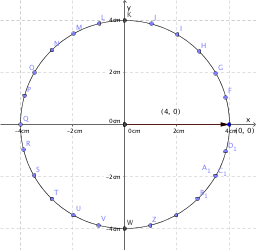
This example demonstrates the geometric relationship between the unit circle and similarity transformations, highlighting the connection between trigonometric functions and vectors. Key math concepts include the unit circle, trigonometry, vectors, similarity transformations, fractal geometry, scalene triangles, and continuity. Construction involves GeoGebra commands like Intersect, Circle, Vector, OrthogonalLine, and Point. Suitable for high school and above, aiding in understanding trigonometry, geometric transformations, and complex numbers.
GeoGebra Commands & Parameters
Intersect(xAxis, yAxis) → ACircle(A, B) → cVector(A, B) → uOrthogonalLine(B, xAxis) → aOrthogonalLine(B, yAxis) → bIntersect(b, yAxis) → CIntersect(xAxis, a) → DVector(C, B) → vVector(D, B) → wIntersect(c, xAxis, 2) → EPoint(c) → FPoint(c) → GPoint(c) → HPoint(c) → IPoint(c) → JIntersect(c, yAxis, 2) → KPoint(c) → LPoint(c) → MPoint(c) → NPoint(c) → OPoint(c) → PPoint(c) → QPoint(c) → RPoint(c) → SPoint(c) → TPoint(c) → UPoint(c) → VIntersect(c, yAxis, 1) → WPoint(c) → ZPoint(c) → A_1Point(c) → B_1Point(c) → C_1Point(c) → D_1
AI Drawing Prompt Reference
Draw a unit circle and demonstrate similarity transformations. Start by drawing the intersection point A of the x-axis and y-axis, then draw the unit circle c with A and B as its center. Next, draw vector u from A to B, and draw perpendicular lines a and b from B to the x-axis and y-axis, respectively, with their intersection points being C and D. Then, draw vector v from C to B and w from D to B. Continue by drawing two points E and F on the unit circle c, and then two points G and H on the x-axis. Next, draw two points I and J on the unit circle c, and then two points K and L on the y-axis. Continue by drawing two points M and N on the unit circle c, and then two points O and P on the x-axis. Next, draw two points Q and R on the unit circle c, and then two points S and T on the y-axis. Then, draw two points U and V on the unit circle c, and then two points W and Z on the x-axis. Finally, draw two points A_1 and B_1 on the unit circle c.
The prompt above was compiled from the original drawing commands and is for reference only.