
Trigonometric Identities and the Unit Circle by Amanda Jensen
Loading the math board and drawing, please wait…
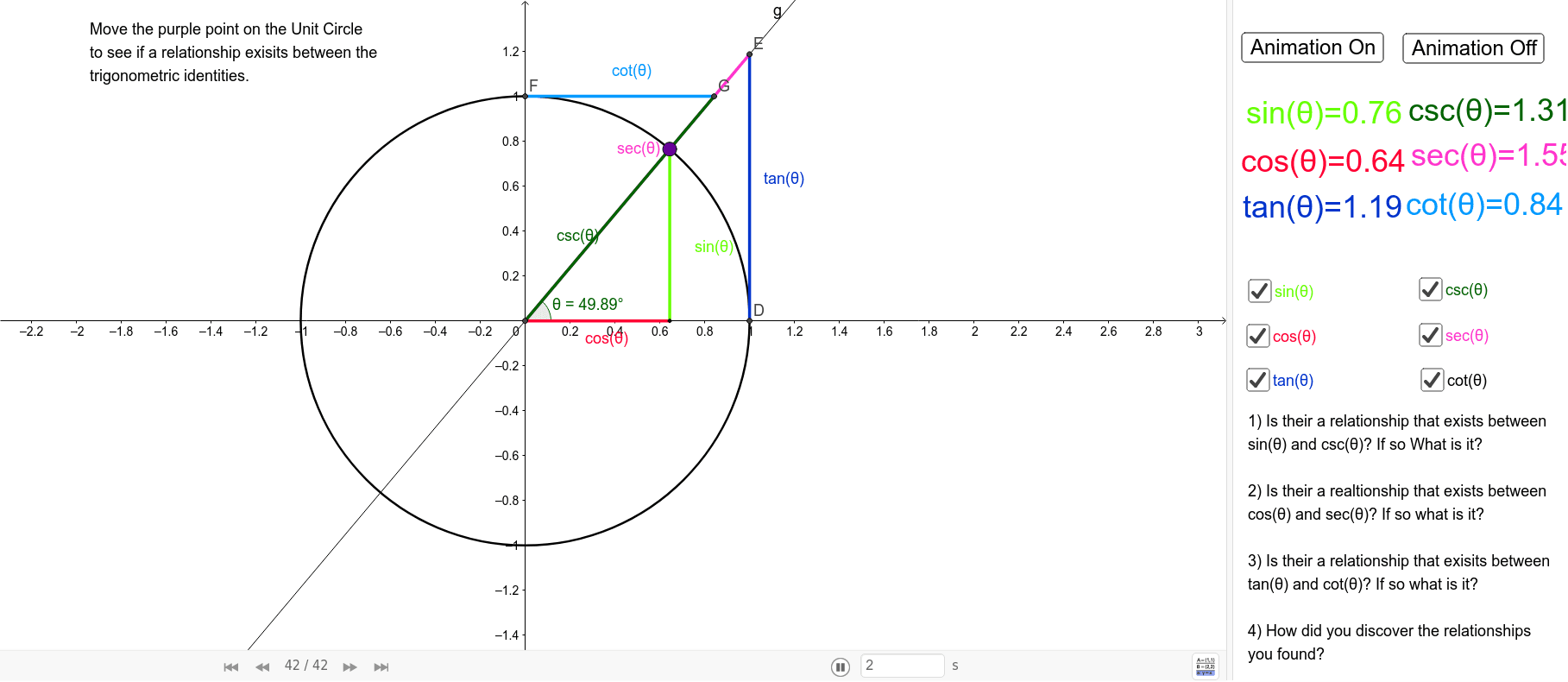
This example demonstrates trigonometric identities using the unit circle. It involves angles, sine, and cosine functions on the unit circle. By constructing circles, lines, tangents, and angles, it illustrates the basic properties of trigonometric functions. Suitable for high school mathematics education and learning.
GeoGebra Commands & Parameters
Intersect(xAxis, yAxis) → ACircle(A, 1) → cPoint(c) → BOrthogonalLine(B, xAxis) → fIntersect(f, xAxis) → CLine(A, B) → gSegment(A, C) → hSegment(B, C) → iTangent(yAxis, c) → j, kIntersect(c, k, 1) → DIntersect(g, k) → ESegment(D, E) → lTangent(xAxis, c) → m, nIntersect(c, m, 1) → FIntersect(g, m) → GSegment(F, G) → pSegment(A, E) → qSegment(A, G) → rAngle(D, A, B) → θ
AI Drawing Prompt Reference
Draw a unit circle and mark point B on it. Draw a perpendicular line from B to the x-axis, intersecting at point C. Connect the center A to points B and C, then connect A to C and B to C. Draw tangents j and k to the circle, touching the x-axis and y-axis, respectively, and intersecting the circle at points D and F. Draw a line g from A, intersecting tangents k and m at points E and G. Connect points D and E, F and G, A and E, and A and G. Finally, mark angle θ.
The prompt above was compiled from the original drawing commands and is for reference only.