
Trigonometric Calculus Derivation by Marius Sandu
Loading the math board and drawing, please wait…
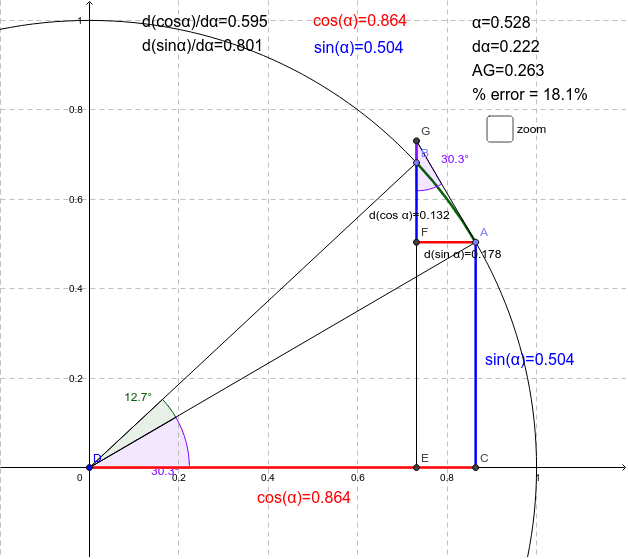
This example demonstrates the geometric derivation of the sine or cosine derivative using infinitesimals. It involves core math concepts like calculus, trigonometric functions, and derivatives. GeoGebra commands used include Circle, Point, Segment, Angle, Rotate, Tangent, Intersect, and CircleArc. Suitable for high school students and educators to understand the geometric meaning of trigonometric derivatives.
GeoGebra Commands & Parameters
Circle((0, 0), 1) → cPoint(c) → ASegment((0, 0), (x(A), 0)) → aSegment(A, (x(A), 0)) → bSegment(A, (0, 0)) → dPoint(c) → BAngle(C, D, A) → αAngle(A, D, B) → dαSegment(B, E) → eRotate(F, (-α), A) → F'Tangent(A, c) → f,Intersect(x = x(B), f) → GSegment(B, G) → gSegment(F, A) → hSegment(A, G) → iCircleArc(D, A, B) → kSegment(D, B) → jSegment(B, F) → lAngle(F, G, A) → β
AI Drawing Prompt Reference
Draw a unit circle centered at the origin with a point on the circle. Connect the origin to the point and the point to the intersection of the circle with the x-axis. Draw a line segment from the point to the origin. Create an angle at the origin with the first two segments. Then create a smaller angle with the point and the segment to the origin. Rotate the smaller angle to match the larger angle. Find the intersection of the tangent at the point with the x-axis and connect the point to this intersection. Finally, draw an arc connecting the origin to the point and label the segments and angles involved.
The prompt above was compiled from the original drawing commands and is for reference only.