
Triangle Inequality Theorem Interactive Exploration
Loading the math board and drawing, please wait…
In collections
Inequalities in a Triangle
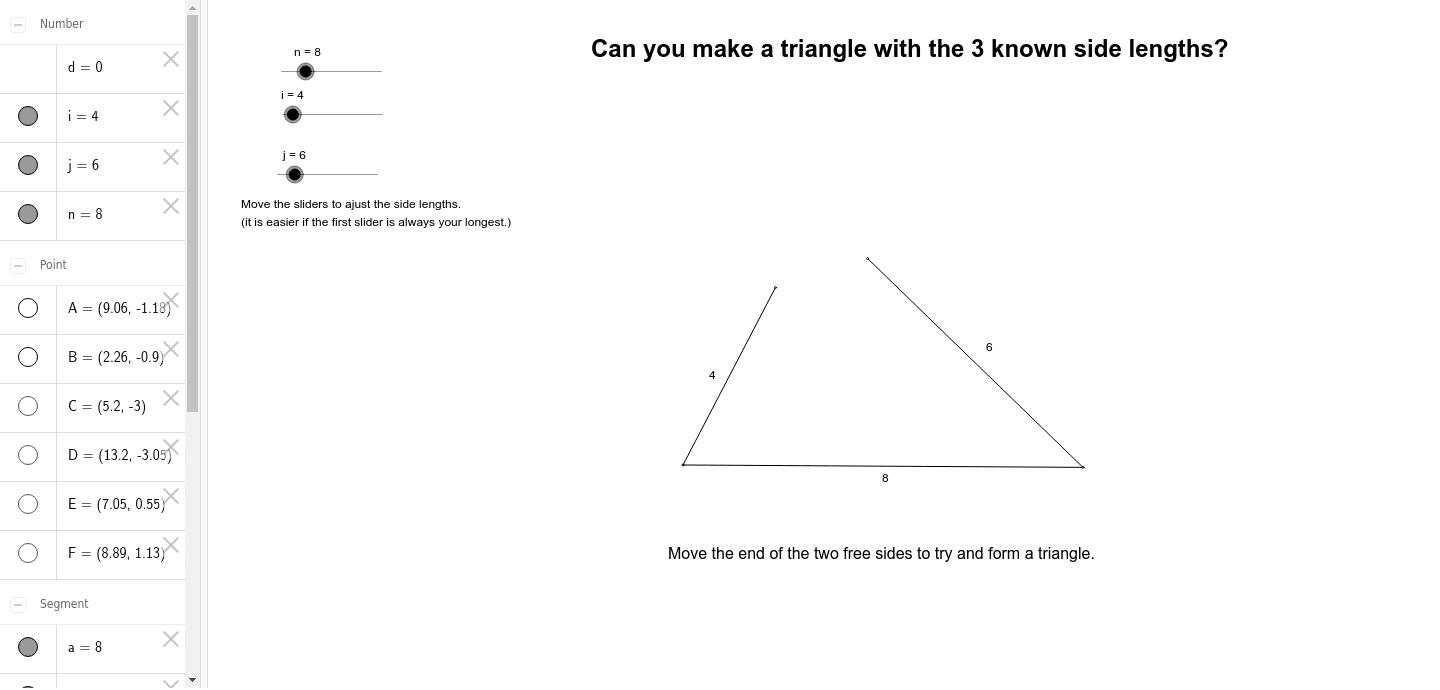
①This example demonstrates the triangle inequality theorem through interactive manipulation, showing that the sum of any two sides of a triangle must be greater than the third side, and the difference of any two sides must be less than the third. ②Core mathematical concepts include triangle properties, distance measurement, and inequality relationships. ③Construction details: using GeoGebra commands Point to create points A, B, C, D, E, F, Segment to construct segments a, b, c, d, Distance to compute side lengths, and sliders n, i, j to adjust point positions or parameters, with text1, text2, text3 displaying side lengths and inequality verification results. ④Suitable for middle school geometry lessons or self-study, helping students intuitively grasp the conditions for forming a triangle and explore how changing side lengths affects the triangle's existence and shape.
GeoGebra Commands & Parameters
Point(Circle[C, n]) → DSegment(C, D) → aPoint(Circle[C, i]) → ESegment(C, E) → bPoint(Circle[D, j]) → FSegment(D, F) → cDistance(b, a) → d
AI Drawing Prompt Reference
Draw a triangle with three points defining its sides. Use sliders to adjust the positions of two points, causing the third side's length to change accordingly. Display text to show whether the sum of any two sides is greater than the third and whether the difference of any two sides is less than the third, verifying the triangle inequality theorem.
The prompt above was compiled from the original drawing commands and is for reference only.