
Transformations, Dilations, and Algebraic Formulas
Loading the math board and drawing, please wait…
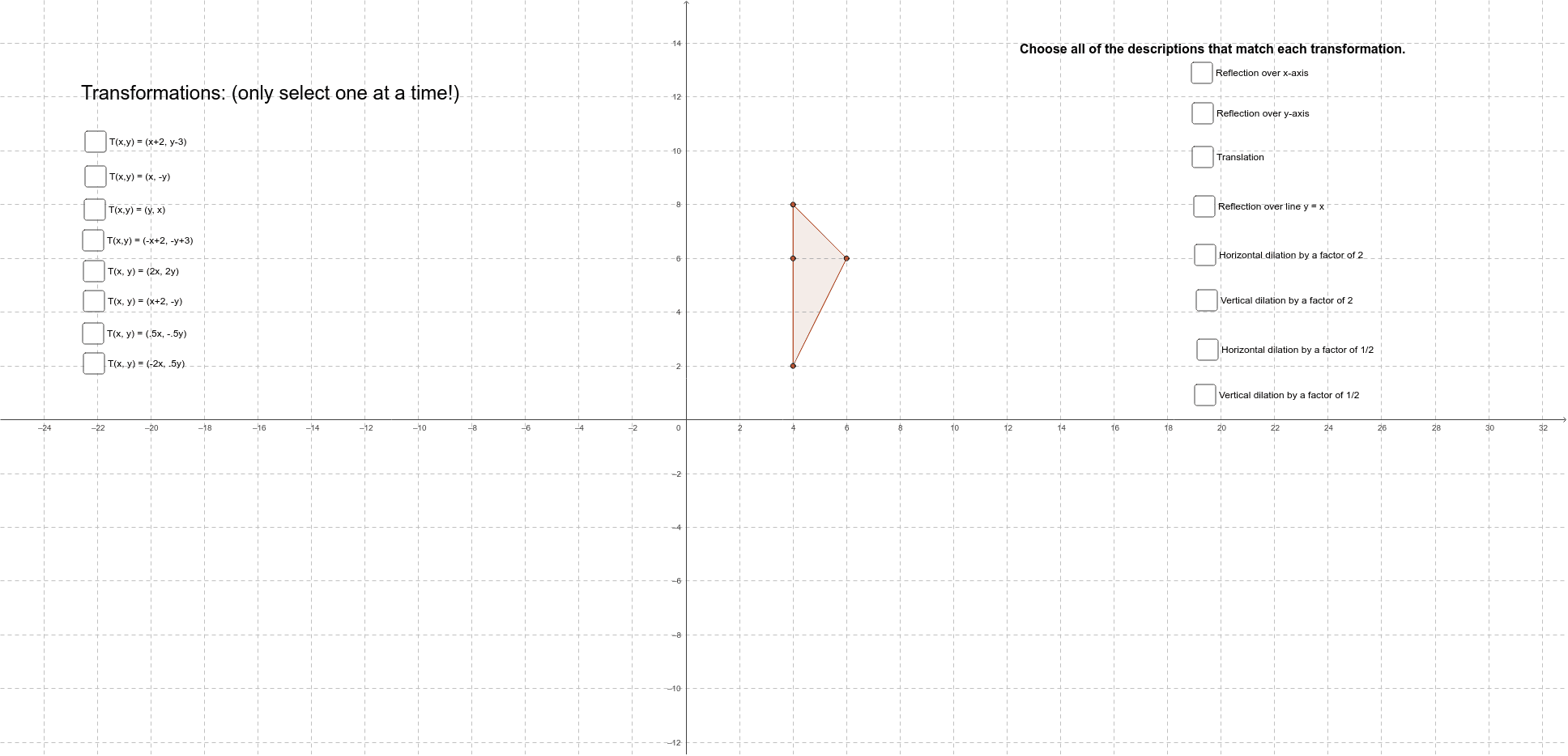
This example demonstrates the relationship between geometric transformations (including dilations) and their algebraic representations. Key concepts include geometric transformations, algebraic expressions, and vectors. Using GeoGebra commands such as Polygon, Vector, and Translate, students can visually understand how these transformations affect the shapes. Suitable for high school geometry and algebra courses.
GeoGebra Commands & Parameters
Polygon(A, D, C, B) → poly1, a, d, c, bVector(A, E) → uTranslate(A, u) → A'Translate(D, u) → D'Translate(C, u) → C'Translate(B, u) → B'Polygon(A', D', C', B') → poly1', a', d', c', b'Polygon(H, I, F, G) → poly2, h_1, i_1, f_1, g_1Polygon(L, M, J, K) → poly3, l_1, m, j_1, k_1Polygon(Q, P, O, N) → poly4, q, p, o, nPolygon(T, S, R, U) → poly5, t, s, r, u_1Polygon(Z, W, V, A_1) → poly6, z, w, v, a_1Polygon(D_1, B_1, E_1) → poly7, e_1, d_1, b_1Polygon(F_1, H_1, I_1) → poly8, i_2, f_2, h_2
AI Drawing Prompt Reference
Draw a quadrilateral ABCD, then draw a vector u from point A towards point E, and translate quadrilateral ABCD along vector u to get a new quadrilateral A'B'C'D'. Next, draw another quadrilateral HIJK, then draw a vector u from point H towards point I, and translate quadrilateral HIJK along vector u to get a new quadrilateral H'I'J'K'. Finally, draw a triangle DE1F1, where E1 and F1 are the points obtained by translating D and F along vector u.
The prompt above was compiled from the original drawing commands and is for reference only.