
Time as Fractions
Loading the math board and drawing, please wait…
In collections
El dominio del Tiempo (cinemática intuitiva)
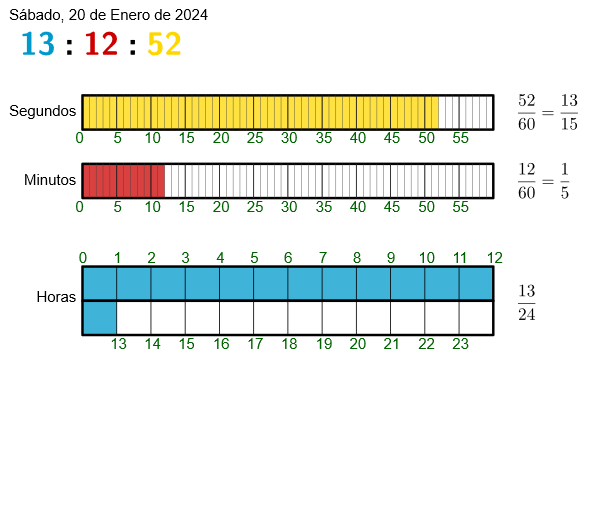
This example demonstrates the representation of hours, minutes, and seconds as fractions of time. Key mathematical concepts include fractions and time unit conversion. It uses GeoGebra commands such as CurveCartesian, Point, Sequence, Circle, Vector, and Segment for construction. Suitable for middle school and above students to learn time unit conversion and fraction applications.
GeoGebra Commands & Parameters
CurveCartesian(P2 + (0.45; pi / 2 - t), t, 0, (2 * pi)) → curvaSCurveCartesian(P1 + ((0.82 * r); pi / 2 - t), t, 0, (2 * pi)) → curvaMCurveCartesian(P1 + ((0.6 * r); pi / 2 - t), t, 0, (2 * pi)) → curvaHPoint(curvaH) → HSequence(Segment[P1 + (2; s°), P1 + (1.9; s°)], s, 0, 360, 6) → marcasMSequence(Segment[P2 + (0.6; s°), P2 + (0.55; s°)], s, 0, 360, 6) → marcasSSequence(Segment[P2 + (0.6; s°), P2 + (0.5; s°)], s, 0, 360, 30) → marcasS2Point(Sequence[Point[curvaM, k / 60], k, 0, 59]) → MCircle(P2, 0.6) → circSPoint(Sequence[Point[curvaS, k / 60], k, 0, 59]) → SCircle(P1, r) → circMSequence(Segment[P1 + (2; s°), P1 + (1.75; s°)], s, 0, 360, 30) → marcasHCircle(P1, r) → circHVector(P1, (1.04 * H) - (0.04 * P1)) → libreHVector(P1, (1.04 * M) - (0.04 * P1)) → libreMSegment(P2, (1.04 * S) - (0.04 * P2)) → libreSPoint(curvaH, (tiempo(4) - (12 * (tiempo(4) ≥ 12)) + tiempo(3) / 60 + tiempo(2) / 3600) / 12) → HHPoint(curvaM, tiempo(3) / 60) → MMPoint(curvaS, tiempo(2) / 60) → SSVector(P1, (1.04 * HH) - (0.04 * P1)) → actualHVector(P1, (1.04 * MM) - (0.04 * P1)) → actualMSegment(P2, (1.04 * SS) - (0.04 * P2)) → actualS
AI Drawing Prompt Reference
Draw a clock face representing time as fractions. At the center of the image is a dial with three concentric circular tracks representing the paths of the second, minute, and hour hands. The dial contains fine tick marks: hour marks every 30 degrees, minute marks every 6 degrees, and second marks every 6 degrees. Three hands extend from the center as line segments of varying lengths and directions, with the second hand shortest and hour hand longest. The hands are positioned dynamically based on time, illustrating the fractional conversion between time units. The overall design presents the mathematical relationship between time and circular motion.
The prompt above was compiled from the original drawing commands and is for reference only.