
Three Constructions of Inverse Functions
Loading the math board and drawing, please wait…
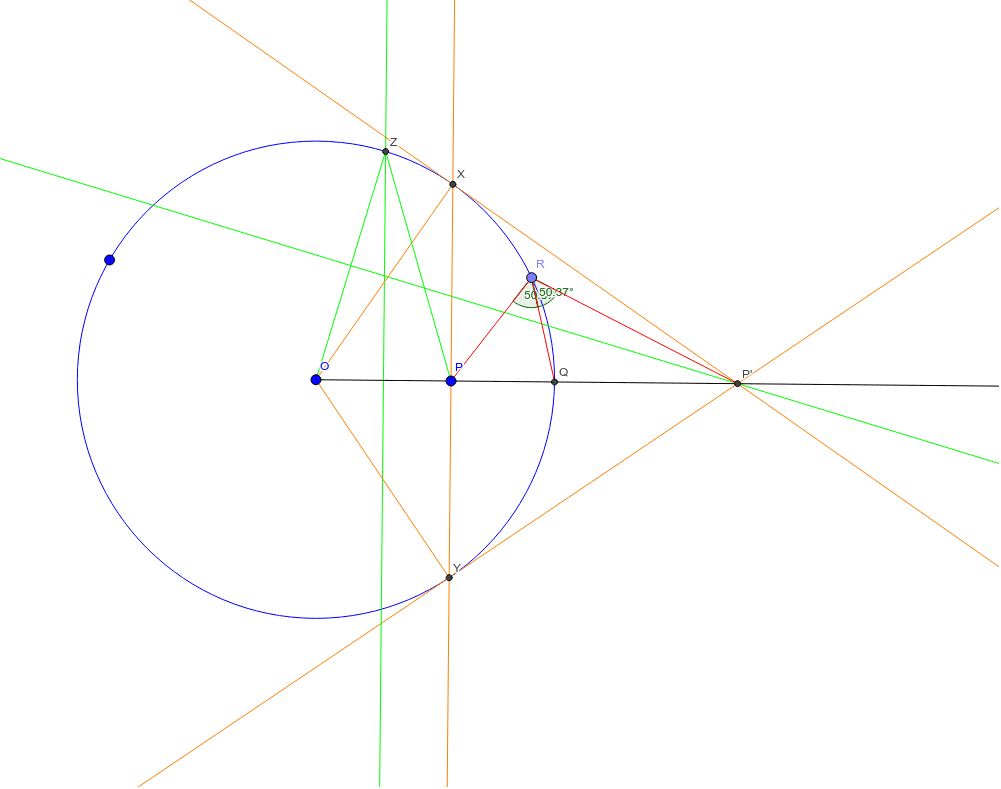
This example demonstrates three methods of geometric construction for inverse functions. Key mathematical concepts include inverse functions, function graphs, and geometric constructions. Using GeoGebra commands such as Circle, Ray, and OrthogonalLine, the construction process of inverse functions can be visually understood. Suitable for high school mathematics education and learning.
GeoGebra Commands & Parameters
Circle(O, B) → cRay(O, P) → aOrthogonalLine(P, a) → bIntersect(c, b, 2) → XIntersect(c, b, 1) → YSegment(O, Y) → dSegment(O, X) → eOrthogonalLine(X, e) → fOrthogonalLine(Y, d) → gIntersect(g, f) → P'LineBisector(P, O) → hIntersect(c, h, 1) → ZSegment(Z, O) → iSegment(P, Z) → jLineBisector(Z, O) → kPoint(c) → RIntersect(c, a, 1) → QSegment(R, P) → mSegment(R, P') → nAngle(P, R, Q) → αSegment(R, Q) → lAngle(Q, R, P') → β
AI Drawing Prompt Reference
Draw a function graph and demonstrate the geometric construction of its inverse function. Start by drawing a circle and a ray, then find the intersection points of the circle with the ray and draw a line perpendicular to the ray through one of the intersection points. Next, find the other intersection points of the circle with the perpendicular line and connect the origin to these points. Then, draw lines perpendicular to the connecting lines through these intersection points, and their intersection is a point on the inverse function. Finally, draw lines from the origin to these points on the inverse function, and show the symmetric relationship between the function graph and the inverse function graph about the line y=x.
The prompt above was compiled from the original drawing commands and is for reference only.