
Theorem 11: Parallel Lines Cutting Equal Segments
Loading the math board and drawing, please wait…
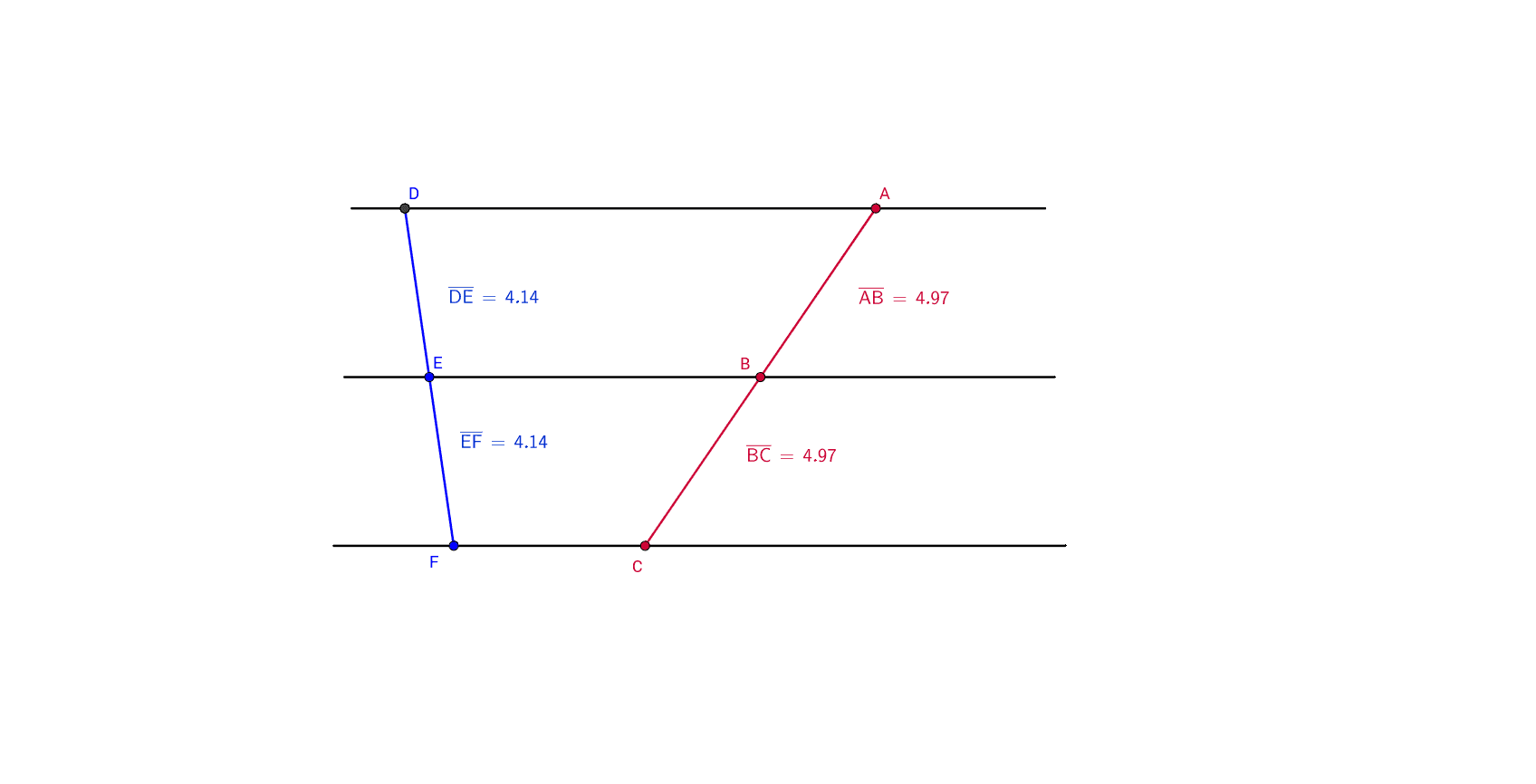
This example demonstrates that when a set of parallel lines cut one transversal, they will cut any other transversal into equal segments. Key mathematical concepts include parallel lines, segment lengths, and geometric construction. GeoGebra commands used include Segment, Line, Point, Intersect, Mirror, Distance, and Midpoint. Suitable for students in middle school and above.
GeoGebra Commands & Parameters
Segment(A_1, B_1) → aLine(C_1, a) → bLine(D_1, b) → cPoint(b) → E_1Point(b) → F_1Segment(E_1, F_1) → dPoint(c) → GPoint(c) → HSegment(G, H) → ePoint(a) → DPoint(e) → FSegment(D, F) → fPoint(a) → APoint(e) → CSegment(A, C) → gLine(A, f) → hIntersect(d, f) → EIntersect(d, g) → BMirror(F, E) → F'_1Distance(D, E) → distanceDEMidpoint(D, E) →Distance(E, F) → distanceEFMidpoint(E, F) →Distance(A, B) → distanceABMidpoint(A, B) →Distance(B, C) → distanceBCMidpoint(B, C) →
AI Drawing Prompt Reference
Draw three parallel lines intersected by a transversal, creating several intersection points. Measure and label the lengths of the segments formed on the transversal by the parallel lines, demonstrating that they are equal. Use reflection and midpoint calculations to illustrate the geometric property of parallel lines cutting equal segments.
The prompt above was compiled from the original drawing commands and is for reference only.