
Surface of Revolution by cbishop
Loading the math board and drawing, please wait…
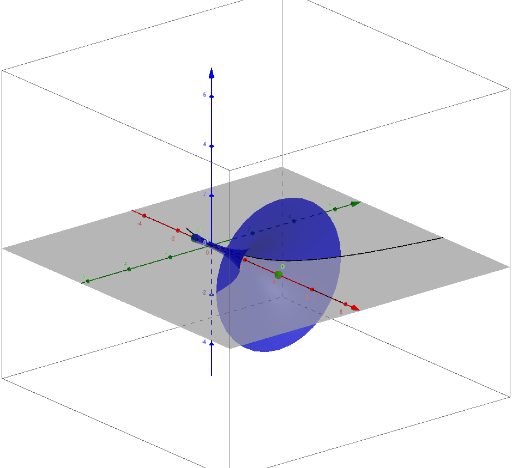
This example demonstrates the generation of a surface of revolution. Key mathematical concepts include rotation, parametric equations, and coordinate geometry. Using GeoGebra commands such as Surface and CurveCartesian, a surface of revolution can be constructed. Suitable for high school and above students or teachers.
GeoGebra Commands & Parameters
Textfield(f) → InputBox2Point(xAxis) → APoint(xAxis) → BSegment(A, B) → mPoint(m) → CPoint(m) → DSequence(Cylinder[(x(C) + ((x(D) - x(C)) * (j - 1) / n), 0, 0), (x(C) + ((x(D) - x(C)) * j / n), 0, 0), f(x(C) + ((x(D) - x(C)) * j / n))], j, 1, n) → list1Sequence(Cylinder[(x(C) + ((x(D) - x(C)) * j / n), 0, 0), (x(C) + ((x(D) - x(C)) * (j + 1) / n), 0, 0), f(x(C) + ((x(D) - x(C)) * j / n))], j, 0, n - 1) → list2CurveCartesian(t, 0, f(t), t, x(C), x(D)) → cSurface(u, (cos(v) * f(u)), (sin(v) * f(u)), u, x(C), x(D), v, 0, T) → dSurface(u, (cos(v) * f(u)), (sin(v) * f(u)), u, x(C), x(D), v, 0, 6.28319) → aCurveCartesian(u, g(u), h(u), u, x(C) - 1, x(D) + 1) → b