
Sum of N Terms: A Vector and Geometric Visualization
Loading the math board and drawing, please wait…
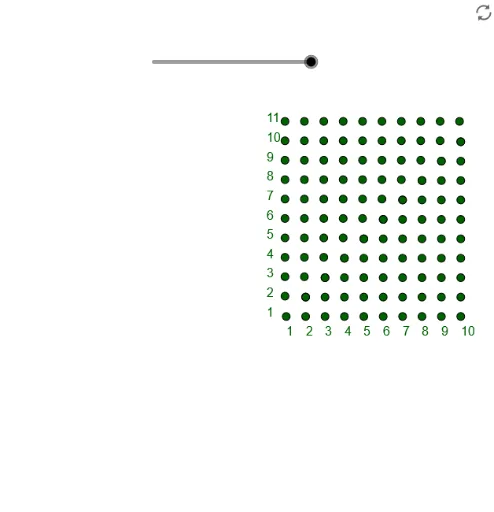
① This GeoGebra example dynamically illustrates the geometric meaning of the sum of the first N terms of a sequence, converting the summation process into an intuitive visual of vector translations and accumulated points. ② Core mathematical concepts include sequence summation, vector addition, translation transformations, and point distributions on a line, with extensions to differences, slopes, differential equations, and 3D vectors. ③ Construction highlights: the Sequence command generates term indices, If controls term validity, Point and Vector create geometric elements, and Translate performs vector shifts, while multiple objects (l1–l14, A, B, D, E, etc.) build the cumulative path. ④ Suitable for high school to early college students, this serves as a dynamic teaching tool for understanding summation geometrically and for exploring vector and transformation concepts.
GeoGebra Commands & Parameters
Sequence(Sequence[(i, k), k, 0, i], i, 0, a - 1) → l5Sequence((k, k), k, 1, a - 1) → l2Sequence(a) → l4Sequence((k, 0), k, 0, a - 1) → l1Sequence((14, k), k, 0, a - 1) → l3Sequence((a - 1, k), k, 0, a - 1) → l6Sequence(Vector[Element[l6, k], Element[l3, k]], k, 1, a) → l7If(0 ≤ b < 1, Rotate[l5, β, (0, 0)], If[b ≥ 1, Rotate[l5, 180°, (0, 0)]]) → l8Point(l8) → DPoint(yAxis) → EVector(D, E) → wTranslate(l8, w) → l8'Point(yAxis) → AVector(A, B) → uIf(1 < b < 2, Vector[Dilate[u, b - 1]], Vector[If[b ≥ 2, u]]) → vSequence((k, -1), k, 0, 9) → l9Translate(l8', v) → l8''Sequence(Text[Element[l10, k], Element[l9, k]], k, 1, 10) → l11Sequence((-1, k), k, 0, 10) → l13Sequence(Text[Element[l12, k], Element[l13, k]], k, 1, 11) → l14