
Starfish
Loading the math board and drawing, please wait…
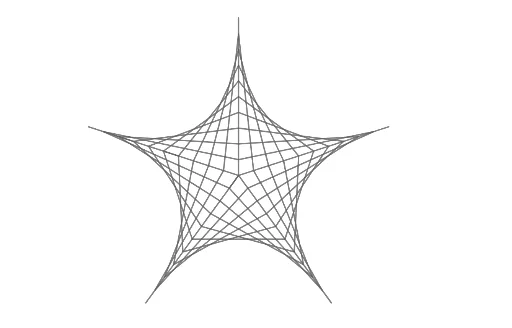
This example demonstrates the geometric construction of a starfish shape. It involves core math concepts like isosceles triangles, secant lines, conditional probability, random experiments, and mode. The construction uses GeoGebra commands such as Point, Intersect, Rotate, Circle, and Segment. It is suitable for high school mathematics, showcasing the integration of geometric construction and probability statistics.
GeoGebra Commands & Parameters
Point(yAxis) → AIntersect(xAxis, yAxis) → BRotate(A, 72°, B) → A'Rotate(A', 72°, B) → A''Rotate(A'', 72°, B) → A'''Rotate(A''', 72°, B) → CCircle(B, 0.5) → cCircle(B, 1) → dCircle(B, 1.5) → eCircle(B, 2) → fCircle(B, 2.5) → gCircle(B, 3) → hCircle(B, 3.5) → kCircle(B, 4) → pCircle(B, 4.5) → qCircle(B, 5) → rSegment(B, A') → iSegment(B, A) → jSegment(B, C) → lSegment(B, A''') → mSegment(B, A'') → nIntersect(d, l, 1) → DIntersect(c, l, 1) → EIntersect(c, l, 1) → FIntersect(e, l, 1) → GIntersect(f, l, 1) → HIntersect(g, l, 1) → IIntersect(h, l, 1) → JIntersect(k, l, 1) → KIntersect(p, l) → L,Intersect(q, l, 1) → MIntersect(q, l, 1) → NIntersect(c, j, 1) → OIntersect(d, j, 1) → PIntersect(e, j, 1) → QIntersect(q, j, 1) → RIntersect(p, j, 1) → SIntersect(k, j, 1) → TIntersect(h, j, 1) → UIntersect(g, j, 1) → VIntersect(f, j, 1) → WIntersect(q, i, 1) → ZIntersect(p, i, 1) → A_1Intersect(k, i, 1) → B_1Intersect(h, i, 1) → C_1Intersect(g, i, 1) → D_1Intersect(f, i, 1) → E_1Intersect(e, i, 1) → F_1Intersect(d, i, 1) → G_1Intersect(c, i, 1) → H_1Intersect(q, n, 1) → I_1Intersect(p, n, 1) → J_1Intersect(k, n, 1) → K_1Intersect(h, n, 1) → L_1Intersect(g, n, 1) → M_1Intersect(f, n, 1) → N_1Intersect(e, n, 1) → O_1Intersect(d, n, 1) → P_1Intersect(c, n, 1) → Q_1Intersect(c, m, 1) → R_1Intersect(d, m, 1) → S_1Intersect(e, m) → T_1,Intersect(f, m, 1) → U_1Intersect(g, m) → V_1,Intersect(h, m, 1) → W_1Intersect(k, m, 1) → Z_1Intersect(p, m, 1) → A_2Intersect(q, m, 1) → B_2Segment(A_1, O) → tSegment(Z, A_1) → sSegment(O, Z) → aSegment(A_1, P) → bSegment(B_1, Q) → f_1Segment(C_1, W) → g_1Segment(D_1, E_1) → h_1Segment(V, D_1) → i_1Segment(E_1, U) → j_1Segment(F_1, T) → k_1Segment(G_1, S) → l_1Segment(H_1, R) → m_1Segment(O, M) → n_1Segment(P, L) → p_1Segment(Q, K) → q_1Segment(W, J) → r_1Segment(V, I) → s_1Segment(U, H) → t_1Segment(T, G) → a_1Segment(S, D) → b_1Segment(R, E) → c_1Segment(Z, Q_1) → d_1Segment(B_1, A_1) → e_1Segment(A_1, P_1) → f_2Segment(B_1, O_1) → g_2Segment(C_1, N_1) → h_2Segment(D_1, M_1) → i_2Segment(E_1, L_1) → j_2Segment(F_1, K_1) → k_2Segment(G_1, J_1) → l_2Segment(H_1, I_1) → m_2Segment(I_1, R_1) → n_2Segment(J_1, S_1) → p_2Segment(K_1, T_1) → q_2Segment(L_1, U_1) → r_2Segment(M_1, V_1) → s_2Segment(N_1, W_1) → t_2Segment(O_1, Z_1) → a_2Segment(P_1, A_2) → b_2Segment(B, Q_1) → c_2Segment(Q_1, B_2) → d_2Segment(B_2, E) → e_2Segment(A_2, D) → f_3Segment(Z_1, G) → g_3Segment(W_1, H) → h_3Segment(V_1, I) → i_3Segment(U_1, J) → j_3Segment(T_1, K) → k_3Segment(S_1, L) → l_3Segment(R_1, M) → m_3
AI Drawing Prompt Reference
Draw a starfish shape centered at the origin of a coordinate system. Start by drawing two coordinate axes and finding their intersection point. Create concentric circles with radii from 0.5 to 5 centered at this point. From the origin, rotate a point 72 degrees clockwise to get new points, repeating this five times. Connect the origin to each rotated point to form five lines. Intersect each line with circles of radius 1 and 2 to get multiple points. Finally, connect these points to form the edges of the starfish.
The prompt above was compiled from the original drawing commands and is for reference only.