
Squares and Parallelograms on Triangle by Doug Kuhlmann
Loading the math board and drawing, please wait…
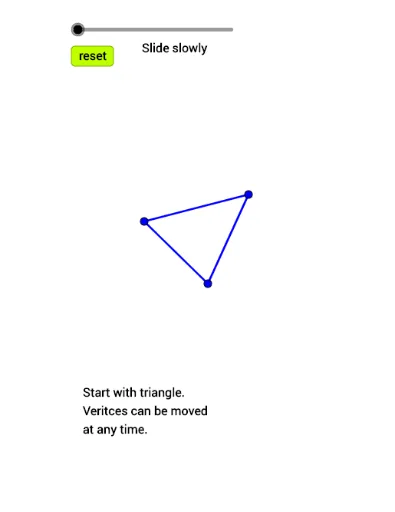
This example demonstrates constructing squares and parallelograms on a triangle. Key concepts include geometric construction, polygons, and line segments. Using GeoGebra commands such as Polygon, Segment, and If, the lengths of the triangle's sides can be dynamically adjusted to observe changes in the squares and parallelograms. Suitable for middle and high school students learning geometric construction and transformations.
GeoGebra Commands & Parameters
Polygon(B, A, 4) → poly3, r, s, t, a, H, ISegment(A, B) → fSegment(B, C) → gSegment(C, A) → hPolygon(C, B, 4) → poly1, i, j, k, l, D, EPolygon(A, C, 4) → poly2, m, n_1, p, q, F, GIf(t1 ≤ 1, Segment[B, B + (t1 * (D - B))], If[t1 ≤ 2, Segment[D, D + ((t1 - 1) * (E - D))], Segment[E, E + ((t1 - 2) * (C - E))]]) → eIf(t1 ≤ 1, Segment[B, B + (t1 * (D - B))], If[t1 ≤ 2, Segment[D, D + ((t1 - 1) * (E - D))], Segment[E, E + ((t1 - 2) * (C - E))]]) → f_1If(t2 ≤ 1, Segment[C, C + (t2 * (F - C))], If[t2 ≤ 2, Segment[F, F + ((t2 - 1) * (G - F))], Segment[G, G + ((t2 - 2) * (A - G))]]) → i_1If(t3 ≤ 1, Segment[A, A + (t3 * (H - A))], If[t3 ≤ 2, Segment[H, H + ((t3 - 1) * (I - H))], Segment[I, I + ((t3 - 2) * (B - I))]]) → g_1Line(E, n_1) → bLine(F, e) → cIntersect(b, c) → JLine(H, i_1) → dLine(G, s) → h_1Intersect(d, h_1) → KLine(I, j) → j_1Line(D, g_1) → k_1Intersect(k_1, j_1) → LSegment(E, E + (t4 * (J - E))) → l_1Segment(F, F + (t4 * (J - F))) → m_1Segment(G, G + (t5 * (K - G))) → p_1Segment(H, H + (t5 * (K - H))) → q_1Segment(I, I + (t6 * (L - I))) → r_1Segment(D, D + (t6 * (L - D))) → s_1Ray(L, B) → t_1Ray(K, A) → a_1Intersect(t_1, a_1) → MSegment(K, K + (t7 * (M - K))) → b_1Segment(J, J + (t7 * (M - J))) → c_1Segment(L, L + (t7 * (M - L))) → d_1