
Solve the Equation - Level 1 (Systematic Trial & Visualization)
Loading the math board and drawing, please wait…
In collections
Wiederholung: Variablen, Terme und Gleichungen
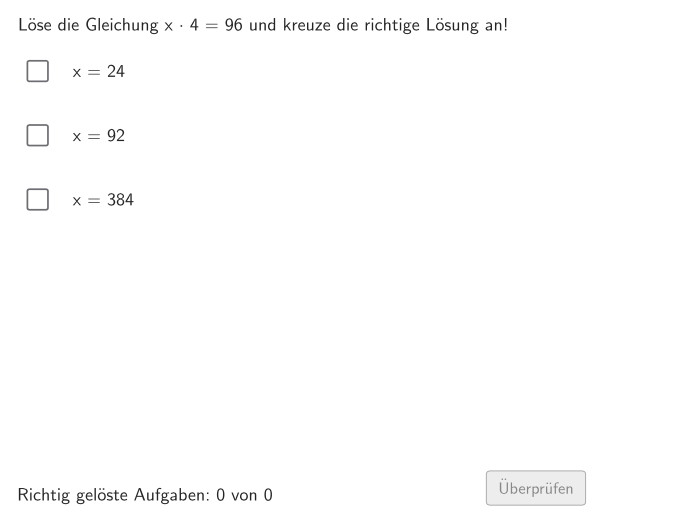
This GeoGebra example is an interactive algebra practice tool for grades 5-6, focusing on solving simple linear equations through systematic trial and error with visual support. It randomly generates equations with one unknown, prompting students to test values and observe the balance between both sides. Core math concepts include one-variable linear equations, properties of equality, unknowns, factors and multiples, and verification of solutions. The construction uses GeoGebra commands such as Shuffle, Append, Remove, DivisorsList, Factors, If, Split, Corner, RemoveUndefined, Union, Max, CountIf, RoundBox, and Divisors to generate non-repeating coefficients and constants, manage question logic, and display the equation text via Text objects. The interface is designed for repeated practice with fresh problems each time. Suitable for classroom exercises, homework, or teacher demonstrations of systematic equation-solving strategies.
GeoGebra Commands & Parameters
Shuffle(Sequence[Random[21, 40], i, 1, 100]) → randomNosFora, {30, 25, 24, 35, 21, 32, 40, 28, 26, 36, 33, 38, 38, 38, 38, 24, 39, 40, 35, 27, 40, 32, 22, 23, 35, 27, 37, 31, 22, 32, 35, 36, 25, 38, 22, 28, 29, 40, 35, 34, 26, 22, 23, 34, 30, 38, 40, 37, 23, 31, 39, 31, 32, 23, 26, 27, 24, 31, 31, 29, 37, 30, 39, 25, 30, 27, 33, 36, 32, 28, 36, 26, 37, 38, 39, 33, 35, 28, 38, 21, 40, 40, 21, 29, 31, 35, 26, 29, 39, 37, 35, 38, 35, 38, 25, 31, 39, 23, 39, 21}Append(true, Sequence[If[randomNosFora(i) ≟ randomNosFora(i - 1), false, true], i, 2, 100]) → stayyShuffle(Sequence[Random[2, 20], i, 1, 100]) → RandomNosFory, {3, 13, 4, 10, 18, 13, 7, 16, 20, 11, 16, 15, 5, 20, 8, 4, 14, 17, 10, 5, 3, 20, 5, 4, 20, 9, 13, 16, 15, 18, 9, 20, 8, 19, 7, 10, 19, 17, 6, 8, 13, 17, 3, 17, 15, 4, 6, 13, 9, 14, 17, 9, 11, 13, 19, 5, 3, 18, 8, 19, 19, 3, 3, 12, 18, 12, 9, 9, 10, 17, 13, 16, 10, 11, 3, 18, 20, 2, 2, 3, 17, 6, 19, 13, 18, 11, 2, 10, 13, 2, 11, 7, 5, 3, 6, 20, 20, 13, 19, 14}Remove(Sequence[If[stayy(i), RandomNosFory(i), 0], i, 1, 100], Sequence[0, i, 1, 100]) → randomNosForywithoutRepeatElement(randomNosForywithoutRepeat, Mod[questionCount, Length[randomNosForywithoutRepeat]] + 1) → numywithoutRepeatDivisorsList(numywithoutRepeat) → teilerListForyFactors(numywithoutRepeat) →Shuffle(Sequence[RandomElement[l1], i, 1, 100]) → l1zufi, {"a - 4", "4 : a", "a \cdot 4", "a \cdot 4", "a + 4", "4 \cdot a", "a \cdot 4", "4 + a", "a \cdot 4", "4 + a", "a \cdot 4", "a - 4", "4 + a", "4 + a", "4 + a", "a + 4", "a + 4", "4 : a", "a \cdot 4", "a - 4", "a + 4", "4 + a", "a + 4", "4 + a", "4 \cdot a", "4 : a", "4 \cdot a", "4 : a", "a + 4", "a \cdot 4", "a + 4", "a \cdot 4", "4 + a", "4 + a", "a \cdot 4", "4 \cdot a", "4 : a", "a \cdot 4", "4 \cdot a", "a + 4", "4 : a", "4 \cdot a", "4 \cdot a", "4 \cdot a", "a - 4", "4 \cdot a", "a - 4", "4 \cdot a", "4 + a", "4 + a", "a - 4", "a \cdot 4", "a - 4", "4 + a", "4 \cdot a", "4 + a", "a \cdot 4", "4 \cdot a", "4 \cdot a", "a \cdot 4", "4 \cdot a", "a + 4", "a \cdot 4", "4 \cdot a", "4 \cdot a", "4 : a", "a \cdot 4", "a + 4", "a + 4", "a \cdot 4", "4 + a", "a + 4", "a - 4", "4 + a", "a \cdot 4", "a + 4", "a - 4", "a - 4", "a + 4", "4 : a", "a + 4", "4 + a", "4 : a", "4 \cdot a", "4 : a", "4 \cdot a", "a \cdot 4", "4 : a", "4 : a", "a \cdot 4", "a - 4", "a + 4", "4 + a", "4 : a", "a + 4", "a \cdot 4", "a \cdot 4", "4 \cdot a", "a - 4", "4 + a"}Append(true, Sequence[If[l1zufi(i) ≟ l1zufi(i - 1), false, true], i, 2, 100]) → stayzufiRemove(Sequence[If[stayzufi(i), l1zufi(i), 0], i, 1, 100], Sequence[0, i, 1, 100]) → l1zufiwithoutRepeatElement(l1zufiwithoutRepeat, Mod[questionCount, 100] + 1) → numzufiIf(numzufi ≟ F8, RandomElement[teilerListFory], Element[randomNosFora, Mod[questionCount, 100] + 1]) → numaElement(l1zufiwithoutRepeat, Mod[questionCount, 100] + 1) → Text2If(numzufi ≟ F9, E9, If[numzufi ≟ F8, E8, If[numzufi ≟ F7, E7, If[numzufi ≟ F6, E6, If[numzufi ≟ F5, E5, If[numzufi ≟ F4, E4, If[numzufi ≟ F3, E3, If[numzufi ≟ F2, E2]]]]]]]) → Text1Split(GlTxt, {""}) → splittedTextIf(corrAdd, Text1 + numywithoutRepeat, If[corrSub, numywithoutRepeat - Text1, If[corrMult, (Text1 * numywithoutRepeat), If[corrDivi, Text1 + numywithoutRepeat]]]) → number2If(corrAdd, (Text1 * numywithoutRepeat), If[corrSub, (Text1 * numywithoutRepeat), If[corrMult, numywithoutRepeat - Text1, If[corrDivi, Text1 - numywithoutRepeat]]]) → number3Shuffle(Sequence[RandomElement[{6, 12, 18, 24, 30, 36, 42, 48, 54, 60, 66}], i, 1, 100]) → randomNosForaDividend, {24, 54, 24, 12, 30, 24, 66, 24, 18, 18, 6, 12, 30, 18, 36, 66, 66, 30, 54, 60, 42, 54, 24, 30, 66, 66, 6, 54, 30, 42, 42, 42, 30, 66, 6, 36, 48, 48, 42, 54, 42, 24, 60, 24, 54, 24, 30, 54, 36, 48, 48, 54, 18, 54, 48, 48, 48, 42, 30, 54, 36, 60, 66, 12, 60, 6, 30, 48, 36, 48, 36, 18, 18, 36, 48, 18, 54, 36, 48, 12, 66, 42, 12, 60, 12, 30, 30, 18, 66, 30, 12, 36, 42, 24, 48, 24, 66, 42, 30, 48}If(showanswer, "\bold{Lösung: }", "") → LoesungTextAppend(true, Sequence[If[l1zufi(i) ≟ l1zufi(i - 1), false, true], i, 2, 100]) → randomNosForawithoutRepeatIf(numzufi ≟ F8, Element[randomNosForaDividend, Mod[questionCount, Length[randomNosForaDividend]] + 1], Element[randomNosForawithoutRepeat, Mod[questionCount, Length[randomNosForawithoutRepeat]] + 1]) → numawithoutRepeatCorner(HinweisText, 2) → CornerHint2Corner(HinweisText, 3) → CornerHint3Corner(Angabe, 1) → CornerAngabeCorner(HinweisText, 1) → CornerHint1If(tries ≠ 3, y(CornerHint3) - y(CornerHint2) - 0.15, y(Corner[SolutionText, 3]) - y(Corner[SolutionText, 2]) - 0.15) → heighthintRemoveUndefined({richtig1, If[RO > 1, richtig2], If[RO > 2, richtig3], If[RO > 3, richtig4], If[RO > 4, richtig5]}) → ListeRichtigRemoveUndefined({If[MCO ≟ 5 ∧ RO < 5 ∨ MCO ≟ 4 ∧ RO < 4 ∨ MCO ≟ 3 ∧ RO < 3, falsch1], If[MCO ≟ 5 ∧ RO < 4 ∨ MCO ≟ 4 ∧ RO < 3 ∨ MCO ≟ 3 ∧ RO < 2, falsch2], If[MCO ≟ 5 ∧ RO < 3 ∨ MCO ≟ 4 ∧ RO < 2, falsch3], If[MCO ≟ 5 ∧ RO < 2, falsch4]}) → ListeFalschUnion(ListeRichtig, ListeFalsch) → ListeAlleShuffle(ListeAlle) → Reihenfolge, {"\textsf{x = 24}", "\textsf{x = -92}", "\textsf{x = 384}"}If(Reihenfolge(1) ∈ ListeRichtig, (("\math{" * Reihenfolge(1)) * "}\\\\"), "") → Loesungstext1If(Reihenfolge(2) ∈ ListeRichtig, (("\math{" * Reihenfolge(2)) * "}\\\\"), "") → Loesungstext2If(Reihenfolge(3) ∈ ListeRichtig, (("\math{" * Reihenfolge(3)) * "}\\\\"), "") → Loesungstext3If(Reihenfolge(4) ∈ ListeRichtig, (("\math{" * Reihenfolge(4)) * "}\\\\"), "") → Loesungstext4If(Reihenfolge(5) ∈ ListeRichtig, (("\math{" * Reihenfolge(5)) * "}\\\\"), "") → Loesungstext5Corner(Optionstext5, 3) → Corner53Corner(Optionstext5, 1) → Corner51Corner(Optionstext5, 2) → Corner52Corner(Optionstext4, 1) → Corner41Corner(Optionstext4, 2) → Corner42Corner(Optionstext3, 1) → Corner31Corner(Optionstext3, 2) → Corner32Corner(Optionstext2, 1) → Corner21Corner(Optionstext2, 2) → Corner22Corner(Optionstext1, 2) → Corner12Corner(Optionstext1, 1) → Corner11Max({x(Corner12) - x(Corner11), x(Corner22) - x(Corner21), x(Corner32) - x(Corner31), x(Corner42) - x(Corner41), x(Corner52) - x(Corner51)}) → maxwidthCorner(Optionstext4, 3) → Corner43Corner(Optionstext3, 3) → Corner33Corner(Optionstext2, 3) → Corner23Corner(Optionstext1, 3) → Corner13If(step < 3, Erklaerung2, "\\\textsf{ \large{\bold{. . .}}}") → ShowErkl2If(MCO ≥ 4, If[Reihenfolge(4) ∈ ListeRichtig ∧ option4 ≟ true ∨ Reihenfolge(4) ∈ ListeFalsch ∧ option4 ≟ false, true, false], true) → correct4If(correct4, 1, 0) → point4If(MCO ≟ 5, If[Reihenfolge(5) ∈ ListeRichtig ∧ option5 ≟ true ∨ Reihenfolge(5) ∈ ListeFalsch ∧ option5 ≟ false, true, false], true) → correct5If(correct5, 1, 0) → point5If(Reihenfolge(3) ∈ ListeRichtig ∧ option3 ≟ true ∨ Reihenfolge(3) ∈ ListeFalsch ∧ option3 ≟ false, true, false) → correct3If(correct3, 1, 0) → point3If(Reihenfolge(2) ∈ ListeRichtig ∧ option2 ≟ true ∨ Reihenfolge(2) ∈ ListeFalsch ∧ option2 ≟ false, true, false) → correct2If(correct2, 1, 0) → point2If(Reihenfolge(1) ∈ ListeRichtig ∧ option1 ≟ true ∨ Reihenfolge(1) ∈ ListeFalsch ∧ option1 ≟ false, true, false) → correct1If(correct1, 1, 0) → point1If(option1 ∨ option2 ∨ option3 ∨ option4 ∨ option5, (point1 + point2 + point3 + point4 + point5) / 5, 0) → scoreCountIf(x ≟ true, {option1, option2, option3, option4, option5}) → angekreuztRoundBox(radius, Box1, height1, width) → box14, box11, box15, box12, box13RoundBox(radius, Box2, height2, width) → box24, box21, box25, box22, box23RoundBox(radius, Box3, height3, width) → box34, box31, box35, box32, box33RoundBox(radius, Box4, height4, width) → box44, box41, box45, box42, box43RoundBox(radius, Box5, height5, width) → box54, box51, box55, box52, box53If(step ≟ 3, "", step ≟ 1, ("\\\\" * Erklaerung3), "\\\textsf{ \large{\bold{. . .}}}") → ShowErkl3CountIf(x ≟ true, {correct1 ∧ option1, correct2 ∧ option2, correct3 ∧ option3, correct4 ∧ option4, correct5 ∧ option5}) → richtigIf(richtig > 0 ∧ (¬correct), "✘ Teilweise richtig", correct, "✓ Richtig", "✘ Falsch") → CheckTextIf(tries ≠ 3, x(CornerHint2) - x(CornerHint1) - 0.15, x(Corner[SolutionText, 2]) - x(Corner[SolutionText, 1]) - 0.15) → widthhintRoundBox(radius, PosBoxHint, heighthint, widthhint) → boxh1, boxh2, boxh5, boxh3, boxh4Corner(Angabe, 4) → CornerAngabe2Shuffle(Sequence[RandomElement[{2, 3}], i, 1, 100]) → randomNosForaDivisor, {2, 3, 2, 2, 3, 3, 2, 2, 2, 2, 3, 3, 2, 3, 2, 2, 3, 2, 2, 2, 3, 3, 2, 3, 2, 3, 3, 2, 3, 3, 2, 3, 2, 2, 3, 2, 3, 2, 2, 2, 2, 2, 3, 3, 2, 3, 3, 3, 3, 3, 3, 3, 3, 3, 3, 3, 3, 3, 2, 2, 2, 2, 3, 3, 2, 2, 2, 2, 3, 2, 3, 2, 2, 2, 2, 3, 2, 3, 3, 3, 2, 2, 2, 2, 2, 2, 3, 2, 2, 3, 2, 3, 3, 3, 3, 2, 3, 2, 3, 2}Append(true, Sequence[If[randomNosFora(i) ≟ randomNosFora(i - 1), false, true], i, 2, 100]) → stayaElement(randomNosForaDividend, Mod[questionCount, 100] + 1) → numForDividendElement(randomNosForaDivisor, Mod[questionCount, 100] + 1) → numForDivisorElement(RandomNosFory, Mod[questionCount, 100] + 1) → numyDivisors(numywithoutRepeat) → aFactors(numywithoutRepeat) →If(showsolution, Corner[LoesungswegText, 2] - (1, 1), (3, y(PosButton1))) → PosButton3
AI Drawing Prompt Reference
Draw a graph containing multiple equations, including a linear equation and a fraction equation, with the left and right sides of the equation containing a variable and a constant, respectively. The constant can be a positive integer or a negative integer, and the variable can be x or y. The graph also includes a slider to adjust the coefficients and constants of the equation. In the background of the graph, there is a hint text that guides the user on how to solve the equation.
The prompt above was compiled from the original drawing commands and is for reference only.