
Solve Equations - Start to Mars!
Loading the math board and drawing, please wait…
In collections
Wiederholung: Variablen, Terme und Gleichungen
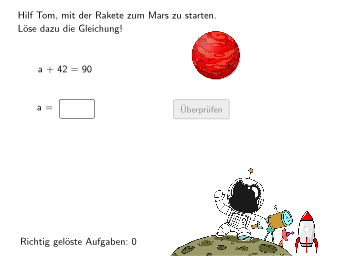
This example demonstrates how to solve linear equations using GeoGebra, guiding students through the process step-by-step. The core math concepts involve solving linear equations through inverse operations. Key GeoGebra commands and objects used include Shuffle, Append, Remove, Element, Textfield, Polygon, questionCount, randomNosFora, staya, randomNosForawithoutRepeat, numawithoutRepeat, aInput, correct2, stayy, RandomNosFory, RandomNosForywithoutRepeat, numywithoutRepeat, F9, F8, F7, F6, F5, F4, F3, F2, l1, l1zufi, stayzufi, l1zufiwithoutRepeat, numzufi, E2, E9, E8, E7, E6, E5, E4, E3, Blue, Green, Orange, Red, Purple, Gray, GrayDark, validate. Suitable for students in grades 5-6, this lesson helps in practicing math and understanding concepts.
GeoGebra Commands & Parameters
Shuffle(Sequence[Random[41, 90], i, 1, 100]) → randomNosFora, {90, 72, 63, 72, 81, 57, 90, 58, 75, 65, 75, 75, 64, 55, 66, 54, 43, 63, 57, 71, 48, 72, 78, 81, 59, 78, 48, 48, 76, 88, 58, 44, 87, 85, 42, 75, 65, 83, 81, 82, 58, 44, 50, 51, 41, 51, 65, 88, 45, 85, 75, 82, 42, 89, 56, 41, 49, 63, 44, 84, 66, 54, 86, 84, 48, 85, 65, 71, 55, 86, 68, 66, 56, 48, 75, 57, 54, 63, 89, 46, 65, 79, 72, 90, 66, 58, 84, 44, 67, 69, 41, 68, 55, 45, 82, 68, 56, 66, 59, 66}Append(true, Sequence[If[randomNosFora(i) ≟ randomNosFora(i - 1), false, true], i, 2, 100]) → stayaRemove(Sequence[If[staya(i), randomNosFora(i), 0], i, 1, 100], Sequence[0, i, 1, 100]) → randomNosForawithoutRepeatElement(randomNosForawithoutRepeat, Mod[questionCount, Length[randomNosForawithoutRepeat]] + 1) → numawithoutRepeatAppend(true, Sequence[If[randomNosFora(i) ≟ randomNosFora(i - 1), false, true], i, 2, 100]) → stayyShuffle(Sequence[Random[1, 40], i, 1, 100]) → RandomNosFory, {31, 9, 37, 40, 26, 20, 30, 9, 21, 9, 32, 30, 1, 22, 27, 4, 13, 17, 8, 9, 10, 9, 37, 13, 24, 30, 19, 27, 18, 19, 37, 1, 35, 10, 10, 16, 11, 30, 19, 31, 28, 2, 3, 34, 35, 7, 35, 16, 32, 11, 31, 31, 34, 16, 39, 33, 10, 4, 34, 5, 33, 31, 16, 31, 18, 29, 10, 24, 37, 21, 32, 1, 30, 15, 23, 33, 7, 36, 6, 21, 37, 28, 25, 19, 29, 22, 8, 8, 25, 14, 10, 22, 16, 10, 6, 26, 18, 16, 1, 16}Remove(Sequence[If[stayy(i), RandomNosFory(i), 0], i, 1, 100], Sequence[0, i, 1, 100]) → RandomNosForywithoutRepeatElement(RandomNosForywithoutRepeat, Mod[questionCount, Length[RandomNosForywithoutRepeat]] + 1) → numywithoutRepeatShuffle(Sequence[RandomElement[l1], i, 1, 100]) → l1zufi, {"a \cdot 31", "a - 31", "a \cdot 31", "31 + a", "a \cdot 31", "a - 31", "a - 31", "31 \cdot a", "a + 31", "31 \cdot a", "a \cdot 31", "a \cdot 31", "a + 31", "31 \cdot a", "a \cdot 31", "a - 31", "a + 31", "a - 31", "a + 31", "a - 31", "a + 31", "a - 31", "a + 31", "a \cdot 31", "a + 31", "a + 31", "a + 31", "a - 31", "a \cdot 31", "31 \cdot a", "a \cdot 31", "a + 31", "31 + a", "31 + a", "a + 31", "31 + a", "31 + a", "31 + a", "a + 31", "31 + a", "a \cdot 31", "a - 31", "31 + a", "a + 31", "a - 31", "31 + a", "a \cdot 31", "a - 31", "a \cdot 31", "a \cdot 31", "a \cdot 31", "a - 31", "a + 31", "a + 31", "31 + a", "a \cdot 31", "a \cdot 31", "a \cdot 31", "a + 31", "a + 31", "a - 31", "a \cdot 31", "31 \cdot a", "a \cdot 31", "a + 31", "a \cdot 31", "31 + a", "31 + a", "a \cdot 31", "a - 31", "31 \cdot a", "a + 31", "a - 31", "a - 31", "a + 31", "a \cdot 31", "a - 31", "a + 31", "a + 31", "a \cdot 31", "31 \cdot a", "a + 31", "a - 31", "a - 31", "31 \cdot a", "a + 31", "31 + a", "31 \cdot a", "a \cdot 31", "a - 31", "31 \cdot a", "a - 31", "31 \cdot a", "a + 31", "a + 31", "31 \cdot a", "a - 31", "a - 31", "a - 31", "a \cdot 31"}Append(true, Sequence[If[l1zufi(i) ≟ l1zufi(i - 1), false, true], i, 2, 100]) → stayzufiRemove(Sequence[If[stayzufi(i), l1zufi(i), 0], i, 1, 100], Sequence[0, i, 1, 100]) → l1zufiwithoutRepeatElement(l1zufiwithoutRepeat, Mod[questionCount, 100] + 1) → numzufiTextfield(aInput) → InputBox1Textfield(bInput) → InputBox2Polygon(PtopLeftCornerFeedback, PtopRightCornerFeedback, PbottomRightCornerFeedback, PbottomLeftCornerFeedback) → rectangleCorrect, ptopleftcornerfeedback, ptoprightcornerfeedback, pbottomrightcornerfeedback, pbottomleftcornerfeedbackElement(randomNosFora, Mod[questionCount, 100] + 1) → numaElement(RandomNosFory, Mod[questionCount, 100] + 1) → numyShuffle(Sequence[RandomElement[{6, 12, 18, 24, 30, 36, 42, 48, 54, 60, 66}], i, 1, 100]) → randomNosForaDivision, {18, 54, 54, 60, 30, 48, 48, 12, 30, 42, 42, 12, 24, 42, 12, 18, 48, 48, 42, 30, 30, 18, 60, 60, 18, 54, 60, 6, 6, 48, 30, 42, 30, 42, 24, 12, 12, 60, 36, 18, 54, 42, 24, 66, 66, 12, 42, 48, 30, 66, 12, 24, 30, 42, 24, 12, 24, 12, 48, 60, 30, 30, 12, 42, 6, 48, 18, 24, 42, 6, 66, 36, 42, 12, 6, 60, 30, 66, 54, 30, 24, 36, 54, 24, 42, 36, 54, 12, 30, 24, 48, 30, 42, 30, 66, 48, 12, 42, 48, 36}
AI Drawing Prompt Reference
Draw a graph containing a square and multiple circles. The square has four corners with different colors. The circles' colors and sizes are generated randomly. There are two text input boxes for inputting two numbers. The graph has a square in the center, with four corners having circles, whose colors and sizes are generated randomly. The graph has four corners with squares, each having a circle, whose colors and sizes are generated randomly. The graph has a square in the center, with four corners having circles, whose colors and sizes are generated randomly.
The prompt above was compiled from the original drawing commands and is for reference only.