
Sine Ratio & the Ambiguous Case
Loading the math board and drawing, please wait…
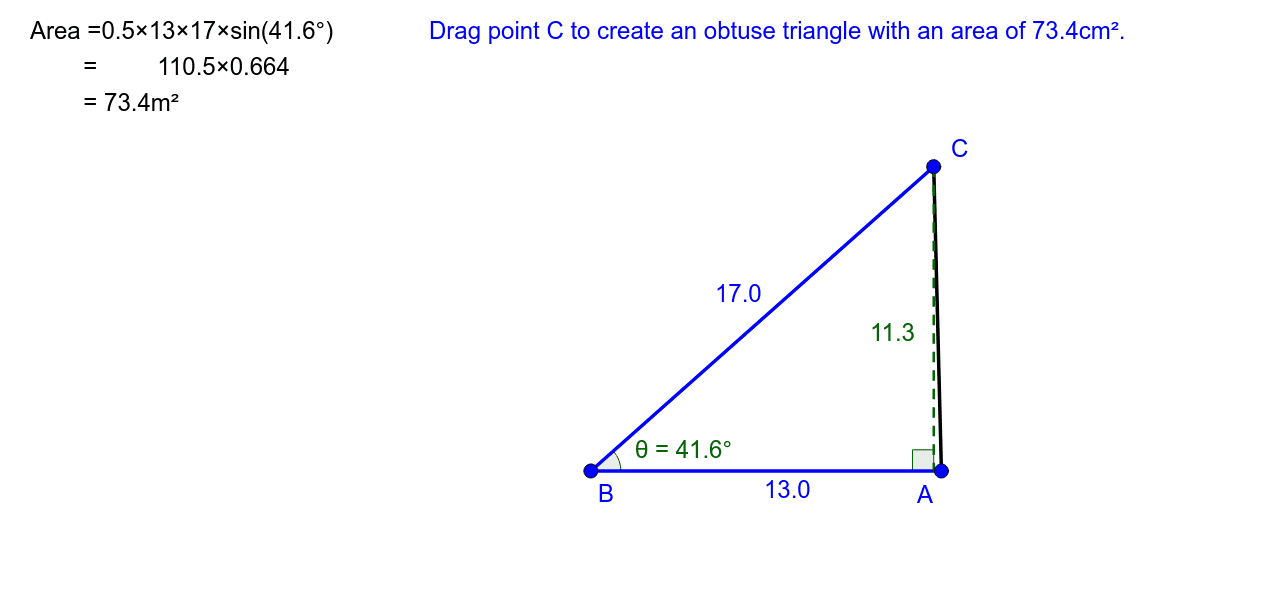
This example demonstrates the ambiguous case in trigonometry where given one side and an opposite angle, there can be two possible triangles. It involves core concepts like the sine rule, triangle ambiguity, and trigonometric functions. Constructed using GeoGebra commands such as Point, Segment, OrthogonalLine, Intersect, Angle, and function graphing. Suitable for high school students learning trigonometric applications and handling ambiguous cases.
GeoGebra Commands & Parameters
Point(Circle[B, 17]) → CSegment(A, B) → aOrthogonalLine(C, a) → dSegment(B, C) → bSegment(A, C) → cIntersect(d, f) → A_1Segment(C, A_1) → eAngle(B, A_1, C) → αAngle(C, B, A) → θSegment(A_1, A) → g
AI Drawing Prompt Reference
Draw a triangle ABC with point B and point C determining segment BC, whose length is 17. Construct a perpendicular line through point C to segment BC, and let it intersect the extension of segment AB at point A1. Then, connect point C and point A1 to form segment CA1. Measure the angles BAC1 and CBA.
The prompt above was compiled from the original drawing commands and is for reference only.