
Similar Twin Model (Arbitrary Triangle)
This example demonstrates the geometric construction of a Similar Twin Model based on an arbitrary triangle. Through transformations such as rotation and scaling, a similar triangle is generated from the original triangle, and the geometric relationships and extremal properties between the two are explored in depth.
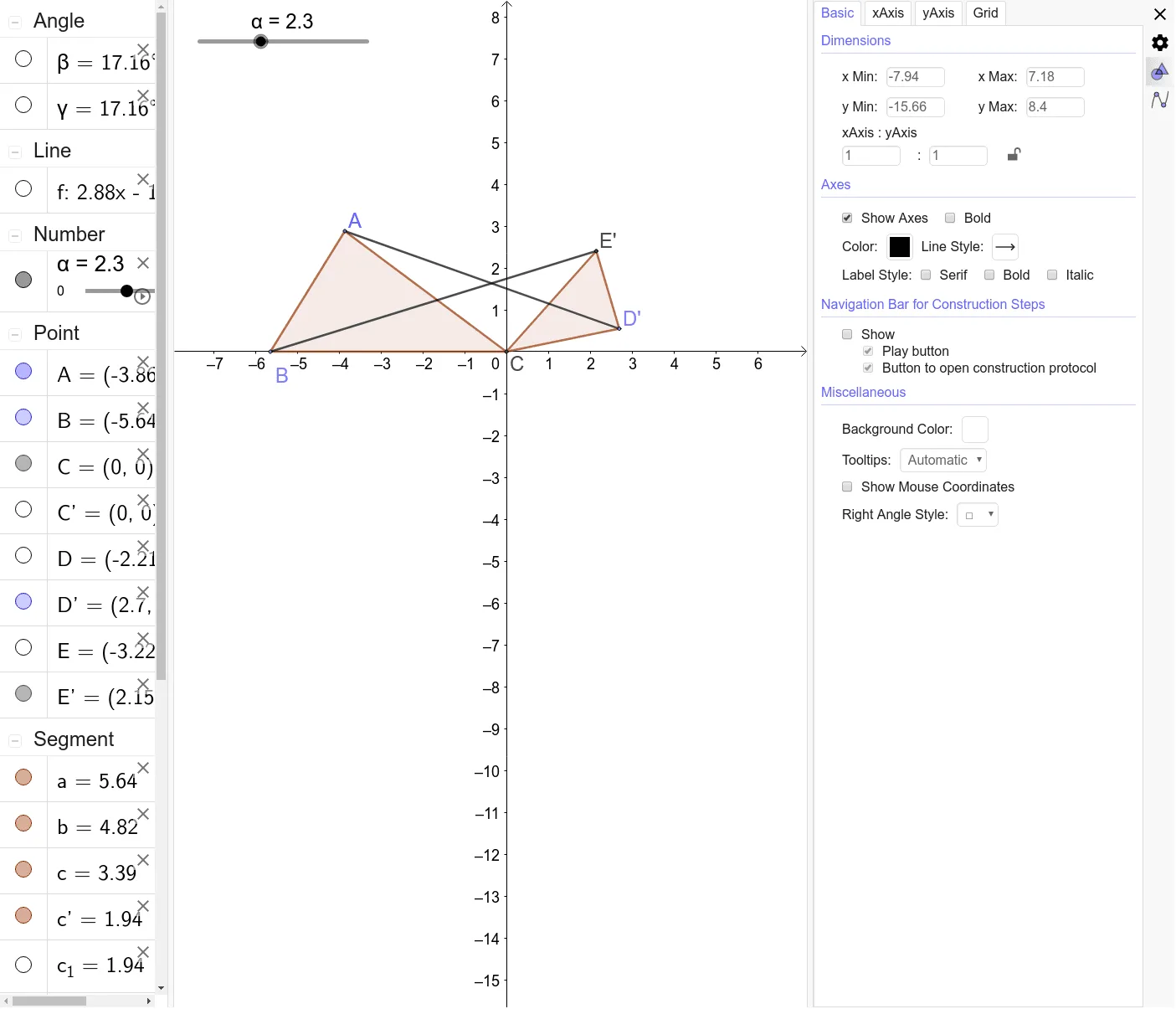
The applet begins with an arbitrary triangle defined by three movable vertices. Students can drag these vertices to reshape the original triangle freely, observing how the constructed similar twin triangle responds dynamically while preserving its similarity. The construction process involves applying a sequence of geometric transformations—specifically rotation about a chosen point and uniform scaling—to produce the twin triangle. Key elements include auxiliary points, construction lines, shared polygons, and angle markers that reveal the underlying structure.
Several interactive features are built into the applet. Users can adjust the center and angle of rotation via sliders, control the scale factor to enlarge or reduce the twin triangle, and toggle the visibility of auxiliary construction elements. This allows learners to experiment with different transformation parameters and see immediate visual feedback.
The mathematical content centers on the properties of similar triangles, including proportional sides, equal corresponding angles, and the effects of similarity transformations on area and perimeter. The extremal properties explored include the conditions under which certain distances, areas, or angle configurations reach their maximum or minimum values. For instance, students can investigate how the relative position of the twin triangle changes as the scale factor or rotation angle varies, and identify special configurations that yield optimal geometric relationships.
This applet is suitable for studying similarity properties in triangle geometry and for exploring extremal problems through dynamic visualization. It provides an intuitive, hands-on learning experience that bridges abstract theoretical concepts with concrete geometric intuition, making it valuable for both classroom instruction and independent exploration in secondary-level geometry courses.
Loading the math board and drawing, please wait…