
Similar Triangles and Inequalities Demo
Loading the math board and drawing, please wait…
In collections
Phebe Tanner Translation Tessallation
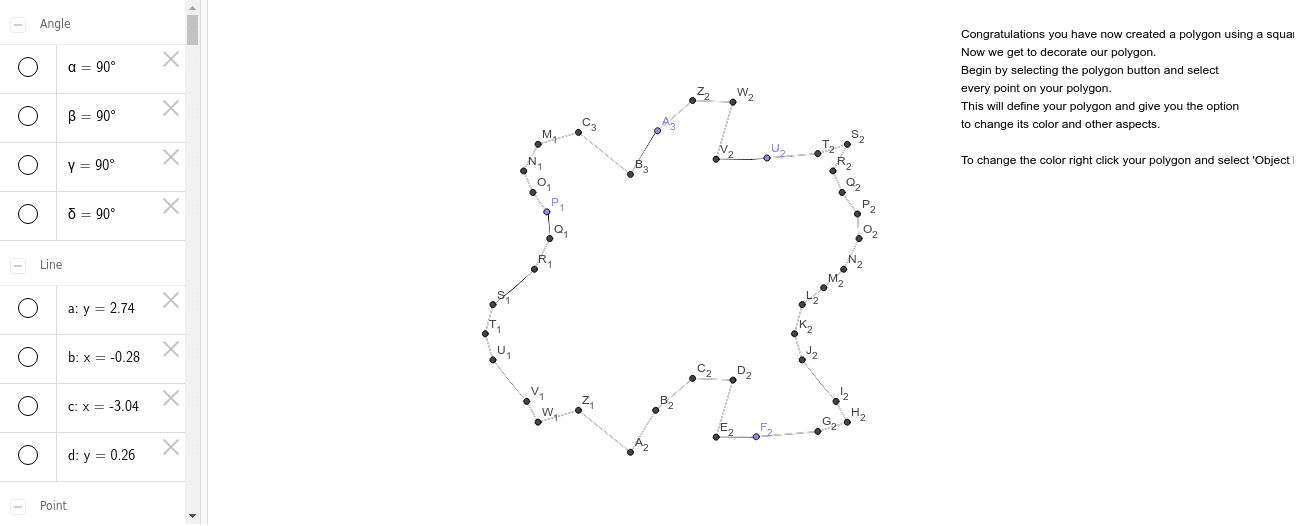
This example dynamically demonstrates the relationship between similar triangles and inequalities, visually showcasing invariants during geometric transformations. Core math concepts include triangle similarity criteria, inequality properties, circle and vector applications. Construction highlights the use of GeoGebra commands/objects like Line, OrthogonalLine, Point, Intersect, Segment, Angle, Vector, Translate, Polygon for precise figure building and dynamic changes. Suitable for high school mathematics teaching to enhance understanding of geometric transformations, inequalities, and probability & statistics.
GeoGebra Commands & Parameters
Line(A, B) → aOrthogonalLine(B, a) → bOrthogonalLine(A, a) → cPoint(b) → COrthogonalLine(C, c) → dIntersect(c, d) → DSegment(D, C) → eSegment(C, B) → fSegment(B, A) → gSegment(A, D) → hAngle(A, B, C) → αAngle(C, D, A) → βAngle(D, A, B) → γAngle(B, C, D) → δSegment(D, E) → iSegment(E, F) → jSegment(F, G) → kSegment(G, H) → lSegment(H, I) → mSegment(I, J) → nSegment(J, K) → pSegment(K, L) → qSegment(L, M) → rSegment(M, C) → sVector(C, B) → uTranslate(D, u) → D'Translate(E, u) → E'Segment(D', E') → i'Translate(E, u) → E'_1Translate(F, u) → F'Segment(E'_1, F') → j'Translate(F, u) → F'_1Translate(G, u) → G'Segment(F'_1, G') → k'Translate(G, u) → G'_1Translate(H, u) → H'Segment(G'_1, H') → l'Translate(H, u) → H'_1Translate(I, u) → I'Segment(H'_1, I') → m'Translate(I, u) → I'_1Translate(J, u) → J'Segment(I'_1, J') → n'Translate(J, u) → J'_1Translate(K, u) → K'Segment(J'_1, K') → p'Translate(K, u) → K'_1Translate(L, u) → L'Segment(K'_1, L') → q'Translate(L, u) → L'_1Translate(M, u) → M'Segment(L'_1, M') → r'Translate(M, u) → M'_1Translate(C, u) → C'Segment(M'_1, C') → s'Segment(D, N) → tSegment(N, O) → a_1Segment(O, P) → b_1Segment(P, Q) → c_1Segment(Q, R) → d_1Segment(R, S) → e_1Segment(S, T) → f_1Segment(T, U) → g_1Segment(U, V) → h_1Segment(V, W) → i_1Segment(W, Z) → j_1Segment(Z, A) → k_1Vector(A, B) → vTranslate(D, v) → D'_1Translate(N, v) → N'Segment(D'_1, N') → t'Translate(N, v) → N'_1Translate(O, v) → O'Segment(N'_1, O') → l_1Translate(O, v) → O'_1Translate(P, v) → P'Segment(O'_1, P') → m_1Translate(P, v) → P'_1Translate(Q, v) → Q'Segment(P'_1, Q') → n_1Translate(Q, v) → Q'_1Translate(R, v) → R'Segment(Q'_1, R') → p_1Translate(R, v) → R'_1Translate(S, v) → S'Segment(R'_1, S') → q_1Translate(S, v) → S'_1Translate(T, v) → T'Segment(S'_1, T') → r_1Translate(T, v) → T'_1Translate(U, v) → U'Segment(T'_1, U') → s_1Translate(U, v) → U'_1Translate(V, v) → V'Segment(U'_1, V') → t_1Translate(V, v) → V'_1Translate(W, v) → W'Segment(V'_1, W') → a_2Translate(W, v) → W'_1Translate(Z, v) → Z'Segment(W'_1, Z') → b_2Translate(Z, v) → Z'_1Translate(A, v) → A'Segment(Z'_1, A') → c_2Translate(D', v) → D''Intersect(j_1, k_1) → A_1Point(i_1) → B_1Intersect(h_1, i_1) → C_1Intersect(g_1, h_1) → D_1Intersect(f_1, g_1) → E_1Point(e_1) → F_1Intersect(d_1, e_1) → G_1Intersect(c_1, d_1) → H_1Intersect(b_1, c_1) → I_1Intersect(t, a_1) → J_1Intersect(i, t) → K_1Intersect(i, j) → L_1Intersect(i', k_1) → M_1Intersect(j_1, k_1) → N_1Intersect(i_1, j_1) → O_1Point(i_1) → P_1Intersect(g_1, h_1) → Q_1Intersect(f_1, g_1) → R_1Intersect(d_1, e_1) → S_1Intersect(c_1, d_1) → T_1Intersect(b_1, c_1) → U_1Intersect(t, a_1) → V_1Intersect(i, t) → W_1Intersect(i, j) → Z_1Intersect(j, k) → A_2Intersect(k, l) → B_2Intersect(l, m) → C_2Intersect(m, n) → D_2Intersect(n, p) → E_2Point(q) → F_2Intersect(r, s) → G_2Intersect(s, t') → H_2Intersect(t', l_1) → I_2Intersect(m_1, n_1) → J_2Intersect(n_1, p_1) → K_2Intersect(p_1, q_1) → L_2Intersect(q_1, r_1) → M_2Intersect(r_1, s_1) → N_2Intersect(s_1, t_1) → O_2Intersect(t_1, a_2) → P_2Intersect(a_2, b_2) → Q_2Intersect(b_2, c_2) → R_2Intersect(s', c_2) → S_2Intersect(r', s') → T_2Point(q') → U_2Intersect(n', p') → V_2Intersect(m', n') → W_2Intersect(l', m') → Z_2Point(l') → A_3Intersect(j', k') → B_3Intersect(i', j') → C_3Polygon(M_1, N_1, W_1, Z_1, A_2, B_2, C_2, D_2, E_2, F_2, G_2, H_2, O_1, I_2, J_2, K_2, L_2, M_2, N_2, O_2, P_2, Q_2, R_2, P_1, S_2, T_2, U_2, V_2, W_2, Z_2, A_3, B_3, C_3, Q_1, R_1, S_1, T_1, U_1, V_1) → poly1, m_2, v_1, w_1, z_1, a_3, b_3, c_3, d_2, e_2, f_2, g_2, n_2, h_2, i_2, j_2, k_2, l_2, m_3, n_3, o_2, p_3, q_3, o_1, r_3, s_3, t_3, u_2, v_2, w_2, z_2, a_4, b_4, c_4, p_2, q_2, r_2, s_2, t_2, u_1
AI Drawing Prompt Reference
Draw two similar triangles, label their sides and angles, and demonstrate vector translation of one triangle to observe invariance in similarity and inequalities. Highlight corresponding vertices and edges during translation, and use symbols for angles, showing key geometric relationships with dashed lines or different colors.
The prompt above was compiled from the original drawing commands and is for reference only.