
Sequencing Rotations
Loading the math board and drawing, please wait…
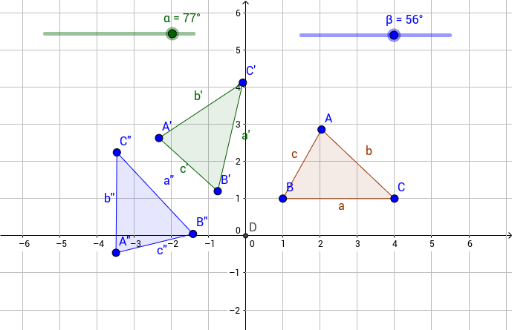
This example demonstrates the construction of polygons through rotations, showcasing the application of rotational transformations in geometry. Core math concepts include rotation, polygon construction, symmetry, and transformation. It leverages GeoGebra commands such as Polygon, Intersect, and Rotate. Suitable for high school students learning geometric transformations, polygon properties, and spatial reasoning skills.
GeoGebra Commands & Parameters
Polygon(A, B, C) → poly1, c, a, bIntersect(xAxis, yAxis) → DRotate(A, α, D) → A'Rotate(B, α, D) → B'Rotate(C, α, D) → C'Polygon(A', B', C') → poly1', c', a', b'Rotate(A', β, D) → A''Rotate(B', β, D) → B''Rotate(C', β, D) → C''Polygon(A'', B'', C'') → poly1'', c'', a'', b''
AI Drawing Prompt Reference
Draw a coordinate plane with axes intersecting at the origin. Construct an arbitrary triangle in the plane. Then rotate this triangle about the origin by a certain angle to form a second triangle. Next, rotate the second triangle about the same origin by another angle to create a third triangle. All three triangles share the same rotation center at the origin, and the rotations are sequential, producing a symmetric pattern of polygons. The final image should clearly show the three triangles and the coordinate axes, emphasizing rotational symmetry and geometric transformation.
The prompt above was compiled from the original drawing commands and is for reference only.