
Sections of Cuboids
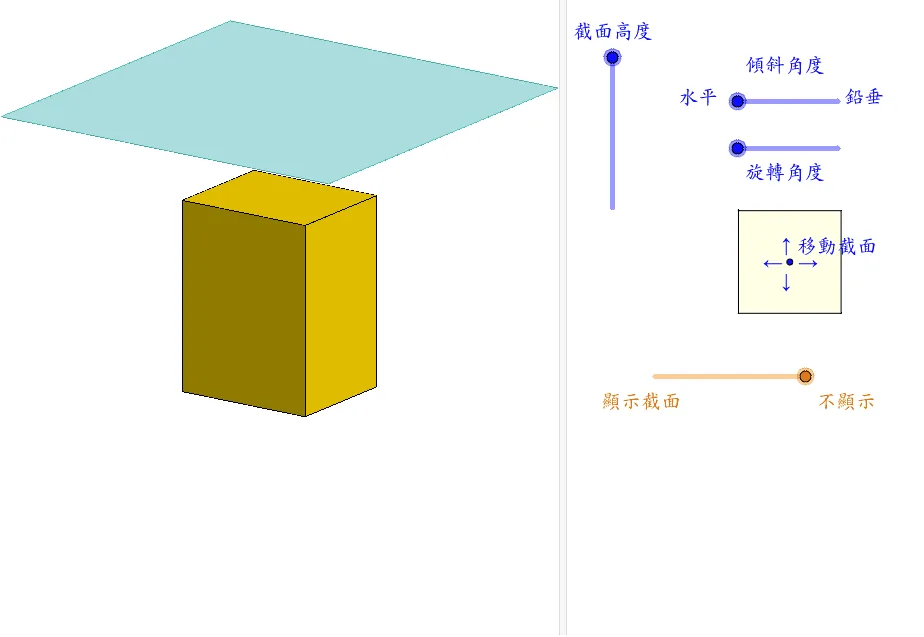
This GeoGebra applet demonstrates the various cross-sections that can be formed when a plane intersects a cuboid (rectangular prism). By manipulating the position and orientation of the cutting plane, users can visually explore the different polygonal shapes that arise from these intersections. The applet allows students to observe cross-sections in real time as they slide, rotate, or adjust the plane, revealing how the shape of the intersection changes depending on the angle and location of the cut.
Through this interactive exploration, users can discover that a single plane cutting through a cuboid can produce a wide variety of polygons. Triangles are formed when the plane intersects three faces of the cuboid, including equilateral and isosceles triangles under specific conditions. Quadrilaterals such as parallelograms, rectangles, trapezoids, and other four-sided figures appear when the plane cuts through four faces. In certain symmetric configurations, the resulting cross-sections exhibit special properties like equal side lengths or parallel opposite sides. The dynamic nature of the model makes it possible to witness smooth transitions between different polygon types as the plane moves continuously, helping learners intuitively grasp the boundaries and conditions that produce each shape.
This applet serves as a powerful visual aid for understanding spatial relationships in solid geometry. It reinforces key concepts such as how a plane intersects the edges and faces of a three-dimensional figure, how the orientation of the cutting plane determines the number and type of sides in the resulting polygon, and how symmetry and proportion manifest in cross-sectional figures. Students benefit from the hands-on, exploratory approach, which encourages them to form hypotheses, test them interactively, and develop a deeper geometric intuition. Rather than relying solely on static textbook diagrams, learners can manipulate the model themselves, making connections between abstract geometric principles and their concrete visual outcomes. This active engagement supports both conceptual understanding and problem-solving skills in立体几何, making it an effective tool for classroom instruction and independent study.
Loading the math board and drawing, please wait…