
Roots of Complex Numbers by asmeurer
Loading the math board and drawing, please wait…
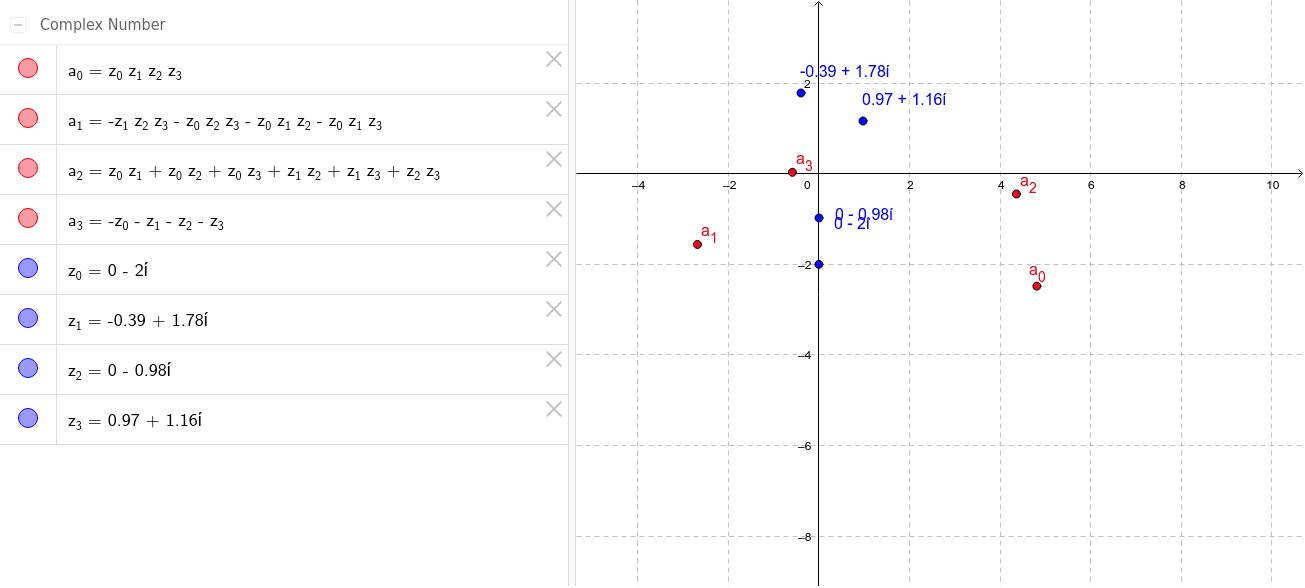
This example demonstrates the roots of a complex quartic polynomial. By adjusting the coefficients represented by the red points, you can observe the changes in the blue points (roots). Key mathematical concepts include complex numbers, polynomials, and roots. The construction uses GeoGebra objects such as i, z_1, z_2, z_3, z_0, a_0, a_1, a_2, a_3. Suitable for high school mathematics education and learning.
GeoGebra Commands & Parameters
Point i(0, 1)Point z_1(-0.39433091228236344, 1.7820095753611598)Point z_2(0.003004075327174188, -0.9772611719272986)Point z_3(0.9742673783727106, 1.163932927968545)Point z_0(0, -2)(((z_0 * z_1) * z_2) * z_3)(((-z_1) * z_2) * z_3) - ((z_0 * z_2) * z_3) - ((z_0 * z_1) * z_2) - ((z_0 * z_1) * z_3)(z_0 * z_1) + (z_0 * z_2) + (z_0 * z_3) + (z_1 * z_2) + (z_1 * z_3) + (z_2 * z_3)(-z_0) - z_1 - z_2 - z_3
AI Drawing Prompt Reference
Draw the roots of a complex quartic polynomial. First, draw the imaginary unit i, then draw three complex points z1, z2, and z3. Next, calculate the coefficients a0, a1, a2, and a3 using these points, and find the roots of the polynomial. Finally, draw the root point z0 and observe how changes in the coefficients affect the position of the root points.
The prompt above was compiled from the original drawing commands and is for reference only.