
Roots: Linear to Cubic
Loading the math board and drawing, please wait…
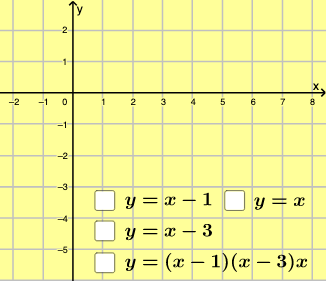
① This GeoGebra example dynamically visualizes the evolution of polynomial roots from linear to cubic equations, showing how the graph of a function intersects the x-axis as the degree increases. ② Core mathematical concepts include roots (zeros) of polynomial functions, linear, quadratic, and cubic functions, the relationship between function graphs and coordinate axes, and how roots change with varying coefficients. ③ Construction details: The construction summary lists objects such as f, g, h (function objects), points A, B, C (intersections or special points), sliders a, b, c controlling coefficients, and text objects text1, text1_1, text1_2, text2 displaying roots or equation information. Additional elements like circles, step functions, and combinatorics appear as auxiliary, but the main focus is on function graphs and dynamic root visualization. ④ Suitable for middle and high school students learning polynomial functions and equation roots, as well as for pre-university courses or teacher demonstrations to illustrate the connection between function zeros and equation solutions, and the increasing complexity from linear to cubic cases.
GeoGebra Commands & Parameters
f(x) = x - 1g(x) = x - 3(1, 0)(3, 0)Boolean a(false)Boolean b(false)Boolean c(false)j(x) = xh(x) = ((f(x) * g(x)) * j(x))(0, 0)Boolean d(false)