
Rhombus Construction: Geometric Drawing and Coordinate Analysis
Loading the math board and drawing, please wait…
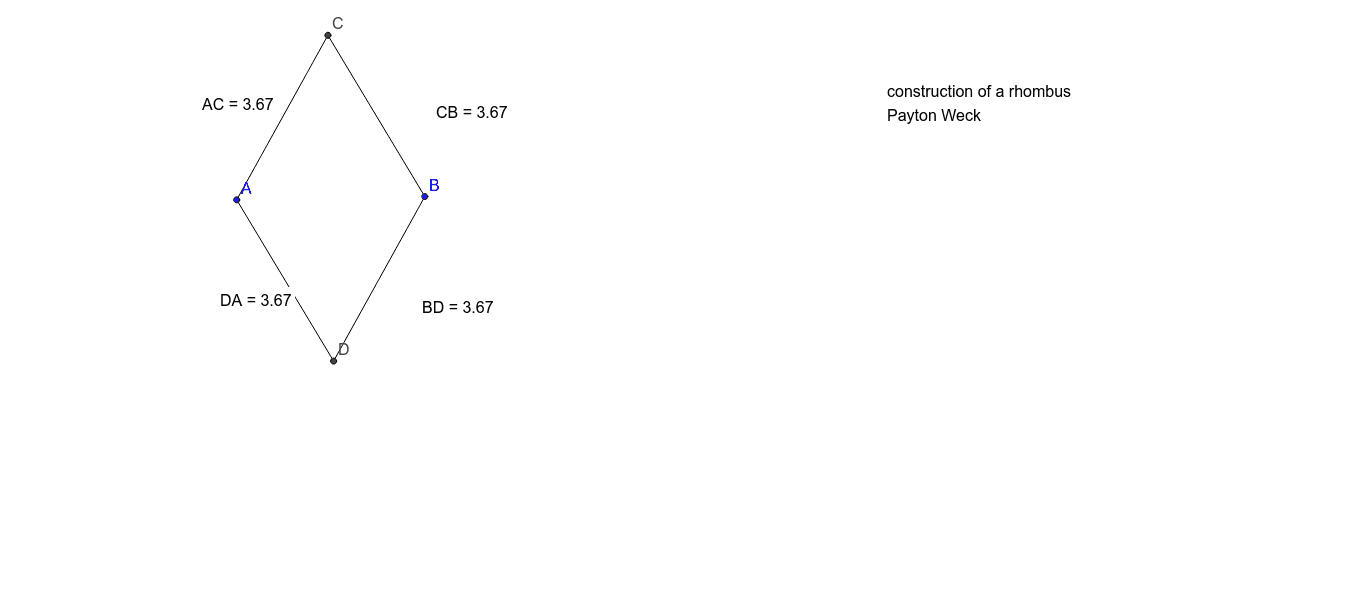
This example demonstrates how to draw and analyze a rhombus using geometric construction and coordinate geometry. Key mathematical concepts include the definition of a rhombus, coordinate geometry, and distance calculations. Construction involves using GeoGebra commands such as Circle, Intersect, Segment, and Distance to create the rhombus, and calculating key distances like distanceAC and distanceCB. Suitable for middle or high school mathematics courses to understand rhombus properties and geometric drawing techniques.
GeoGebra Commands & Parameters
Circle(A, B) → cCircle(B, A) → dIntersect(c, d, 1) → CIntersect(c, d, 2) → DSegment(A, D) → aSegment(D, B) → bSegment(A, C) → eSegment(C, B) → fDistance(A, C) → distanceACMidpoint(A, C) →Distance(C, B) → distanceCBMidpoint(C, B) →Distance(B, D) → distanceBDMidpoint(B, D) →Distance(D, A) → distanceDAMidpoint(D, A) →Distance(A, C) → gMidpoint(A, C) →
AI Drawing Prompt Reference
Draw a rhombus by constructing two circles with two line segments as diameters, finding their intersection points to form the vertices of the rhombus, and connecting these points. Calculate and label the lengths of the diagonals and their intersection points.
The prompt above was compiled from the original drawing commands and is for reference only.