
Rhombus Area Demonstration
Loading the math board and drawing, please wait…
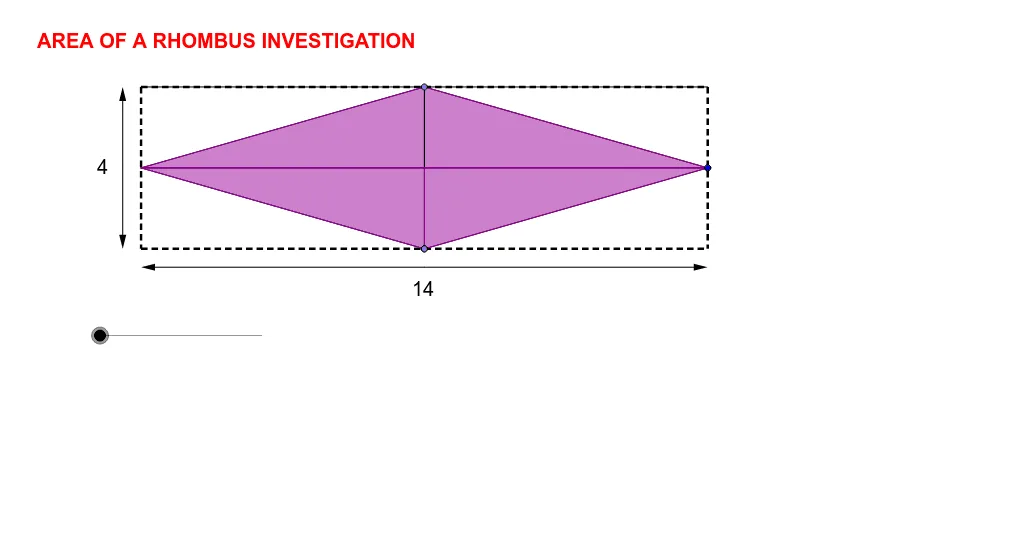
This example demonstrates how to calculate the area of a rhombus by constructing its diagonals. Key math concepts include rhombus properties, perpendicular bisectors of diagonals, triangle area formula, and vector operations. GeoGebra commands/objects used in construction are Segment, Midpoint, OrthogonalLine, Point, Mirror, Vector, Translate, Polygon, and Rotate. Suitable for high school mathematics teaching or self-learning to understand the derivation of the rhombus area formula.
GeoGebra Commands & Parameters
Segment(A, B) → aMidpoint(a) → COrthogonalLine(C, a) → bPoint(b) → DMirror(D, C) → D'Vector(C, D') → uTranslate(B, u) → B'Vector(C, B') → wSegment(A, D') → cSegment(D', B) → dSegment(B, D) → eSegment(D, A) → fTranslate(A, u) → A'Segment(A', B') → a'Vector(C, D) → vTranslate(A, v) → A'_1Translate(B, v) → B'_1Segment(A'_1, B'_1) → a'_1Segment(A', A'_1) → gSegment(D', D) → hSegment(B', B'_1) → iPolygon(A, B, D') → poly2, d', a_1, b_1Polygon(A, C, D) → poly1, d_1, a_2, c_1Segment(C, B') → jTranslate(C, Vector[k * w]) → C'Translate(D, Vector[k * w]) → D'_1Translate(A, Vector[k * w]) → A'_2Polygon(A'_2, C', D'_1) → poly1', d'_1, a'_2, c'Vector(C, A') → zPolygon(D, C, B) → poly3, b_2, d_2, c_2Translate(D, Vector[k * z]) → D'_2Translate(C, Vector[k * z]) → C'_1Translate(B, Vector[k * z]) → B'_2Polygon(D'_2, C'_1, B'_2) → poly3', b'_2, d'_2, c'_1Segment(A', B') → lPoint(b) → EVector(D, E) → nTranslate(A'_1, n) → FTranslate(B'_1, n) → GVector(E, G) → qVector(E, F) → rRotate(n, 270*°, D) → n'Translate(A', n') → A''Translate(A'_1, n') → HMidpoint(A'', H) → IVector(I, A'') → mVector(I, H) → p