
Redefining Trigonometric Functions via the Unit Circle
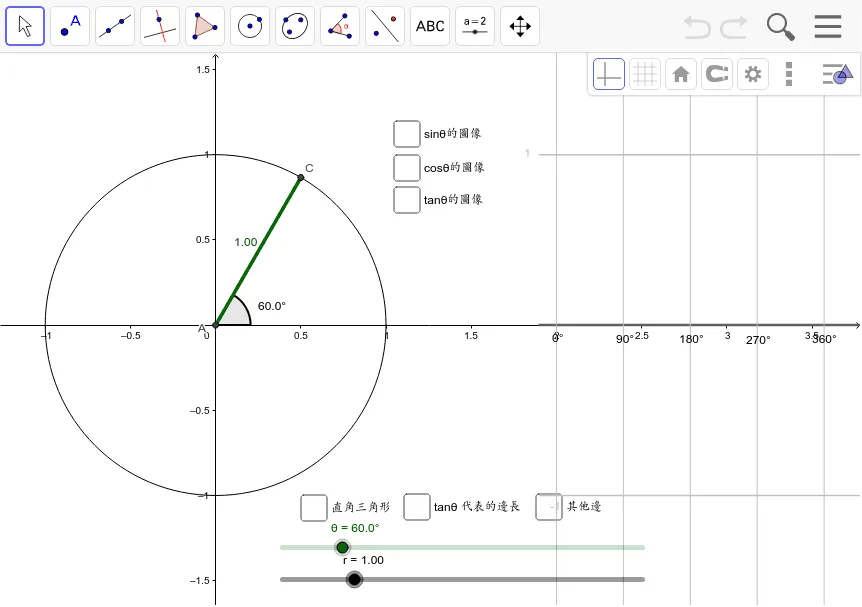
This interactive example demonstrates how sine and cosine are geometrically defined using the unit circle: as a point moves around the circle, its x- and y-coordinates trace out cosine and sine values, revealing periodicity, symmetry, and sign changes across quadrants. Core mathematical concepts include the unit circle definition of trigonometric functions, radian measure, reference angles, and coordinate projections. The construction uses key GeoGebra commands such as Circle (to create the unit circle), Point (a movable point on the circumference), Angle (to define θ), Rotate (to position points based on angle), Segment and OrthogonalLine (to drop perpendiculars for coordinate extraction), and Intersect (to locate projection points). Auxiliary objects like labeled points, segments, and angles support visualization. Ideal for high school trigonometry instruction or precalculus courses, this model bridges geometric intuition with algebraic function behavior.
Loading the math board and drawing, please wait…