
Geometric Proof of the Double Angle Formula
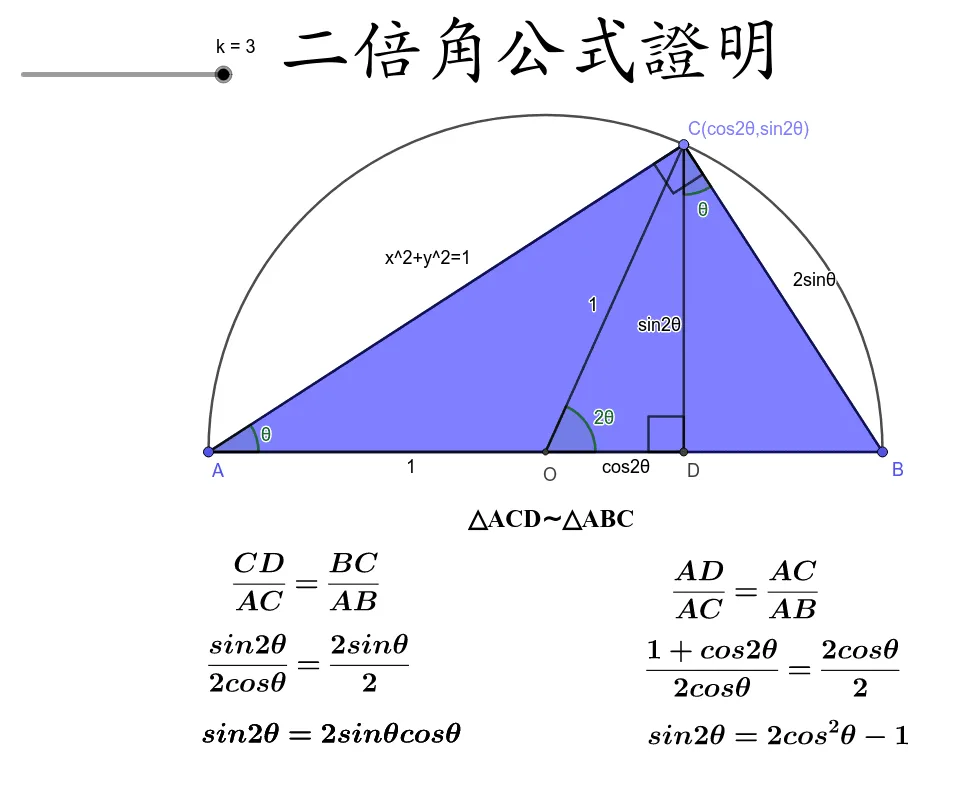
This GeoGebra applet visually demonstrates and proves the double angle formulas in trigonometry through careful geometric construction. By utilizing midpoints, perpendicular lines, semicircles, circular arcs, and polygons, the model illustrates the precise relationships between angles and line segments to verify the double angle identities for sine, cosine, and tangent. Each geometric element is dynamically linked, so users can manipulate the construction—dragging key points or adjusting angles—and observe in real time how the corresponding segment lengths and angle measures change while the underlying algebraic relationships remain perfectly consistent.
The applet begins with a foundational geometric setup, typically involving a unit circle or a carefully arranged triangle configuration. Through the strategic placement of midpoints and the drawing of perpendiculars, the construction reveals how an angle can be decomposed into two equal parts, each corresponding to half the original measure. The semicircle and arc elements serve to establish congruent triangles and proportional segments, which together yield the classical double angle identities: sin(2theta) = 2sin(theta)cos(theta), cos(2theta) = cos²(theta) - sin²(theta), and tan(2theta) = 2tan(theta)/(1 - tan²(theta)). As students interact with the model, they can trace the logical flow from geometric premises to algebraic conclusions, seeing concretely why these identities hold rather than merely memorizing them.
This dynamic model helps students deeply understand the algebraic properties of trigonometric functions from a purely geometric perspective, bridging the traditionally separate domains of algebra and geometry. By watching the construction respond fluidly to their inputs, learners develop an intuitive grasp of why the double angle formulas are true at a structural level. The visual confirmation provided by the applet reinforces abstract symbolic manipulation with concrete spatial reasoning, making it an excellent teaching tool for secondary and undergraduate mathematics courses. Instructors can use it to lead classroom discussions, allowing students to hypothesize about relationships before the construction confirms them, thereby fostering active discovery-based learning. The interactive nature of the model also supports independent exploration, enabling students to test edge cases, verify boundary conditions, and build confidence in the universal validity of these fundamental trigonometric identities.
Loading the math board and drawing, please wait…