
Rational Number Conversion Example: Fraction and Decimal Conversion
Loading the math board and drawing, please wait…
In collections
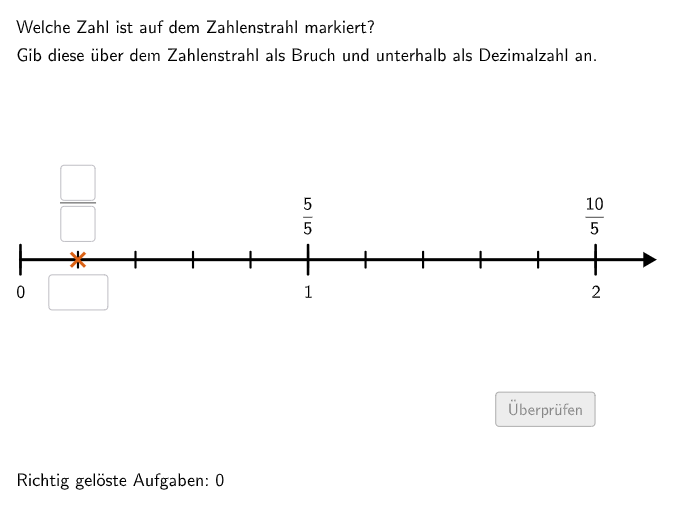
Bruchzahlen in endliche Dezimalzahlen umrechnen
This example demonstrates the conversion between fractions and decimals, suitable for students in grades 5-6. The key mathematical concepts involve rational numbers and the conversion between fractions and decimal representations. Construction involves using GeoGebra commands like Join, Element, and Polygon to create graphics, with random parameters to generate varied problems. It is useful for classroom teaching or online practice to enhance number sense.
GeoGebra Commands & Parameters
Join({Shuffle[{4, 5}], Join[Sequence[Shuffle[{2, 4, 5, 8, 10}], m, 1, 25]]}) → randomNennerElement(randomNenner, Mod[questionCount, 100] + 1) → nennerZip(RandomElement[Sequence[1, (2 * m)] \ Join[{{m, (2 * m)}, If[m > 5, {m - 1, m + 1, (2 * m) - 1, 1}, {}]}]], m, randomNenner) → randomZaehler1Random(1, randomNenner(1) - 1) → randomzaehlerstartRandom(1, randomNenner(2) - 1) → randomzaehlerstart2If(questionCount ≟ 0, randomzaehlerstart, If[questionCount ≟ 1, randomzaehlerstart2, Element[randomZaehler1, Mod[questionCount, 100] + 1]]) → zaehler1Textfield(input4) → InputBox4Textfield(input3) → InputBox3Textfield(input8) → InputBox8Textfield(input2) → InputBox2Textfield(input1) → InputBox1Textfield(input7) → InputBox7If(num1 ≥ 1, SelectedIndex[DropDown], 3) → selectedIf(selected ≟ 3, zaehler1 / nenner ≟ input1 / input2, bruchechtcorrect ∧ bruchganzecorrect) → bruch1correctZip(If[m ≥ 8, RandomElement[Sequence[1, (2 * m)] \ {m, (2 * m), n - 3, n - 2, n - 1, n, n + 1, n + 2, n + 3}], RandomElement[Sequence[1, (2 * m)] \ {m, (2 * m), n}]], m, randomNenner, n, randomZaehler1) → randomZaehler2Element(randomZaehler2, Mod[questionCount, 100] + 1) → zaehler2Shuffle(Sequence[i, i, 2, 12]) → NennerListe, {5, 11, 8, 12, 9, 7, 6, 3, 2, 4, 10}If(nenner ∈ {2, 3, 4}, 2, 1) → minstrahlgrenzeIf(nenner ≟ 2, 5, If[nenner ≟ 3 ∨ nenner ≟ 4, 4, If[nenner ∈ {5, 6, 7}, 2, If[nenner ≟ 8 ∨ nenner ≟ 9, 1.5, 1.1]]]) → maxstrahlgrenzeShuffle(Sequence[i, i, 1, (nenner * maxganze)]) → ZaehlerListe1, {8, 6, 7, 4, 5, 10, 9, 1, 3, 2}Polygon(PtopLeftCornerFeedback, PtopRightCornerFeedback, PbottomRightCornerFeedback, PbottomLeftCornerFeedback) → rectangleCorrect, ptopleftcornerfeedback, ptoprightcornerfeedback, pbottomrightcornerfeedback, pbottomleftcornerfeedbackShuffle(Sequence[Random[0, 10], i, 1, 100]) → randomNosQuestion, {1, 10, 6, 4, 2, 1, 5, 10, 6, 3, 10, 0, 2, 0, 0, 0, 8, 2, 10, 3, 5, 1, 5, 7, 3, 9, 5, 2, 5, 8, 3, 3, 5, 10, 5, 8, 9, 7, 7, 6, 1, 5, 3, 0, 4, 3, 0, 9, 7, 0, 5, 2, 9, 6, 10, 3, 0, 2, 10, 8, 2, 6, 8, 1, 10, 5, 1, 4, 9, 1, 7, 10, 1, 4, 1, 9, 9, 1, 4, 9, 10, 4, 1, 6, 10, 1, 10, 7, 0, 6, 2, 6, 5, 10, 8, 0, 3, 7, 4, 6}Element(randomNosQuestion, Mod[questionCount, 100] + 1) → questionNumSequence(StrahlEndPL + (unterteilungsvektor * i), i, 0, unterteilungen) → UnterteilungenPunkteSequence(Element[UnterteilungenPunkte, 1 + (nenner * i)], i, 0, maxganze + 5) → GanzePunkteSegment(StrahlEndPL, StrahlEndPInf) → ZahlenStrahlPolygon(VR1E1, VR1E2, VR1E3, VR1E4) → VR1, vr1e1, vr1e2, vr1e3, vr1e4Polygon(VR2E1, VR2E2, VR2E3, VR2E4) → VR2, vr2e1, vr2e2, vr2e3, vr2e4Polygon(VR3E1, VR3E2, VR3E3, VR3E4) → VR3, vr3e1, vr3e2, vr3e3, vr3e4Distance(Corner[SolText1, 1], Corner[SolText1, 2]) → BreiteSolText1Distance(Corner[SolText2, 1], Corner[SolText2, 2]) → BreiteSolText2Distance(Corner[SolText3, 1], Corner[SolText3, 2]) → BreiteSolText3Segment(Bruch3Punkt + (0, 1.6), Bruch3Punkt) → SolStrecke3Segment(Bruch2Punkt - (0, 2.3), Bruch2Punkt) → SolStrecke2Segment(Bruch1Punkt - (0, 2.3), Bruch1Punkt) → SolStrecke1If(IsInteger[(num1 * 10)], nkstelle1, If[IsInteger[(num1 * 100)], nkstelle2, nkstelle3]) → nkstelledezi1If(IsInteger[(num2 * 10)], nkstelle1, If[IsInteger[(num2 * 100)], nkstelle2, nkstelle3]) → nkstelledezi2RandomElement(Sequence[1, (2 * nenner)] \ {nenner, (2 * nenner), zaehler1, zaehler1 + 1, zaehler1 - 1, zaehler2 + 1, zaehler2 - 1, zaehler2}) → zaehlerbspSequence((0, (-1 * i)), i, 1, 15) → l1Sequence(Segment[UnterteilungenPunkte(i) + (0, 0.15), UnterteilungenPunkte(i) + (0, -0.15)], i, 1, Length[UnterteilungenPunkte]) → UnterteilungenStreckenSegment(Bruch1Punkt + (0, heightsolution2), Bruch1Punkt + (0, heightsolution)) → fSequence(StrahlEndPL + ((i * unterteilungsvektor) * unterteilungen / 2), i, 0, 2) → UnterteilungenPunkte2Sequence(Segment[UnterteilungenPunkte2(i) + (0, 0.28), UnterteilungenPunkte2(i) + (0, -0.28)], i, 1, Length[UnterteilungenPunkte2]) → l2
AI Drawing Prompt Reference
Draw a number line with multiple fractions and their corresponding decimal positions, using different colors to represent integer and decimal parts, and show the conversion process between fractions and decimals, including randomly generated fractions and their graphical representations, emphasizing the divisions on the number line and the conversion relationships.
The prompt above was compiled from the original drawing commands and is for reference only.