
Quadrilateral Classification: Dynamic Geometry Based on Side Lengths and Angle P
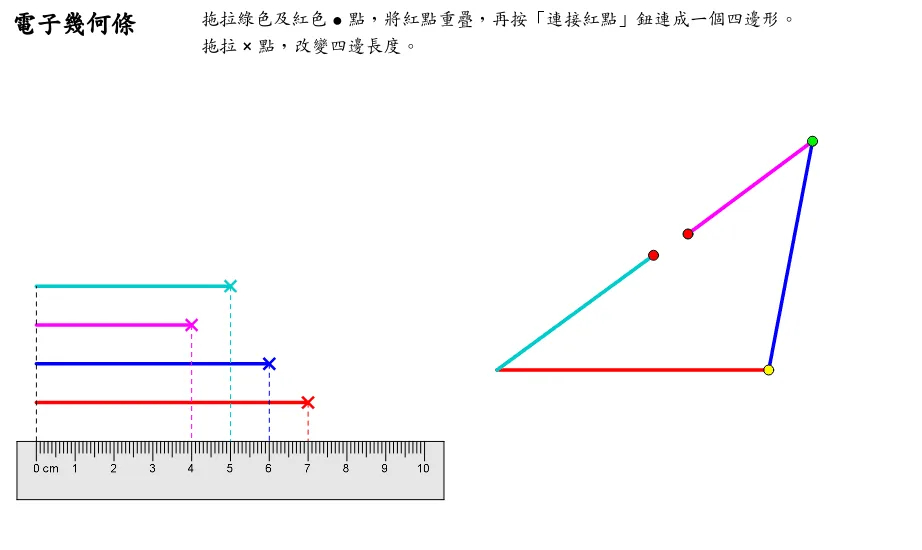
This GeoGebra example demonstrates how to classify quadrilaterals based on side length relationships, right angles, and parallel sides. It covers identification conditions for special quadrilaterals including parallelograms, rectangles, rhombuses, and squares. Using geometric construction commands such as rotation, reflection, intersection, and circular arcs, combined with conditional logic and dynamic coordinates, the applet intuitively displays the inclusion and transformation relationships among various types of quadrilaterals. Students can manipulate vertices and observe in real time how changes in side lengths and angle measures affect the classification of the shape. The interactive features allow learners to explore the hierarchical structure of quadrilaterals, understanding that a square is simultaneously a rectangle, a rhombus, and a parallelogram. The applet also visually reinforces key theorems and properties from middle school plane geometry, such as the relationships between opposite sides and angles, diagonal properties, and the criteria for parallelism. This makes it an effective teaching and learning tool for geometry classrooms, enabling students to develop a deeper conceptual understanding through hands-on exploration rather than rote memorization.
In collections
Quadrilaterals (2001 Teacher Edition)
Grade 4 Semester 2: Quadrilaterals (Student Edition)
Quadrilaterals
Loading the math board and drawing, please wait…